




By Hyun-seung Lee
Director of Policy & External Affairs, The Korea Signal
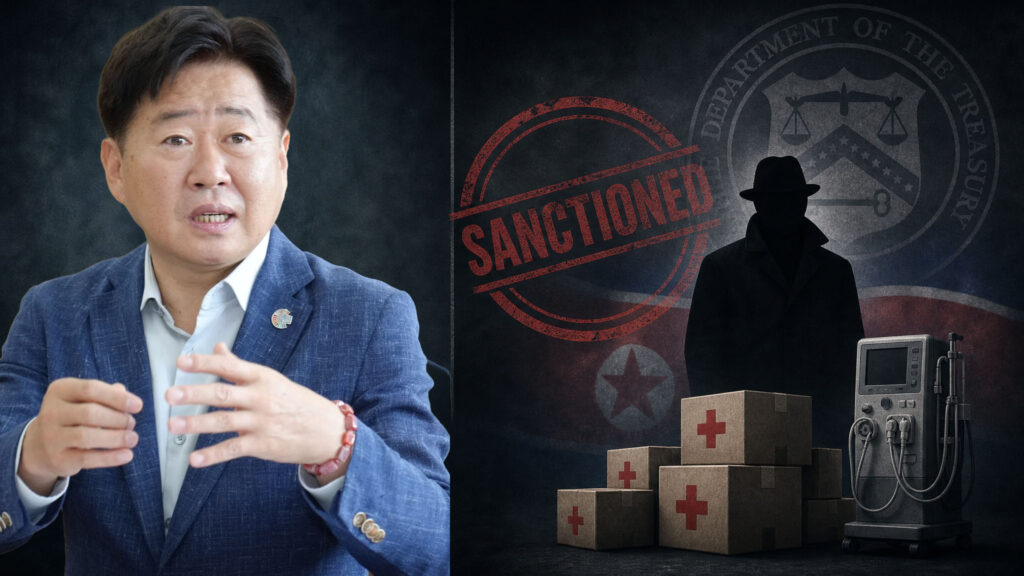
On June 11, the U.S. Treasury’s Office of Foreign Assets Control published a list of medical devices that may no longer be exported to North Korea under the standing humanitarian general license; they now require a specific OFAC license. The contents are pointed — oxygen generators, diagnostic imaging systems, and pumps above a set flow rate — the precision-component end of the medical spectrum, not bandages and antibiotics. No press conference accompanied it. Three days earlier, an American treaty ally had shipped one of those very categories of equipment to Pyongyang. South Korea’s Jeju Province confirmed on June 8, through Yonhap and international wires, that it had sent about 160 million won — roughly $105,000 — in goods to the North: citrus saplings, greenhouse materials, forestry pesticide, and a hemodialysis machine with consumables. The cargo left Incheon on April 1, transited China’s Dalian, and reached the port of Nampho on May 4, with the approval of Seoul’s Unification Ministry. It was the first local-government transfer to the North under President Lee Jae-myung, cast by the province as a revival of its old “vitamin C diplomacy.” Humanitarian aid, in other words. The complication is the man who reportedly arranged it.
The operative across the table
South Korean reporting places Jeju’s governor in Beijing in late February, negotiating with Ri Ho Nam. Yoo Dong-yeol, who directs the Seoul-based Liberty Democracy Institute and has assembled one of the fuller public dossiers on him, describes Ri as a Vice Department Director-level special operative tied to North Korea’s Reconnaissance General Bureau — a career hand who has worked the South for three decades under a rotating set of aliases, including Ri Chol-un and Jang Ho-jin. Ri first surfaced in the late-1990s “Black Venus” affair and has long been assessed by South Korean intelligence as a figure who operates with the trust of the regime’s highest levels.
He has never fronted official talks, presenting a freshly tailored business card for each contact. His record is a history of inter-Korean back channels. In October 2006, Ri met An Hee-jung, a close confidant of then-President Roh Moo-hyun, and the lawmaker Lee Hwa-yong in Beijing to discuss an envoy and a summit — contacts that helped produce the 2007 Roh–Kim Jong Il meeting. He is also the North Korean figure at the center of the Ssangbangwool remittance case, in which roughly $8 million was illegally routed north in 2019 — including a reported $3 million tied to a planned Pyongyang trip by then-Gyeonggi Governor Lee Jae-myung, now South Korea’s president; prosecutors allege $700,000 of it was handed to Ri at a Manila hotel. Above all, on September 26, 2017, the U.S. Treasury designated Ri a Specially Designated National — a Ryugyong Commercial Bank representative operating in Beijing, his property blocked under U.S. law. That designation rests on no contested narrative; it is public U.S. record.
Concede the U.N. point — it isn’t the problem
Grant Seoul its strongest defense up front, and grant it on neutral authority rather than the province’s own word. The Unification Ministry has told NK News it authorized the exchange, and a former member of the U.N. Panel of Experts that once monitored North Korea sanctions noted that food and most medical equipment generally fall outside Security Council prohibitions. Finished medical devices and farm goods sit outside Resolution 2397’s bans on industrial machinery and metals, and in February the 1718 Committee unfroze a batch of humanitarian exemptions with Washington’s blessing. So concede it entirely: assume no U.N. rule was broken and no waiver was needed.
The problem was never the cargo’s customs classification. It was the hand it passed through.
The reflexive defense — “Ri never received a dialysis machine” — misreads how U.S. sanctions work. By the reporting, the shopping list was his: the operative-led North Korean delegation asked Jeju for the dialysis machine, the saplings, and the pesticide. No representative of the disability welfare body named as recipient was in the room, and — by the province’s own admission to the wires — Jeju has received no confirmation from the North that the goods even arrived, let alone how they are used. So a U.S.-designated person specified the goods, Seoul’s ministry approved them, and the province shipped them. That is the kind of exposure U.S. secondary-sanctions authority is built to catch, and it attaches to the counterparty, not the cargo. A box of tangerines arranged through a sanctioned operative is the same kind of problem as a controlled machine; the item changes, the exposure does not. The Dalian routing only widens it, pulling any settlement bank or freight agent — and any contact with the U.S. dollar — into view.
Who the machine is for
There is also the question no exemption can answer on paper: who the equipment serves. North Korea’s medical system is rigidly tiered, its best facilities reserved for the Kim family and senior cadres. With no recipient in the room, no confirmation that the goods arrived, and a sanctioned intelligence operative running the deal, the premise of humanitarian aid — that it reaches ordinary people — is not a fact here. It is a hope.
That opacity is also the likeliest reason for the June 11 list. The devices OFAC pulled back under specific licensing run on precision pumps, controllers, and sensors — dual-use components that export-control regimes watch closely. U.N. classification and U.S. proliferation concerns are different lenses: a device can clear the Council’s lists and still trouble Washington. Even as the multilateral system kept the humanitarian lane open in February, the United States narrowed the device sub-channel in June. The humanitarian label may satisfy the U.N.; it does not buy a free pass under U.S. law.
Why $105,000 is not the story
This is why a six-figure shipment matters out of all proportion to its value. Sanctions are a coalition instrument; they hold only when everyone holds the line. The largest breaches belong to China and Russia — no argument there. But Washington’s standing to press Beijing and Moscow rests on its closest allies refusing to normalize exceptions for themselves. If a U.S. treaty ally can route a deal through a man the U.S. Treasury has sanctioned and treat the matter as closed because the cargo was humanitarian, on what authority does Washington tell its adversaries to keep their own lines clean? A wall with a friendly gap in it is not a wall; it is a formality. And Korean analysts already expect other provinces to follow Jeju’s template — which means the precedent, not the produce, is the payload.
None of this treats engagement as illegitimate; the fix is not to shut every channel but to route it through process. Washington and Seoul should stand up a standing deconfliction channel for subnational and humanitarian dealings with the North, so allies coordinate before a shipment sails, not after it surfaces. Treasury and State should issue plain guidance to South Korean provinces, municipalities, and their banks that U.N. humanitarian status does not waive U.S. exposure when a designated person sits in the transaction chain. Any humanitarian channel should run through vetted, non-designated counterparties with real end-use verification — precisely what this deal lacked. And Congress can start with one question to Treasury: did any U.S.-linked bank touch this transaction?
There is a serious case on the other side. Humanitarian relief is a recognized exception because the international community built machinery to permit it; if Jeju’s paperwork is clean, much of the criticism softens. Severing every channel serves no one, and engagement may be a precondition for eventual stability. Seoul’s ruling party disputes the account of Ri’s role, and the province will neither confirm nor deny whom its governor met — but those are questions for Korean courts, not for U.S. sanctions law, which turns on the counterparty, not the politics.
The flaw is not the goal but the method. Engagement conducted through the multilateral process — with documented exemptions, prior consultation, reciprocity, and clear eyes about how the regime exploits the optics — protects both the humanitarian aim and the alliance. Engagement conducted through a sanctioned operative, on a route that obscures the end user, does neither. It does not buy peace. It spends down the one asset the alliance cannot easily replace: trust. The danger here was never the dialysis machine. It is the precedent — and the temptation to mistake a practiced operative’s wish list for diplomacy.
Hyunseung Lee is a North Korean escapee, human rights advocate, and lead strategist at the Global Peace Foundation, where he works on North Korea policy, human rights, and Korean unification. He is the founder of the North Korean Young Leaders Assembly and has advised the U.S. government and policy community as a consultant on North Korean affairs. Before defecting in 2014 amid a wave of severe regime purges, Lee held significant roles in North Korea’s shipping and mining sectors, facilitating trade between North Korea and China, and served as a sergeant in the special forces of the Korean People’s Army. He is a regular contributor to United Press International (UPI), Voice of America, and Radio Free Asia, among other global media outlets. Lee holds a bachelor’s degree in international trade and economics from Dongbei University of Finance and Economics in China and a master’s degree in public administration from Columbia University.



대남공작원 만난 사람은 오영훈으로 알고 있는데 사진은 위성곤 사진이네요.
걱정은 안하지만 문제 생길 수도 있어 일단 말씀을 드립니다.
감사합니다!
감사합니다. AI를 통해 제작하던 중에 실수가 있었던 것을 확인했습니다. 사진을 업데이트 했습니다.
네 도움이 됐다니 좋네요. 글 잘보고 있습니다. 감사합니다