




by Sung Ku Hong
Head Reporter, News And Post
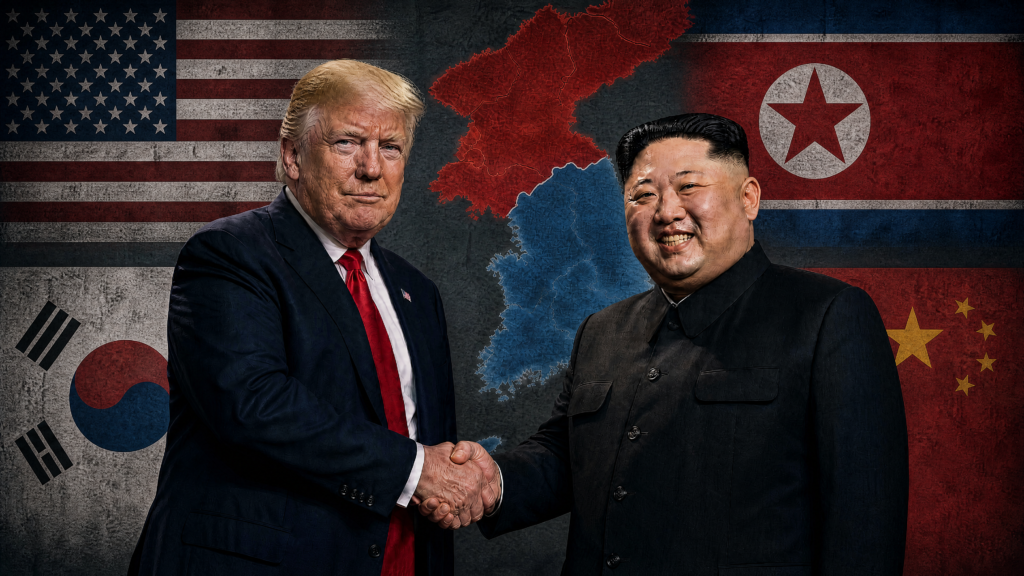
As President Donald Trump has rebuked the South Korean president and revealed that he is talking with Kim Jong Un, the international community is watching closely to see whether a U.S.-North Korea summit will take place again.
In this highly scrutinized development, The Korea Signal seeks to provide clues to the most important question of all: What kind of future does President Trump envision for the Korean Peninsula?
China Wants North Korea to Denuclearize, Too—and North Korea Knows It
The Fact Sheet issued by the White House on May 17 concerning the agreements between President Trump and Chinese President Xi Jinping included the following statement:
“President Trump and President Xi confirmed their shared goal to denuclearize North Korea.”
From North Korea’s perspective, which wants to retain its nuclear weapons, both China and the United States are effectively adversaries.
China can therefore pursue two objectives simultaneously: strengthening its alliance with North Korea through a conciliatory posture toward Pyongyang while containing North Korea by turning South Korea into a subordinate state.
China has restored its trade with North Korea to pre-pandemic levels, and during Kim Jong Un’s summit with Xi Jinping in June 2026, the two sides agreed to expand cooperation in infrastructure, tourism, agriculture, and healthcare.
Again, it is important to emphasize that these pro-North Korean measures by China are separate from recognizing North Korea as a nuclear-weapon state. On the contrary, China is likely to use the United States to push North Korea toward denuclearization—essentially getting someone else to do the dirty work.
When Chinese Foreign Minister Wang Yi was recently asked during his visit to South Korea whether China was willing to mediate a U.S.-North Korea summit, he said that a U.S.-North Korea summit was a matter for the two countries to decide and that, in particular, the United States should change its long-standing hostile policy toward North Korea.
This does not mean at all that China is asking the United States to recognize North Korea as a nuclear-weapon state. The emphasis is on China’s willingness to tolerate direct dialogue between Washington and Pyongyang. Wang’s statement that the United States should “change its long-standing hostile policy toward North Korea” can be interpreted as meaning that Washington should engage in dialogue.
President Trump is better suited than anyone else to undertake this task, and China recognizes that.
At the same time, however, China appears to believe that a two-state coexistence on the Korean Peninsula would serve its interests in many ways. The concept of “peaceful coexistence on the Korean Peninsula,” which South Korean President Lee Jae Myung mentioned in his Liberation Day address, appears to reflect China’s intentions almost perfectly.
Following his meeting with South Korean Foreign Minister Cho Hyun on the 19th, Wang Yi met with National Security Adviser Wi Sung-lac on the 20th and referred to South Korea and North Korea as “two states.” Historically, Beijing has favored expressions such as “the two sides” or “both Koreas” to describe the peninsula, carefully avoiding the explicit label of “two states.” This recent rhetorical shift suggests that China may now be validating Pyongyang’s own “hostile two states” doctrine, a development that signals a significant realignment in their regional strategic recognition.
The “peaceful coexistence on the Korean Peninsula” that China wants means maintaining both South and North Korea under governments that are favorably disposed toward Beijing. As long as China’s influence persists on the Korean Peninsula, the ability of the United States and Japan to contain China will inevitably weaken. Furthermore, South Korea could face increasing economic pain as the likelihood grows that it will be excluded from U.S.-centered supply chains.
Yet the current South Korean government appears unconcerned about how dangerous China’s strategy could become for South Korea over the medium and long term.
America’s Position Has Never Changed
For decades, the United States has maintained the strategic goal of the complete denuclearization of North Korea. To date, there has been no declaration that this objective has been abandoned. Nor has the United States officially recognized North Korea as a nuclear-weapon state.
Following the White House Fact Sheet issued after the Trump-Xi summit, the State Department, in the June 9 Joint Statement on the U.S.-Japan Extended Deterrence Dialogue, stated:
“DPRK’s pursuit of nuclear weapons was a closed issue. They reaffirmed their commitment to the complete denuclearization of the DPRK.”
It is important to note that the United States and Japan treated North Korea’s pursuit of nuclear weapons as an issue that had already been settled while simultaneously reaffirming their commitment to the complete denuclearization of North Korea.
In a June 27 statement issued by the State Department, “Advancing Trilateral Cooperation to Disrupt Democratic People’s Republic of Korea (DPRK) Cyber-Enabled Revenue Generation,” the United States, South Korea, and Japan stated:
“All three delegations reiterated their commitment to achieving the complete denuclearization of the DPRK…”
However, if President Trump’s statement is accurate and North Korea possesses 57 nuclear warheads, and given the reality that North Korea is participating in a war alongside Russia, the United States cannot afford to abandon the option of strengthening its nuclear deterrent against North Korea.
Indeed, while Secretary of State Marco Rubio consistently uses the expression “complete denuclearization,” Secretary of War Pete Hegseth repeatedly emphasizes “deterrence.”
The slogan “peace through strength” does not apply only to Venezuela or Iran. It remains a principle that can also be applied to North Korea.
Therefore, President Trump’s conciliatory gestures toward Kim Jong Un should not automatically be interpreted as meaning that he has abandoned the strategic goal of North Korea’s denuclearization. Likewise, the fact that Pyongyang and Washington are communicating directly, potentially resulting in “Korea passing,” should not be interpreted as meaning that the United States intends to sever its alliance with South Korea or abandon the country.
On the contrary, President Trump brought about a shift in the atmosphere by moving to end the U.S.-South Korea joint military exercises early, prompting a response from North Korea—some scholars have interpreted Kim Jong Un’s actions as a response to Trump’s move. Trump also sounded a warning to the Lee Jae Myung administration by saying that the South Korean president had refused a request for U.S. assistance.
In particular, President Trump specified that North Korea possesses 57 nuclear warheads. This can be interpreted as a threatening signal to Kim Jong Un and, consequently, as a warning message directed at both Koreas.
“Trump Is Now Pursuing Peace on the Korean Peninsula”
Against this backdrop, a statement by Stephen Miller, White House Deputy Chief of Staff for Policy and U.S. Homeland Security Adviser, during an interview with Fox News host Sean Hannity left a particularly powerful message.
In a video Hannity posted on X on Thursday the 20th, Miller said that President Trump:
“He’s now pursuing peace on Korean Peninsula, which hasn’t been achieved since the armistice in the 1950s.”
Every U.S. president has pursued peace on the Korean Peninsula to some degree. But President Trump has clearly distinguished himself from his predecessors by holding the first-ever U.S.-North Korea summit in Singapore on June 12, 2018, and by becoming the only sitting U.S. president to set foot on North Korean soil, on June 30, 2019. In total, Trump met with North Korea’s supreme leader three times.
The 2018 Singapore Joint Statement produced a written agreement covering the establishment of new U.S.-North Korea relations, the building of a peace regime, and the complete denuclearization of the Korean Peninsula. Although it has been criticized for producing limited substantive results because it failed to secure concrete denuclearization measures, it clearly contributed to reducing tensions on the Korean Peninsula and restraining North Korean provocations.
Meanwhile, Hannity posted Miller’s remarks on X along with notes mentioning “Trade, NATO, Korea, Iran, Venezuela, inflation at 2%, largest tax cut ever, 15 months of ZERO border releases.”
Interestingly, the countries Miller specifically named in the video were Korea, Iran, and Venezuela. All three can be understood as countries in which the Chinese Communist Party has significant influence. This suggests that President Trump has been paying particular attention to these three countries as part of his effort to counter China.
Another interesting point is that neither Hannity nor Miller referred to “North Korea.” They simply said “Korea.” This could be interpreted as suggesting that Trump’s target is not North Korea itself, but rather the current pro-China government in South Korea.
Returning to the original point, President Trump’s apparent intention to meet Kim Jong Un while leaving no opening for the South Korean government to insert itself into that dialogue can be interpreted as his determination not to repeat the negative experience he had with the Moon Jae-in administration.
Peace on the Korean Peninsula That Has Yet to Be Experienced
At this point, we are forced to ask an important question: What exactly does Miller mean by “peace on the Korean Peninsula, which hasn’t been achieved since the armistice in the 1950s”?
The Republic of Korea and the Democratic People’s Republic of Korea have experienced periods of hostility as well as periods in which they established cooperative relations. There have been various attempts throughout history to pursue peaceful coexistence as two separate states, but none of those periods of peace lasted.
Miller clearly said that Trump’s approach seeks a kind of peace that has “never been achieved.” Some have therefore raised the possibility that he could be referring to unification.
On the other hand, some analysts believe that Trump’s approach could ultimately lead to an agreement formally ending the Korean War, which began 76 years ago, followed by a peace treaty between the two Koreas.
There could also be concerns that a peace treaty between North and South Korea alone would not guarantee lasting stability. Therefore, Washington and Beijing could pursue a four-party peace agreement involving the United States, China, North Korea, and South Korea—or even a six-party peace treaty involving Russia and Japan as well.
Whatever form the outcome ultimately takes, one thing is clear: it would be something that has “never been achieved.” And some will inevitably argue that such an outcome was possible only because it was Trump.
Whether Trump’s vision for North Korea ultimately follows the Venezuela model—removing the leadership and restructuring the government; the Iran model—isolating the country to the point of collapse; or something entirely different, such as establishing a new peace regime on the Korean Peninsula involving the United States, China, North and South Korea, Japan, and Russia, remains to be seen.
There is certainly a reason to watch with keen interest.



[…] The Korea Signal 원문 분석 보기 ♥ 좋아요 (댓글 0개) […]