




by Choon Kun Lee, Ph.D (International Relations)September 20, 2026
1. World Political History Is a History of Struggles for Hegemony
Since the emergence of international politics in the modern sense, the history of international politics can be summarized as a history of struggles among great powers. In every era, there has been a superpower that defined the international politics of its time, and such a superpower has been called a hegemonic power.
The Roman Empire, which dominated the ancient Western world, and the Tang Dynasty of China, which dominated the ancient Eastern world, were hegemonic great powers that defined the international orders of their respective regions.
After the beginning of the Age of Exploration at the end of the fifteenth century, the world came to be understood as a single system, or a global system. From that point onward, international political history unfolded through a succession of hegemonic powers, roughly on a century-long cycle.
After the world became a single global system, the Netherlands emerged as the first global hegemonic power, followed by Portugal, Spain, and then Britain. The four hegemonic powers that dominated world politics from the sixteenth through the twentieth centuries shared one distinctive characteristic: they were all maritime powers that had achieved supremacy at sea.
British hegemony was particularly notable for the breadth of its reach and the extent of its influence. Because international politics was relatively peaceful during the period of British predominance, the era in which Britain dominated the world is often referred to as the “Pax Britannica,” or the era of peace under British leadership.
The Pax Britannica, however, was by no means an era of complete peace. Whenever Britain faced a major challenger to its hegemony, the world experienced a major war. Napoleon’s France challenged Britain’s position; Germany under Kaiser Wilhelm challenged Britain during World War I; and during World War II, Britain faced the challenge of Germany under Adolf Hitler. Scholars refer to conflicts over who will exercise global hegemony in the future as hegemonic wars.
Britain defeated Germany in both World War I and World War II and emerged among the victorious powers. Yet after World War II, Britain no longer possessed sufficient national power to maintain its hegemonic position on its own and was ultimately compelled to yield that position to the United States.
Although the United States already possessed the power of a hegemonic state, it had a diplomatic tradition of isolationism and non-intervention in international affairs. Consequently, America assumed the responsibilities of global leadership in a state of relative unpreparedness and, in some respects, reluctantly.
After 1945, the United States took on the responsibility of leading the world as the hegemonic power and did so on the basis of liberal ideals. During the period in which the United States served as the leading power of the international system, world politics remained relatively stable. Almost immediately after the United States assumed this role, however, the Soviet Union challenged American hegemony. Yet the era in which the United States and the Soviet Union competed as two superpowers was, in historical terms, an unusually peaceful period. Yale University professor John Gaddis described this era as the “Long Peace.” The United States and the Soviet Union confronted each other fiercely, but they did not descend into direct war.
The United States ultimately defeated the Soviet challenge during the approximately forty-five-year Cold War. In 1990, the Soviet Union collapsed, and the United States became the world’s sole superpower. Having become the dominant power, the United States sought to create a world governed by a liberal international order. American leaders believed that if American-style liberalism came to prevail globally, the world could become more prosperous and peaceful.
Following the Soviet Union, the United States opened its markets to China, an authoritarian state that was increasingly challenging American power, and helped China become economically prosperous without significant hesitation. President Bill Clinton even remarked that a poor China could be more dangerous to the United States than a prosperous China. After winning the Cold War, successive American presidents optimistically expected that a prosperous China would eventually become a liberal country like the United States.
China, however, did not become liberal as it grew wealthier. Instead, authoritarian rule became more entrenched, and China began openly challenging American hegemony, ultimately becoming a greater strategic challenge to the United States than the Soviet Union had been during the Cold War.
Americans have only recently come to recognize that the China policy pursued by the United States over several decades was a strategic mistake, and they have reached the conclusion that China must be contained. The individual who most clearly recognized that China’s challenge could become a major threat to the United States, and who subsequently pursued a policy of countering China in earnest, was Donald J. Trump, the 45th and 47th President of the United States.
2. President Trump’s Perception of China and His Strategy
In the autumn of 2011, while traveling in the United States, I purchased a book written by Trump, Time to Get Tough, at John F. Kennedy International Airport in New York. I read the book on the flight back to Seoul. In it, Trump declared unequivocally, “China is Our Enemy.” At the time, I believed that Trump could make such a statement as a businessman. I thought that if he had been president, he would not have spoken in such terms.
Yet after Trump became president in 2017, he did in fact regard China as an adversary and developed and pursued a comprehensive policy designed to counter China. President Trump’s understanding of international politics was more realist in character, and his approach was economic rather than primarily military. It was based on a clear understanding of the fundamental nature of the Chinese challenge.
President Trump recognized the totalitarian characteristics inherent in China’s political system and resolved to constrain the growth of a Chinese system that suppresses not only the freedom of China’s 1.4 billion citizens but also the freedom of people around the world. Trump challenged the arguments of globalist politicians, business leaders, and scholars who had been uncritically friendly toward China in the name of globalization. He argued that, regardless of the economic logic of international specialization and division of labor, there are certain industries and capabilities that sovereign states must retain for themselves.
Nuno Monteiro, a former professor of international politics at Yale University, argued that a great power at the level of the United States can choose one of three foreign-policy objectives.: First, it can withdraw from international politics altogether. A great power with the capabilities of the United States can adopt an isolationist policy while still maintaining a satisfactory level of national security and economic prosperity. Second, it can pursue the status quo. A superpower such as the United States can intervene selectively in international affairs while maintaining the existing order. Third, such a great power can actively seek to transform the international system into one that is more favorable to itself.
Trump’s foreign policy during his first term was closer to Monteiro’s second option. However, the foreign-policy objective of President Trump’s second term, which began in January 2025, appears to be the establishment of an era of comprehensive American predominance through the active use of America’s formidable power.
Many analysts argue that American power has declined and that the world has entered a multipolar era in which several great powers—at least the United States, China, and Russia—share leadership of the international system. I, however, believe that the United States under Trump in his second term is more powerful than at any other time in history and, particularly because President Trump is a leader who actively and strategically employs America’s considerable power, that world politics under Trump’s second term represents a moment in which a unipolar system centered on the United States is being established.
For the United States to achieve comprehensive hegemony, it must ultimately overcome the challenge posed by China. After taking office for his second term on January 20, 2025, President Trump spent approximately eleven months testing and exploring his options before beginning what appears to have been a full-scale effort to consolidate American hegemony in January 2026.
President Trump articulated what he regarded as the moral objective of American hegemony. In a statement posted on the White House website in early January 2026, President Trump declared that “2026 will be a year of struggle for freedom,” thereby presenting a moral justification for American leadership. Trump then began confronting authoritarian regimes around the world one by one.
In the early hours of January 3, the United States successfully carried out a remarkable operation to capture Venezuelan dictator Nicolás Maduro and bring him before an American court. Following Maduro’s capture, President Trump stated that he had “given freedom back to 30 million Venezuelans.” The removal of Maduro was ultimately part of a broader strategy to prevent Chinese influence from penetrating the Western Hemisphere. China had entered the Americas by aligning itself with Venezuela’s authoritarian government, thereby posing a security challenge to the United States, while also obtaining Venezuelan oil at low prices. The collapse of Venezuela also brought about the decline of Cuba, which had long served as a foothold for Soviet—and later Russian—influence in the Western Hemisphere.
On February 28, the United States, together with Israel, attacked Iran and eliminated Ali Khamenei, the leader of Iran’s forty-seven-year-old Islamist regime. Following thirty-eight days of military operations against Iran, Admiral Brad Cooper, commander of U.S. Central Command, stated that Iran’s military capabilities, which the theocratic regime had built over forty years, had been destroyed in forty days.
The strategic objective of the American attack on Iran was that “Iran must no longer be a country capable of threatening its neighbors, Israel, or the United States.” Iran’s navy and air force were effectively destroyed, leaving the country without the military capability to threaten Israel or the United States. Elements of the Islamic Revolutionary Guard Corps continue to resist, the theocratic regime has not completely collapsed, and sporadic armed clashes continue. Nevertheless, the strategic objectives of the American attack on Iran have, in effect, been achieved. A change of regime in Iran would be even more desirable, and the possibility of such a change appears significant.
The American attack on Iran also contributed decisively to weakening China’s challenge for global predominance. Iran was a strategic foothold for China’s expansion into the Middle East and, together with Venezuela, a source of inexpensive energy supplies for China. By gaining control over Venezuela and Iran, the United States has placed itself in a position to tighten the strategic pressure on China.
China relies on imports for more than 70 percent of the oil it consumes. Consequently, American dominance over global energy supplies places China in a potentially decisive strategic predicament. After the Iranian issue had largely been brought under control, President Trump began turning his attention toward Northeast Asia in April 2026. The next phase of his foreign-policy strategy—countering the challenges posed by China and North Korea—had begun in earnest. The challenge posed by China and North Korea is also, in his view, a challenge from communism, and President Trump began declaring war on what he regarded as the growing influence of communism within the United States itself.
3. President Trump’s Strategy for the Korean Peninsula
In mid-April 2026, President Trump nominated a new U.S. ambassador to South Korea after the position had remained vacant for more than a year and a half. Ambassador Michelle Steel is a Korean-American politician known for her anti-communist views and for her understanding of the seriousness of China’s challenge.
Shortly after the nomination of the new ambassador, Berkovich, the U.S. Under Secretary of War, testified before Congress that North Korea’s nuclear missiles represented the greatest threat to the United States. President Trump also repeatedly posted photographs of himself walking with Kim Jong Un on Truth Social, making it clear that, following Iran, North Korea and China would be at the center of American foreign policy.
After visiting Beijing in late May and holding a summit meeting with Xi Jinping, President Trump also secured Xi’s agreement that North Korea’s possession of nuclear weapons was absolutely unacceptable.
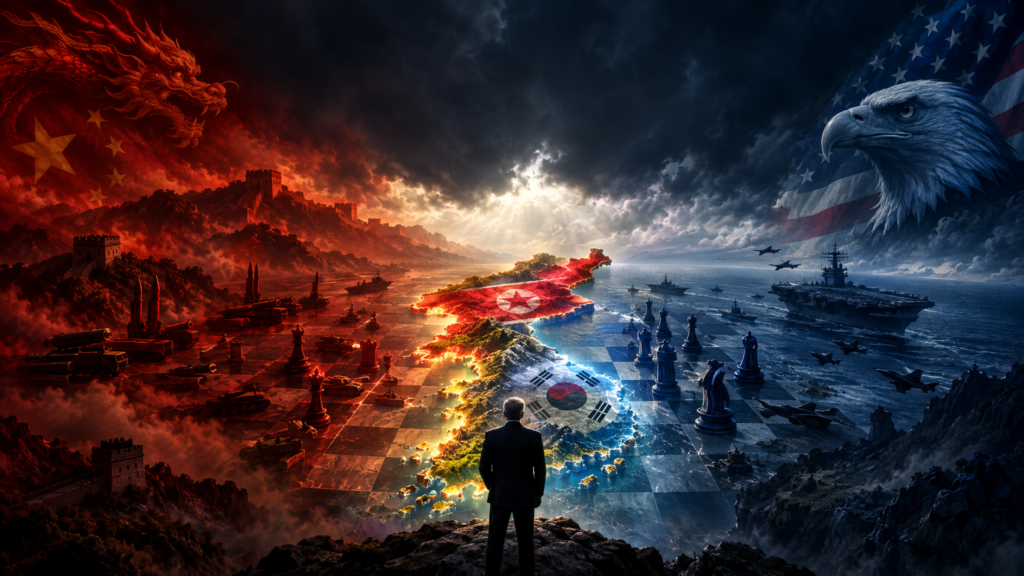
Last summer, General Xavier Brunson, commander of U.S. Forces Korea, referred through various channels to the strategic value of the Republic of Korea. He described South Korea as an “unsinkable aircraft carrier” situated between China and Japan and as a “dagger” capable of constraining China. His remarks meant that, in the midst of the hegemonic struggle with China, South Korea is a strategic position that the United States cannot afford to abandon.
The current South Korean government presents a problem for America’s strategy toward China because it is a left-wing government that displays a more pro-China, pro-North Korea, and anti-American orientation. The U.S. government, however, should clearly recognize that an overwhelming majority of the South Korean public supports the ROK-U.S. alliance.
According to a public opinion survey conducted in the winter of 2021, 93 percent of South Koreans supported the ROK-U.S. alliance. Particularly noteworthy is that 93.9 percent of South Koreans who supported the current Lee Jae-myung government also supported the alliance.
According to a July 2023 survey conducted by the Pew Research Center, 77 percent of South Koreans held an unfavorable view of China. South Koreans’ negative perceptions of China ranked among the highest in the world, at seventh place. This indicates that the international outlook of South Korea’s political elites differs substantially from that of the South Korean public as a whole.
President Trump has repeatedly expressed dissatisfaction with the current South Korean government, criticizing it for neglecting the ROK-U.S. alliance. Some previously planned ROK-U.S. joint military exercises have consequently been reduced or canceled. Nevertheless, exercises conducted with China regarded as a potential adversary, such as the Freedom Edge exercise held in early September, have continued.
South Korea is the most important strategic position in the final stage of America’s hegemonic struggle with China. South Korea possesses shipbuilding capabilities essential to strengthening American naval power and is an important partner capable of complementing America’s global strategy in semiconductors, automobiles, defense industries, and other sectors.
Geographically, South Korea occupies a strategic position from which both China and Japan can be closely monitored and strategically constrained. The United States is fully aware of these realities, and an overwhelming majority of the South Korean people share this understanding.
An ultimate American victory in the U.S.-China hegemonic struggle would mean that the reunification of the Korean Peninsula, a long-standing aspiration of the South Korean people, could take place under the leadership of the liberal camp. It would also mean a substantial reduction in the threat posed by communist authoritarian China.
Recently, both North Korea and China have been experiencing domestic problems associated with economic difficulties and questions surrounding the health of their respective leaders, and the stability of their regimes has consequently been shaken. By contrast, the United States under President Trump has been moving into an increasingly advantageous strategic position, including the permanent military acquisition of Greenland.
President Trump’s grand strategy is certain to reach a successful conclusion in the not-too-distant future. The overwhelming majority of South Koreans eagerly hope that the vision of a free and peaceful reunification of the Korean Peninsula that President Trump promised the Korean people during his visit to South Korea in November 2017 will soon become a reality.
President Trump made the following promise in his address to the National Assembly of the Republic of Korea on November 8, 2017:
We will not permit America or our allies to be blackmailed or attacked. We will not allow American cities to be threatened with destruction. We will not be intimidated. And we will not let the worst atrocities in history be repeated here on this ground we fought and died so hard to secure…….
Together, we dream of a Korea that is free, a peninsula that is safe, and families that are reunited once again. We dream of highways connecting North and South, of cousins embracing cousins, and this nuclear nightmare replaced with the beautiful promise of peace. Until that day comes, we stand strong and alert. Our eyes are fixed to the North and our hearts praying for the day when all Koreans can live in freedom.
The majority of the South Korean people earnestly hope that President Trump’s vision and promise will soon become reality. They offer their active support and encouragement for President Trump’s policies toward North Korea and China and hope for their success.
Choon Kun Lee, Ph.D. is a Korean political scientist specializing in international politics, national security, and military strategy. He earned his B.A. and M.A. in Political Science from Yonsei University and a Ph.D. in Political Science from the University of Texas at Austin. He has served as a researcher at the Sejong Institute, Senior Research Fellow and Research Director at the Korea Institute for Maritime Strategy, Vice President of the Center for Free Enterprise, and Head of the Foreign Affairs and Security Research Center at the Korea Economic Research Institute. He has also taught at several Korean universities and the University of Victoria in Canada. He is the author of several books on international politics, U.S.–Korea relations, the U.S.–China rivalry, and war and strategy.


