




by Hyunseung Lee
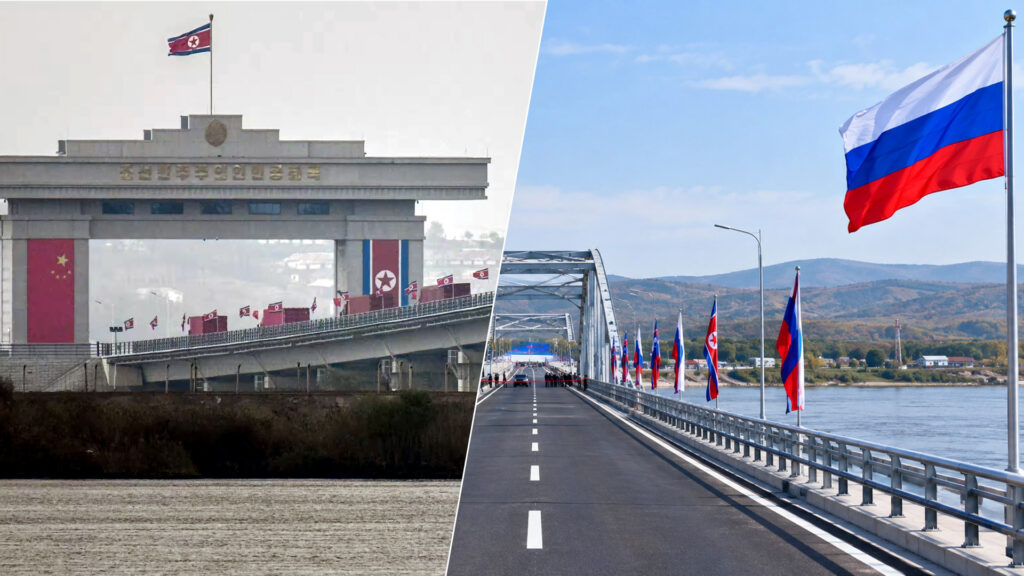
One bridge took 495 days to build. The other took 16 years to open.
On September 7, trucks crossed the first-ever road bridge between North Korea and Russia, a modest two-lane bridge over the Tumen River. Five weeks later, on October 15, the New Yalu River Bridge connecting Sinuiju in North Korea and Dandong in China finally opened. China paid the entire construction cost and completed the bridge in 2014, but it then sat unused for 12 years. If bridges are political statements made of concrete, Pyongyang has just issued two of them. Read side by side, they reveal something that many of the commentaries welcoming the Yalu bridge opening have missed. Kim Jong Un has not turned back toward Beijing. He has only decided to stop ignoring it.
The Bridge That Waited
The New Yalu River Bridge was born in a different North Korea. In October 2009, when Chinese Premier Wen Jiabao visited Pyongyang, Kim Jong Il approved the project to expand economic cooperation between North Korea and China. The project was led by Jang Song Thaek, Kim Jong Un’s uncle by marriage. Jang was planning to turn Hwanggumphyong, a North Korean island next to the Langtou district of Dandong, into a pilot zone for reform and opening. The bridge was built entirely with Chinese money and completed in 2014. But Jang was purged in December 2013, and with him went both the reform line and the broader framework of North Korea–China economic cooperation.
Ri Jong Ho, a former senior official of the Workers’ Party’s Office 39, puts it more bluntly. He recalls that in July 2014, Kim Jong Un reacted strongly against the Chinese-style reform and opening that his uncle had pursued. According to Ri, Kim ordered officials to “cut off relations with China and turn to Russia.” This is the testimony of one defector, not a published directive. It is, however, consistent with what happened afterward.
The Russian bridge followed the opposite path. It was agreed during President Vladimir Putin’s visit to North Korea in 2024, and construction began in April 2025. The regime was the same, the border terrain was the same, and the construction capacity was the same. The only difference was political will.
Reading the Guest Lists
In Pyongyang, protocol is never accidental. At the highest level, the two ceremonies look symmetrical. North Korean Premier Pak Thae Song gave congratulatory remarks by video link at both events. His counterparts were Russian Prime Minister Mikhail Mishustin at the first and Chinese Premier Li Qiang at the second. The real difference lies in who was physically standing on each bridge.
According to North Korea’s official Korean Central News Agency (KCNA), the ribbon in Rason was cut by North Korea’s First Vice Premier of the Cabinet. He was joined by the Minister of External Economic Relations, who chairs the North Korean side of the North Korea–Russia Intergovernmental Commission on Trade, Economic and Scientific-Technological Cooperation. The Minister of Land and Environment Protection and a Vice Minister of Foreign Affairs also attended. On the Russian side, in Khasan, three Russian federal ministers cut the ribbon together with North Korea’s ambassador to Russia. They were the ministers responsible for natural resources, transport, and development of the Far East and the Arctic.
To Sinuiju, North Korea sent the chief secretary of the Workers’ Party committee of North Phyongan Province and a vice chairman of the provincial people’s committee. They were joined by North Korea’s ambassador to China and its consul general in Shenyang. China matched that level with the Communist Party secretary of Liaoning Province, a vice governor of the province, and the Chinese ambassador to North Korea.
The irony is structural. The New Yalu River Bridge is three kilometers long with four lanes. The Tumen River bridge is about one kilometer long with two lanes. The larger and more expensive bridge was entrusted to provincial officials, while the smaller one was entrusted to the central government’s economic ministers.
To be fair, Pyongyang does not write China’s guest list. But the rank and composition of North Korea’s own delegation were decided entirely by North Korea. It sent central government economic ministers to the Russian bridge and provincial political and administrative officials to the Chinese bridge.
What deserves even more attention is not only the rank of the attendees but their function. In his congratulatory remarks, Premier Pak Thae Song expressed confidence that the Yalu bridge would add new momentum to mutually beneficial economic cooperation. KCNA also stressed that the bridge would further strengthen economic ties between North Korea and China. Yet among the North Korean officials named at the Sinuiju ceremony, there was not a single economic official. The provincial party chief secretary, the provincial vice chairman, the ambassador and the consul general all came from political, administrative or diplomatic lines. The same was true of the Chinese side.
By contrast, the Minister of External Economic Relations and the Minister of Land and Environment Protection personally attended the Tumen River bridge ceremony. The Minister of External Economic Relations oversees North Korea’s foreign economic cooperation and leads the intergovernmental economic cooperation commission with Russia. In effect, North Korea talks about economic cooperation with China but practices it with Russia. This is a key point for understanding Kim Jong Un’s intentions and the current temperature of North Korea–China relations.
The language points in the same direction. KCNA described North Korea–Russia relations as a “comprehensive strategic partnership” and an “invincible alliance.” The Russian bridge was also named after Yakov Novichenko, a Soviet Red Army officer credited with saving Kim Il Sung’s life in 1946. That choice ties Russia to the founding story of the Kim dynasty. Coverage of the China bridge, by contrast, relied on shared socialist ideology and historical anniversaries.
The most telling element was Premier Li Qiang’s remarks. He pledged that China’s firm position of placing great importance on China–North Korea friendship would not change, however the international situation may change. These are less the words of a patron giving instructions than of a partner seeking reassurance.
The Trade Illusion
The expectation of a trade boom deserves a sober look. Some South Korean experts forecast that the bridge will expand cargo-handling capacity in the border area by at least three to five times. But handling capacity is not the same as demand.
Trade had already recovered without the new bridge. According to China’s General Administration of Customs, North Korea–China trade reached $2.73 billion in 2025. That is close to the $2.79 billion recorded in 2019, before the COVID-19 pandemic. Trade in the first half of 2026 was about $1.5 billion, the highest first-half figure since 2017, the year UN sanctions on North Korea were fully tightened.
There is also trade that does not appear in the statistics. To win back Kim Jong Un who is leaning toward Russia, Beijing has effectively turned a blind eye to the smuggling of vehicles and trucks whose export to North Korea is banned under UN Security Council Resolution 2397. In Hyesan, Ryanggang Province, on the North Korea–China border, empty lots and alleys have been observed packed with smuggled used Chinese cars. In Pyongyang, the number of privately owned Chinese-brand cars has grown so much that traffic congestion and parking shortages have appeared. Shortly before the New Yalu River Bridge opened, around 100 Chinese-made trucks without license plates were seen waiting at the entrance to the bridge. The Chinese vehicles driving through Pyongyang and the border regions are no accident.
This bridge is more likely to serve as a conduit for “survival goods” than as a pathway to broader economic cooperation. That means North Korean exports of raw materials, and imports of food and construction materials. Even as Pyongyang opens the bridge, it will put up a “mosquito net,” a long-standing North Korean term for letting goods in while filtering out outside information and ideas. In fact, ideological inspections and punishments targeting ordinary citizens and officials are likely to become harsher than before. The regime regards any increase in the number of people who have contact with the outside world, such as trade officials, truck drivers and customs officers, as a threat to the system.
The economic benefits North Korea enjoyed from cooperation with China during the Jang Song Thaek era will not return. What we should watch is something else. Raw materials for processing-on-commission goods, such as wigs and false eyelashes, enter North Korea through Dandong. The finished products, made by North Korean workers whose labor rights and human rights have been violated, then leave North Korea again “legally.” The New Yalu River Bridge could become exactly that channel.
These products are not subject to UN sanctions. However, a report by a North Korean human rights organization alleged that about 70 percent of North Korean wigs are produced through the forced labor of female prisoners in correctional camps. The same report stated that the finished products pass through China’s processing-trade system and are sold on world markets as “Made in China.” There have also been reports that North Korean false eyelashes are openly repackaged in China and passed off as Chinese products. The new four-lane bridge could make this supply chain faster and larger.
Kim Jong Un’s Calculation
Why does Russia come first? Moscow gives what Beijing does not. In 2024, the two countries signed a defense treaty that provides for mutual assistance if either is attacked. North Korea sent thousands of troops to Russia’s Kursk region. Russia provides security, combat experience and foreign currency, and it does not demand that the North Korean regime open up or reform. China provides markets and an economic lifeline, but it also brings “infection.” The abundance of Chinese goods quietly shows North Koreans how far their own system has fallen behind.
Kim Jong Un’s true priority remains close alignment with Russia, with China used as a supplementary tool. This opening is better understood as the result of Chinese demands that followed President Xi Jinping’s visit to Pyongyang in June and could no longer be postponed, rather than as Kim’s own initiative. Beijing must also have been considerably displeased as it watched the Tumen River bridge built at speed in just over a year. Pyongyang has not turned pro-China. It has opened the door halfway to keep a diplomatic balance between Russia and China.
Kim Jong Un is replaying the equidistant diplomacy his grandfather, Kim Il Sung, practiced during the Sino-Soviet split. This time, he also holds nuclear weapons as leverage. In this round, however, Russia gets North Korea’s trust and China gets its trade.
Conclusion: Beijing Is Not the Key to Pyongyang
Washington and Seoul have long relied on a familiar formula: China, which holds North Korea’s economic lifeline, could bring Pyongyang to the negotiating table if it chose to. If President Trump wants a direct deal with Kim Jong Un and the South Korean government expects China to play a “constructive role,” this formula is usually the starting point.
The two bridges show that this formula is outdated. Pyongyang has given China an economic channel, but it has given its strategic trust to Russia. With Russia standing behind it as a security patron, and with sanctions physically breached, China’s economic leverage is far weaker than it once was. Moreover, today’s China is closer to a country trying to hold on to North Korea so as not to lose it to Russia than to a country pressuring it. A country that keeps pledging that its position will not change, however the international situation may change, is in a poor position to hand Pyongyang an ultimatum.
Therefore, if Washington and Seoul intend to use China as leverage to negotiate with North Korea, they need to rethink their tactics. In Pyongyang’s calculation, China is a bridge, not a key. The factor most likely to change Kim Jong Un’s calculations today lies closer to Moscow than to Beijing. Any negotiating strategy must begin with how to offset the benefits North Korea gains from its alignment with Russia, and how to raise the costs of that alignment.
The Tumen River bridge was built to bring Russia closer. The Yalu River bridge was opened under pressure, and Pyongyang will keep it tightly controlled. Anyone seeking a path to negotiations with Pyongyang must first understand that difference.
Hyunseung Lee is a North Korean escapee, lead strategist at the Global Peace Foundation, founder of the North Korean Young Leaders Assembly and a regular contributor to the Korea Regional Review. He has experience in North Korea’s shipping and mining sectors and as a sergeant in the DPRK Army Special Force. He fled in 2014 due to severe governmental purges. He holds a bachelor’s degree in economics from Dongbei University of Finance and Economics and a master’s degree in public administration from Columbia University.


