




By Hyun-seung Lee
Director of Policy & External Affairs, The Korea Signal
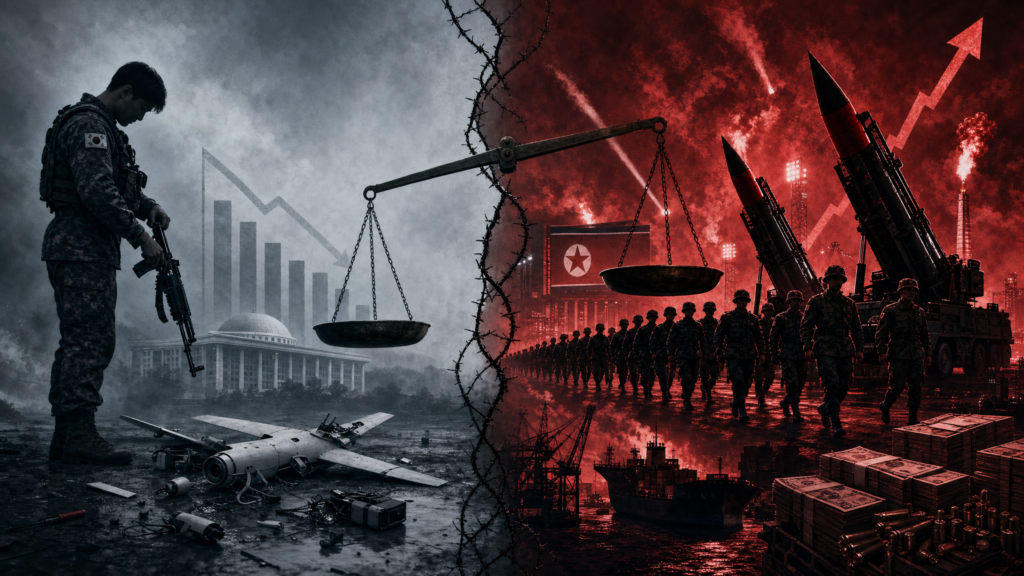
While Kim Jong Un builds the most capable war machine in North Korean history, South Korea’s government is dismantling the very measures designed to deter him — and calling it peace. Meanwhile, its own conservative opposition, retired generals, and even sections of its own military bureaucracy say the erosion runs deeper than diplomacy: down to unloaded machine guns at the DMZ, a documented rupture in intelligence-sharing with Washington, and a budget that funds North Korean soccer fans before it funds border radar.
Pyongyang’s War Dividend
Since 2023, North Korea has supplied Russia an estimated over 6 million artillery shells, and Ukrainian military intelligence assesses Pyongyang now covers 25 to 40 percent of Moscow’s total artillery ammunition needs. Some 200 to 300 munitions factories are reportedly running at full capacity with roughly 500,000 workers. In return, Russia has provided data feedback that measurably improved the guidance accuracy of North Korea’s KN-23/24 ballistic missiles, transferred air-defense and jamming equipment, and helped establish domestic Shahed/Geran-type attack-drone production inside North Korea. South Korean officials believe Russia also supplied key radar and missile technology for Pyongyang’s new nuclear-capable Choe Hyon-class destroyer, the first of a two-ship-a-year construction program through 2030. An estimated 11,000 to 14,000 North Korean troops have already fought in Russia’s Kursk region, and Ukraine President Zelensky claimed in July that Moscow is preparing to receive 30,000 more — a claim South Korean officials have not confirmed through troop-movement indicators,” and then continue into “the partnership has earned Pyongyang an estimated $7.7–14.4 billion since 2023. None of this experience stays in Ukraine. It will come home to the DMZ.
The Alliance’s Information Architecture Is Cracking
The most consequential evidence of strain in Seoul’s own posture is not symbolic. It is operational, and it goes to the heart of what an alliance is for. A joint advisory from four South Korean security agencies disclosed in July that a state-sponsored group tracked as Lazarus had compromised at least 72 South Korean organizations in 2026 alone, including government agencies; separately, hackers sat inside the Foreign Ministry’s diplomatic-academy platform for nine months undetected, and the National Intelligence Service has told lawmakers North Korean actors account for roughly 80 percent of all cyberattacks on the government sector. But the more serious rupture runs the other direction. In March 2026, Unification Minister Chung Dong-young told the National Assembly that North Korea was operating a suspected third uranium-enrichment site at Kusong — a location neither government had publicly confirmed, and one U.S. officials treated as an unauthorized disclosure of classified satellite intelligence. Washington responded by restricting the intelligence it shares with Seoul on North Korea, and USFK Commander Gen. Xavier Brunson personally lodged a complaint with Defense Minister Ahn Gyu-back. Two months later the restriction was still in force and demonstrably degrading South Korea’s own picture of the threat: the Defense Intelligence Agency reportedly told lawmakers it lacked sufficient data even to evaluate North Korea’s troop deployments to Russia. That same friction surfaced again in February 2026, when U.S. fighter jets exercised over the Yellow Sea. U.S. Forces Korea maintained it had notified South Korean counterparts of the drill at the working level in advance; Seoul’s defense minister and the JCS chairman nonetheless lodged a formal protest with the commanding U.S. general, and it later emerged the notice had simply failed to travel up South Korea’s own chain of command.
None of this is abstract for the roughly 28,500 American troops stationed in South Korea. The Combined Forces Command’s ability to warn of an artillery barrage, a missile launch, or a special-forces infiltration rests on the same satellite and signals architecture now partially restricted. If a sitting cabinet minister’s public remarks can degrade that picture for months, the cost is not confined to Seoul’s own situational awareness — it falls directly on the American soldiers, airmen, and sailors whose safety depends on the same feed. An alliance is only as strong as the intelligence flowing through it, and that flow is visibly narrower than it was a year ago, for reasons entirely of Seoul’s own making.
An Iron Curtain on One Side, an Open Gate on the Other
The starkest contrast is physical, and it is happening on the ground right now. Since Kim Jong Un declared the two Koreas “hostile states” in late 2023 and ordered the “southern border” turned into an “impregnable fortress,” North Korean troops have blown up inter-Korean road and rail links, cleared minefield ground along most of the 248-kilometer Military Demarcation Line, built 60–70 kilometers of tactical roads, and strung 80–90 kilometers of barbed wire — in places within 80 to 100 meters of the line itself. Kim Yo Jong has said the border with an enemy state “must be made solid.” South Korea’s Joint Chiefs called this a clear armistice violation; the UN Command, tellingly, declined to agree — a split that shows how contested Seoul’s own read of the threat has become even among its security partners. At the very moment Pyongyang is doing this, Seoul’s own Defense Ministry has moved to open sections of the Civilian Control Line and dismantle anti-tank positions on its own side — and Seoul’s diplomacy has moved the same direction. Within days of taking office, Lee ordered a halt to DMZ loudspeaker broadcasts and pressed activists to stop leaflet balloons; by August 2025 the loudspeakers were physically dismantled. That same month he announced restoration of the 2018 Comprehensive Military Agreement — buffer zones, no-fly zones, guard-post removal — while pledging no “unification by absorption.” In June 2026, Jeju Province, with Unification Ministry approval, shipped roughly 160 million won in dialysis equipment, tree seedlings, and pesticide to the North, arranged through a North Korean intelligence-linked operative met in Beijing. In May, the ministry spent about 235 million won of the inter-Korean cooperation fund on a “joint cheering squad” for a North Korean women’s football club playing in Suwon — approved days after Kim had formally struck unification from North Korea’s constitution.In January, the ministry began rewriting import rules to reopen North Korean food imports, a channel critics say could route tens of millions of dollars a year to Pyongyang under a sanctions regime treating North Korean agricultural trade as a proliferation-adjacent concern.
Pyongyang’s answer to every one of these gestures has been the same: it mirrored Seoul’s loudspeaker pause rather than initiating one, and otherwise dismissed the overtures while accelerating its own fortification.Read Kim’s “hostile two states” doctrine as an invitation to permanent, peaceful separation, and none of this behavior makes sense. Read it correctly — as a regime buying time and ideological cover while it finishes preparing for a war on its own terms — and it is exactly what one would expect.
A Pattern Inside the Ranks, Not a Coincidence
The erosion is visible inside the military itself, and it is too consistent to dismiss as coincidence. In July 2026, the Army’s 1st Corps was found to have stopped loading live ammunition into DMZ machine guns months earlier without informing the Joint Chiefs. In January, a Gangwon division ordered checkpoint sentries to swap rifles for telescopic batons and deleted the standard challenge, “Hands up, or I’ll shoot” — reversed within a day, but not before a lawmaker asked whether the military was “notifying North Korea of our disarmament.” The Yoon-era Drone Operations Command, created as North Korea’s own drone incursions became a live issue, was dissolved this year and downgraded into a policy-only bureau, with operational control handed to the individual services — the Defense Ministry calls it integration, critics call it a step backward exactly when Ukraine has proven drones the decisive weapon of the era. In June, the Defense Ministry’s own War Memorial ran a children’s program presenting the Korean War alongside Beijing’s official framing of it as the “War to Resist America and Aid Korea,” pulled only after public outrage, with opposition leader Jang Dong-hyeok tracing it to a broader pattern among cabinet officials who refer to North Korea by the names Pyongyang prefers. Officials will say each of these was a local commander’s unauthorized decision, caught and corrected. That gets the causality backward. Militaries do not develop a taste for unloaded rifles, deleted warnings, and softened history by accident; they develop it when the signals from the top consistently reward caution toward Pyongyang and treat vigilance as a liability. A defense ministry that replaced all seven of its four-star generals and 20 of 33 lieutenant generals within a year of the December 2024 martial-law crisis has had ample opportunity to reset that signal. It has not.
What the Budget and the Timeline Reveal
Money follows priorities. Lee’s first supplementary budget, in July 2025, cut roughly 90.5 billion won from defense — GOP surveillance upgrades, special-operations sidearms, mobile long-range radar, officers’ quarters — while restoring tens of billions of won in presidential discretionary funds the prior government had lost; opposition lawmakers called it turning national security into “an ATM for cash handouts.” Against a 66-trillion-won budget the sum is trivial; the direction is not. Readiness line items were trimmed in the same season the government found money for a North Korean football cheering squad and began building a channel for North Korean food imports. Seoul’s accelerated push to reclaim wartime operational control ahead of schedule has drawn its own criticism, with continuing disagreement over whether South Korea’s high-altitude missile-defense capability is mature enough to support an early handover. A parallel push toward a “selective” professional-soldier model, a Lee campaign pledge, has drawn opposition from lawmakers with military backgrounds who call the design underspecified and warn it risks hollowing out manpower at precisely the wrong moment. Conservative commentary has summarized the pattern bluntly: that under Lee, the military has become politicized, risk-averse, and deferential to Pyongyang — in the words of one widely circulated column, a “third-rate army.” Next year’s defense budget is, in fairness, rising 8.2 percent to 66.3 trillion won, the sharpest increase in six years, and Defense Minister Ahn Gyu-back insists the alliance is “only getting stronger.” Both things can be true at once, and that is precisely the problem. A larger topline budget buys hardware years from now; it does not explain why live ammunition disappeared from border machine guns, why a drone command was dissolved as drone warfare became decisive, or why a government that says it cannot spare funds for GOP radar can spare funds for a North Korean cheering squad instead.
What Washington Should Do
None of this requires Washington to lecture a sovereign ally on its own choices. It requires Washington to stop treating a documented intelligence rupture, a string of unreciprocated concessions, and a run of readiness lapses as unrelated items on unrelated news cycles, when they are chapters of the same story. Congress should hold a hearing, classified if necessary, on the operational impact of the Kusong-related restriction on both South Korean and U.S. force protection. State and Defense should negotiate a standing pre-clearance protocol for South Korean officials handling U.S.-origin intelligence before public testimony — an arrangement Washington already uses with other close partners. Any further acceleration of wartime operational control should be tied publicly to verified, conditions-based readiness benchmarks rather than a political calendar, with an unclassified GAO or DoD Inspector General assessment preceding any transfer date. Congress should direct an annual unclassified report, modeled on existing burden-sharing reviews, tracking how Seoul’s domestic policy choices affect extended-deterrence credibility. And American and Korean institutions should stand up a Track 1.5 “alliance readiness” dialogue insulated from Seoul’s electoral cycle, so assessments of readiness stop rising and falling with whichever party holds the Blue House.
The government’s own defenders will object that this argument stitches together unrelated incidents to fit a predetermined conclusion. I do not find that objection persuasive. The individual facts are not in dispute; officials have confirmed the intelligence restriction, the unloaded weapons, the War Memorial program, and the budget cuts themselves. What is in dispute is only whether their timing, direction, and cumulative weight are coincidental. A government that simultaneously narrows the flow of allied intelligence relied upon by American troops, funds unreciprocated gestures toward a regime actively fortifying its border, and presides over a run of readiness lapses inside its own military has not suffered a string of bad luck. It has revealed a governing instinct — and the burden of proof now sits with those who would call it coincidence.
Hyunseung Lee is a North Korean escapee, human rights advocate, and lead strategist at the Global Peace Foundation, where he works on North Korea policy, human rights, and Korean unification. He is the founder of the North Korean Young Leaders Assembly and has advised the U.S. government and policy community as a consultant on North Korean affairs. Before defecting in 2014 amid a wave of severe regime purges, Lee held significant roles in North Korea’s shipping and mining sectors, facilitating trade between North Korea and China, and served as a sergeant in the special forces of the Korean People’s Army. He is a regular contributor to United Press International (UPI), Voice of America, and Radio Free Asia, among other global media outlets. Lee holds a bachelor’s degree in international trade and economics from Dongbei University of Finance and Economics in China and a master’s degree in public administration from Columbia University.


