




By Hyunseung Lee
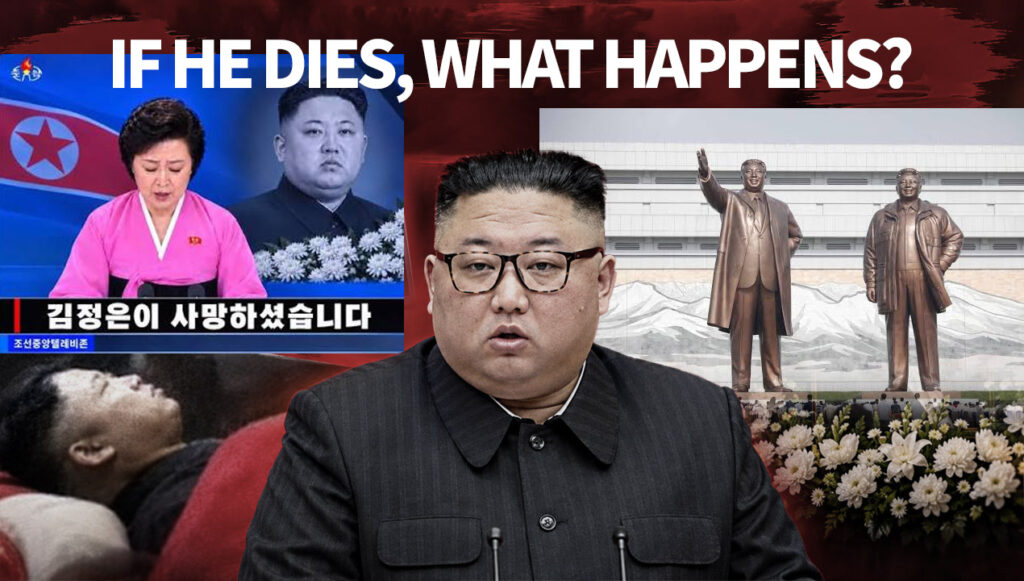
On October 19, a rumor spread across the world on social media that Kim Jong Un had collapsed from a brain hemorrhage, been rushed to a hospital in Beijing, and died there. It started with a post by a Chinese dissident based in the United States. The next day, North Korea’s official Korean Central News Agency (KCNA) released photos of Kim touring a clothing and footwear exhibition in Pyongyang with his wife, Ri Sol Ju, and his daughter, Ju Ae. On social media, some even joked that Kim Jong Un had now “died for the 37th time in the past ten years.”
Still, the question itself cannot be laughed off. On September 30, South Korea’s National Intelligence Service (NIS) told the National Assembly that Kim weighs about 140 kilograms and is at high risk of cardiovascular disease. So when real news of his death eventually comes, rather than a “37th” rumor, what will happen inside North Korea?
The Outside World’s Imagination: Collapse, Refugees and Chinese Troops
The picture most often painted outside North Korea is dramatic. The regime is shaken, starving citizens flood across the Yalu and Tumen rivers into China, and Chinese troops cross the border into North Korea.
This scenario is not pure imagination. In a 2013 report titled ‘Preparing for the Possibility of a North Korean Collapse’, Dr. Bruce Bennett of the RAND Corporation, a U.S. research institution, offered the following analysis. If North Korea collapsed, China would worry about both a massive influx of refugees and a U.S. military intervention. China might therefore set up a buffer zone inside North Korea to stop refugees before they reached Chinese territory. However, Dr. Bennett himself has stated clearly that his research does not assume the North Korean government “will collapse.” His work is planning for the worst case, not a prediction. Yet the outside world has often treated this contingency planning as if it were a prophecy. The ‘death of the leader’ and the ‘collapse of the regime’ are entirely different events.
The opposing view is just as strong. During the 2020 rumors of Kim Jong Un’s death, Andrei Lankov, a Russian-born North Korea expert and professor at Kookmin University in Seoul, predicted that North Korea’s generals and senior politicians would either avoid a power struggle or engage in only a limited one, and would accept a new leader who would most likely come from the Kim family. That same year, The National Interest, a U.S. foreign policy and security magazine, asked more than 60 experts worldwide the same question, and their opinions were divided. Some expected total chaos; others expected “business as usual” in North Korea.
I, too, consider regime collapse, a mass exodus of refugees, and the entry of Chinese troops to be among the least likely of all possible futures.
What I Saw When Kim Il Sung and Kim Jong Il Died
While living in North Korea, I experienced the deaths of both Kim Il Sung and Kim Jong Il. Neither led to instability in the system, a mass movement of refugees, or an internal power struggle. Of course, one could argue that this was because a successor had already been chosen in both cases. That is true. But there is a more important fact. North Korea has its own protocol that takes effect when a leader dies, and the top priority of that protocol has always been the stability of the system.
Kim Il Sung died at 2 a.m. on July 8, 1994. North Korea did not officially announce his death until noon the following day, 34 hours later. In the meantime, his successor, Kim Jong Il, temporarily sealed the border with China to block outside influence. Internally, the first step was to form a State Funeral Committee. The list of committee members was, in effect, an announcement of the new power hierarchy.
Kim Jong Il died at 8:30 a.m. on December 17, 2011. The announcement came 51 hours and 30 minutes later, in a “special broadcast” at noon on December 19. That was more than 17 hours later than in his father’s case. Many analysts interpret the longer delay as a sign that his successor, Kim Jong Un, had a weaker power base. Once again, the North Korean leadership began by sealing the border, raising the military’s alert level, and tightening internal control.
One more thing happened in both periods. Top military commanders, including corps commanders and corps political commissars, were summoned to Pyongyang under the pretext of attending a “meeting.” The purpose was to prevent any possible rebellion or armed clash. Separating the officers who command troops from their units and keeping them in Pyongyang is the first step of North Korean-style crisis management.
North Korea is not an incompetent system that, upon the death of its leader, would open its border to Chinese troops and stand by while refugees pour out. On the contrary, it is a system that has spent decades building up the control and the means to deal with exactly such a moment.
If Kim Jong Un Died Tomorrow: A One-Week Timeline
If Kim Jong Un died suddenly tonight or tomorrow, how would the North Korean leadership act? The overall pattern would likely repeat what happened in 1994 and 2011.
The first 24 hours: silence and lockdown. The fact of his death would be shared only with the commander of the Guard Command, the unit responsible for the leader’s personal security, and a very small circle of aides. The borders with China and Russia would be sealed, and outside communications and domestic travel would be restricted. At the same time, orders would go out to corps commanders and political commissars to come to Pyongyang for a “gathering.” The first step is to tie their hands.
Days 2–3: choosing a successor. This is where the decisive difference from the past emerges. Kim Jong Il had a succession system built up over more than 20 years. Kim Jong Un at least had the title of “General” and an official position. Today, there is no formally designated successor. The leadership would have to choose a successor, or an interim supreme leader, who could win the acceptance of both the elite and the North Korean people. This would be the biggest obstacle of the entire week.
Days 3–5: the official announcement. For this reason, the announcement is likely to come later than it did for his predecessors. However, it would probably not be delayed by more than a few days. The longer the silence lasts, the more rumors spread, and rumors quickly become the seeds of chaos. The moment the leadership judges that it can contain any unrest, a special broadcast would air on Korean Central Television.
Days 5–7: the funeral committee and “rule by the leader’s last instructions.” The list of State Funeral Committee members would be announced, and its order would reveal the new map of power. During the mourning period, pledges of loyalty would follow under the slogan “Upholding the last instructions of Comrade Kim Jong Un.” Grief would become a tool of control.
Who Would Take His Place?
The successor most often named by South Korea’s media, experts and government is Kim’s daughter, Kim Ju Ae. In a report to the National Assembly this year, the NIS assessed that she had reached the stage of “designation as successor.” I do not believe this assessment is accurate. The theory that Kim Ju Ae is the successor ranks lowest among all plausible scenarios.
South Korean intelligence has misjudged North Korea’s internal affairs on many occasions. In 2016, the South Korean government announced that Ri Yong Gil, then chief of the General Staff of the Korean People’s Army, had been executed. Three months later, he appeared in full public view at the party congress and was named an alternate member of the Politburo. In 2020, the assessment that Kim Jong Un had “delegated” part of his governing authority to his sister, Kim Yo Jong, also turned out to be a false alarm. Appearing frequently in public and being designated as a successor are two entirely different things. And if Kim Jong Un were to die “tomorrow,” a girl in her early teens could not possibly take control of the military and the party.
The most likely scenario is that Kim Jong Un’s younger sister, Kim Yo Jong, would take power as the de facto interim successor. As his full sister, born to the same mother, she carries the legitimacy of the “Paektu bloodline,” the Kim family lineage that North Korean propaganda traces back to Kim Il Sung. She is also the only family member who has spent years at her brother’s side, at the very center of power. Kim Jong Un’s older brother, Kim Jong Chol, has rarely appeared on the political stage, making him an unrealistic option, at least for now.
Kim Yo Jong, however, has clear limitations. She has raised her profile by delivering North Korea’s messages to South Korea and the outside world, but her control over the military and the security agencies has never been tested. On her own, Kim Yo Jong would struggle to quickly calm the anxieties of the elite and the public during an interim period.
That is why the most realistic scenario is a transitional arrangement that pairs Kim Yo Jong, as the symbol of the Paektu bloodline, with a working guardian. The strongest candidate for that guardian role is Choe Ryong Hae. For seven years starting in 2019, Choe served as Chairman of the Standing Committee of the Supreme People’s Assembly, North Korea’s legislature, ranking second in the state’s official protocol order. He stepped down from his official posts this year, but after the Kim family, his is still the face most widely recognized by the North Korean public. His background is also decisive. His father, Choe Hyon, fought alongside Kim Il Sung as an anti-Japanese guerrilla in Manchuria and later served as Minister of the People’s Armed Forces. He remains a symbol of the first revolutionary generation, so much so that North Korea named its first new 5,000-ton destroyer, launched in 2025, the Choe Hyon. In effect, Choe Ryong Hae carries the legitimacy of a “partisan bloodline” second only to the Paektu bloodline itself.
His status as a retired elder is not a weakness but a strength. Because he has no faction or power base of his own, the Kim family has little reason to see him as a threat. That makes him a safe choice to serve as the symbol of a transition. Choe Ryong Hae could take on the role Jang Song Thaek played during the first two years of Kim Jong Un’s rule: a symbol who calms the anxieties of the elite and the public, and a guardian who supports Kim Yo Jong. This transitional arrangement would buy Kim Yo Jong the time she needs to take control of the military and of the security and judicial agencies, such as the Ministry of State Security and the Ministry of Social Security.
Conclusion: Prepare Not for Collapse, but for a “New Leadership”
Kim Jong Un’s death would not mark the beginning of North Korea’s collapse. North Korea has gone through the death of its leader twice. Both times, it closed its borders, tied the hands of the military, and reorganized power in silence. The third time will be no different. The only difference is that, because no successor has been designated, the silence may last a little longer.
What Washington and Seoul need to prepare now is not operational plans for refugee camps or the entry of Chinese troops. They need plans for what kind of negotiations to hold with the new North Korean leadership after Kim Jong Un, and for how to steer North Korea toward change during that transition. Power is at its weakest during the transition, before a new leader has secured his or her position. To avoid missing that brief window, what is needed is not a strategy of waiting for collapse, but a strategy capable of persuading the new leadership.
Hyunseung Lee is a North Korean escapee, lead strategist at the Global Peace Foundation, founder of the North Korean Young Leaders Assembly and a regular contributor to the Korea Regional Review. He has experience in North Korea’s shipping and mining sectors and as a sergeant in the DPRK Army Special Force. He fled in 2014 due to severe governmental purges. He holds a bachelor’s degree in economics from Dongbei University of Finance and Economics and a master’s degree in public administration from Columbia University.


