




By Roberta Cohen
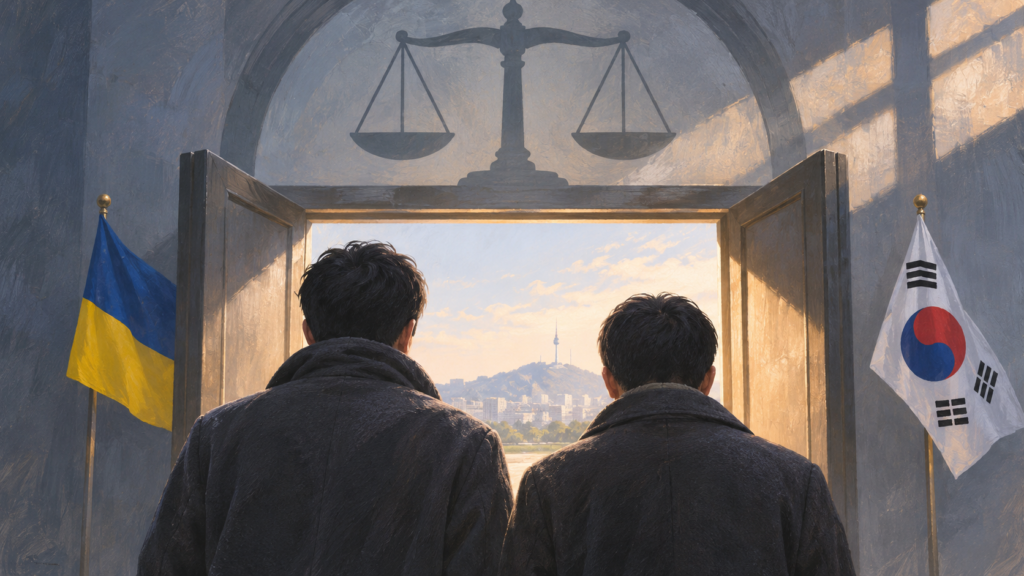
The transfer by Ukraine of two North Korean prisoners of war (POWs) to South Korea in September was an important vindication of the international legal principle of non-refoulement. Contained in international human rights, humanitarian and refugee law, this principle forbids governments from forcing back to their country of origin those who have a well-founded fear of persecution. The two North Korean POWs captured in Russia’s Kursk region in January 2025 made clear that if they were repatriated, they would be harshly punished.
Had Ukraine returned them, it would have violated at least four agreements to which it is bound: 1) the Third Geneva Convention Relative to the Treatment of Prisoners of War; 2) the Convention against Torture and other Cruel, Inhuman or Degrading Treatment or Punishment; 3) the Convention Relating to the Status of Refugees (applicable when POW status ends); and 4) the European Convention on Human Rights. Each treaty either cites non-refoulement or is interpreted by courts to include the provision.
This article examines the reasons why Ukraine felt compelled to comply with its international legal obligations, the competing political priorities that stood in the way of the law’s application, and how Ukraine and South Korea in future should deal with North Korean POWs.
In 2026, a team formed in Washington DC to advocate for Ukraine’s compliance with the principle of non-refoulement. Composed of experts in human rights and humanitarian law, democracy promotion, immigration and refugee law, and with expertise in North Korea, they held lengthy discussions with officials from Ukraine and the European Union (EU). Some members also had exchanges with the US, as well as communication with the International Committee of the Red Cross (ICRC). The team supported the ICRC’s informing the POWs of the choices to which they were entitled under international law — return to North Korea, political asylum in Ukraine, or transfer to a third country. The two POWs chose transfer to South Korea.
Factors contributing to Ukraine’s compliance with international law
The fact that the North Korean POWs would likely be subject to torture, imprisonment and possible execution if returned was one of the more influential considerations. Team members Hyun Seung Lee and Peter Oh, who earlier served in the North Korean army, recounted to Ukrainian officials how POWs sent home after the Korean War were subject to lifelong surveillance and forced labor in coal mines and collective farms. Today, treatment of POWs had become even harsher. Recruits were expected to ‘blow themselves up’ if captured because being taken prisoner was tantamount to treason. Because the two North Korean POWs were held for more than a year and a half, they would be especially suspect of having provided military information to Ukraine, which could lead to their execution.
Were Ukraine to be held responsible for such punishment, its international standing and reputation would suffer, especially with Western democratic governments, with which Ukraine was seeking closer relations. Returning the POWs could also damage its application for membership in the EU, whose criteria included respect for human rights. Team member, Professor Robert K. Goldman, a humanitarian law expert at American University, warned Ukrainian officials that a case against Ukraine could be brought before the European Court of Human Rights. He explained that the Court interpreted the European Convention on Human Rights to include the principle of non-refoulement and Ukraine was under the Court’s jurisdiction.
Goldman further pointed out that the concept of non-refoulement should occupy a special place in Ukraine’s history. He recalled that the forced repatriation of Ukrainian and Russian POWs at the end of the Second World War resulted in their severe mistreatment. This in turn led to the development of new interpretations and applications of humanitarian law to better protect POWs. The Armistice Agreement after the Korean War thus provided for POWs to be interviewed individually to establish whether they wished to return to their country or seek asylum in another country. Had Ukraine forcibly repatriated the two POWs to North Korea, it would have undermined the important international protections for POWs that had developed over the years.
Forced repatriation would also have damaged Ukraine’s relationship with South Korea whose Constitution considers North Koreans to be its nationals. Seoul not only expressed readiness to take in the POWs but also pledged $100 million in reconstruction aid to Ukraine (over and above $2.3 billion earlier pledged) and in addition provided humanitarian assistance. Although Ukraine sought lethal weapons from South Korea, Seoul maintained its policy of indirect arms shipments through Europe, presumably to not impair its relations with Russia.
Finally, Ukraine considered it valuable to contrast its commitment to law and democratic values with that of its adversary, Russia. The Russian government not only violated the UN Charter by invading Ukraine but also the Geneva Conventions by deliberately targeting civilians and consistently mistreating POWs. Unlike Ukraine, Russia denied ICRC access to many of Ukraine’s POWs, which resulted in their maltreatment. Russia also released far fewer Ukrainian POWs than Ukraine did of Russian POWs.
Competing political priorities
Proving that North Korean troops were involved in the war against Ukraine was important for Ukraine, especially since both North Korea and Russia denied this involvement. However, Ukraine’s publicizing and disseminating to the media the pictures of the two POWs it captured was at variance with the Geneva Conventions which outlaws exposing prisoners to “public curiosity.” Both NGOs and the head of the UN office in Seoul, James Heenan, warned, “we should not disclose the identity of prisoners of war in this way under the Third Geneva Convention” because doing so would make their return impossible and also bring harm to their families.
There were indications that Ukraine’s President Volodymyr Zelenskyy might try to make the North Korean POWs part of exchange agreements with Russia, given that Ukrainian POW releases were one of Ukraine’s highest priorities. But the North Korean POWs, who did not want to return, could not legally be bargaining chips. It took the legal office of the Ukrainian Defense Ministry to point out that Ukraine had legal obligations to the North Korean POWs. Its Defense Ministry even communicated to the UN Special Rapporteur on Human Rights in the DPRK that “the risk of persecution and torture” of the North Korean POWs “cannot be ruled out. Therefore, repatriation of these prisoners of war to North Korea is deemed inappropriate [emphasis added].” Both Special Rapporteur Elizabeth Salmon and UN High Commissioner for Human Rights Volker Turk had called upon Ukraine to abide by its legal obligations.
President Zelenskyy then hinted that he might want to place conditions on the POWs. When it was decided they would go to South Korea, he publicly remarked that they would have a better chance of getting to South Korea if they “spread the truth about this war in Korea,” that is, spoke out against North Korea. And when he addressed the UN General Assembly in September 2026, he made a point of revealing to the world community that the two North Korean POWs had been transferred to South Korea. This was immediately protested by Seoul which considered Ukraine’s announcement a breach of confidentiality that could harm the POWs and their families.
But the Lee Jae Myung administration also had its own political objectives. Since coming into office in June 2025, it spoke of improving relations with North Korea and to this end wanted to keep quiet the transfer of the two POWs. The Ukrainian President’s announcement undermined this objective. It would no doubt humiliate Kim Jong Un to hear about the defection of North Korean soldiers and the escape route being developed. Yet for Ukraine, the provision of information to all foreign soldiers fighting for Russia on how to defect to the Ukrainian side had become a matter of survival.
How should the Ukraine, South Korea and other countries respond to POW cases in future?
Since 2024, North Korea has dispatched some 16,000 troops to Russia and Moscow is calling for more. There also are some 12,000 North Korean engineers and laborers working in Russia’s weapons factories. With more North Koreans expected, additional defections are bound to occur. Whether these are dealt with effectively will depend upon the relationship between Ukraine and South Korea.
At present, much needs to be improved in that relationship, as Brookings’ Andrew Yeo recently recounted.
One important goal that needs inclusion in that relationship would be a more effective role for international law, in particular the principle of non-refoulement. It is not enough for Ukraine and South Korea to make general statements of support for international law and its humanitarian principles. The two governments need to work out the details of how the law should be applied in all its stages.
South Korea must take into account Ukraine’s need to stand up to aggression while Ukraine must understand the highly sensitive implications of repatriation for inter-Korean relations. Ukraine’s leadership must also commit to upholding the law in all its phases.
Adherence to the law would not only help insulate Ukraine from threats or disingenuous proposals by Russia and North Korea for prisoner exchanges, but help it to maintain its strong reputation. To its credit, Ukraine did not succumb to bargaining away North Korean POWs. Nor did it give credence to Kim Jong Un’s statements that “wounded“ North Koreans (e.g., like the two POWs captured) would be accepted back as “loyal warriors.”
Not that North Korean POWs will have an easy time in South Korea. They will have to forgo contact with their families and live with the punishments Pyongyang inflicts upon them. They will need not only education and skills training but also psychological and social support plus protection from North Korea’s long arm of cross border repression. As the National Human Rights Commission of South Korea asserted, what matters now “is ensuring that the two can live safely in the Republic of Korea, recover from the physical and psychological wounds sustained during the war and captivity, and begin new lives.”
Other countries should also be encouraged to provide refuge to North Korean POWs in future, an option some POWs might prefer. What international law makes unconscionable is the forced return of POWs to situations where their lives or freedoms will be endangered. POW well-being must be “the center of the story,” as Heenan has insisted, reinforced by Ukraine’s first lady Olena Zelenska when she said: “We are fighting for our values…and these values must be visible in everything we do.”
Roberta Cohen is a human rights specialist and author who has worked with the United Nations, the U.S. Department of State, the Brookings Institution, and human rights organizations and academic institutions. She is former Co-Chair Emeritus of the Board of Directors of the Committee for Human Rights in North Korea (HRNK) and a leading expert on human rights, humanitarian affairs, refugees, and internally displaced persons.


