




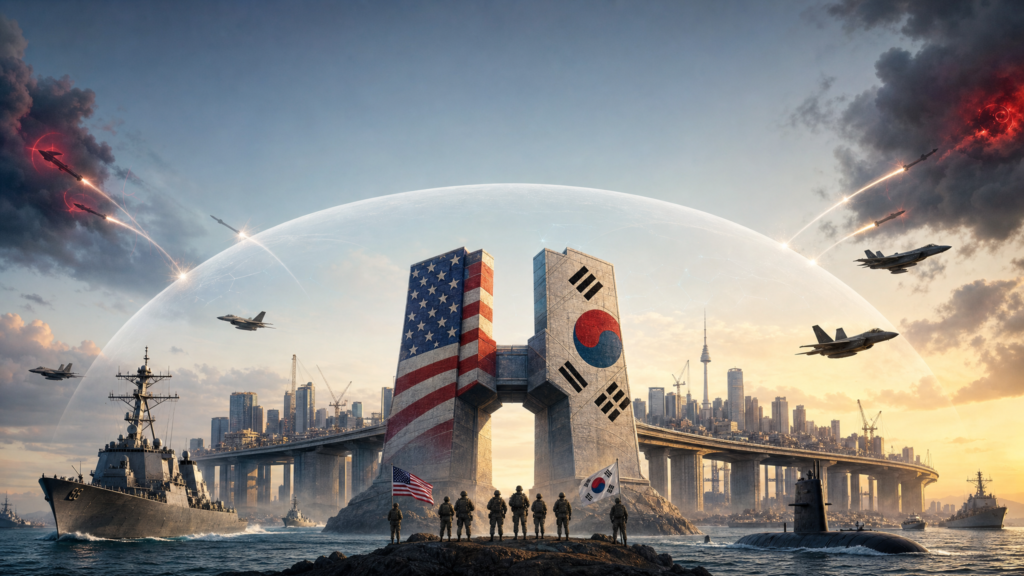
by Ph.D. Daesung Song
President of AKUS-Korea, Former-President of The Sejong Institute, Korean Air Force Brigadier General (Ret.)
The international system comprises more than 190 sovereign states whose relationships vary widely. Some are adversaries, others maintain limited relations based on narrow interests, and still others cooperate closely in pursuit of shared objectives. Among them are relationships of such strategic consequence that their serious deterioration can directly affect a nation’s security and prosperity.
Looking back on more than seven decades of South Korea’s modern history, and considering the geopolitical environment surrounding the Korean Peninsula today, I regard the ROK-U.S. relationship as one of the most consequential factors shaping the Republic of Korea’s security, development, and prosperity. Since the signing of the Mutual Defense Treaty in 1953, the ROK-U.S. alliance has been a central pillar of South Korea’s national defense. Yet what I mean by “ROK-U.S. solidarity” extends beyond the military alliance itself. It encompasses security and economic cooperation, a shared commitment to liberal democracy and the market economy, and the trust and cooperation that have developed between the peoples of our two countries.
Why, then, should ROK-U.S. solidarity be regarded as an essential foundation for South Korea’s survival and prosperity? I would offer four reasons.
First, ROK-U.S. solidarity provides a critical deterrent against North Korea’s weapons of mass destruction.
North Korea has maintained a three-generation hereditary dictatorship under Kim Il Sung, Kim Jong Il, and Kim Jong Un, while making military power a central instrument of the regime. Despite years of international sanctions, Pyongyang has steadily advanced its nuclear weapons and ballistic missile programs and is now widely regarded as a de facto nuclear-armed state.
According to the SIPRI Yearbook 2026, released in June 2026, North Korea was estimated to have assembled approximately 60 nuclear warheads as of January 2026 and to possess enough fissile material to produce at least 30 more. SIPRI also assessed that North Korea continues to expand its production of fissile material while developing new nuclear delivery systems and further advancing its nuclear forces. Pyongyang has developed a broad missile arsenal ranging from short- and medium-range ballistic missiles to intercontinental ballistic missiles. The U.S. Intelligence Community assesses that North Korea has successfully tested ICBMs capable of reaching the U.S. homeland. North Korea’s nuclear and missile programs therefore no longer pose a threat confined to the Korean Peninsula or Northeast Asia; they have become a direct security concern for the United States itself.
North Korea’s deepening military cooperation with Russia has added another dimension to this threat. The Treaty on Comprehensive Strategic Partnership signed by North Korea and Russia on June 19, 2024, provides for military and other assistance if either party is subjected to armed aggression and enters a state of war. The subsequent deployment of North Korean troops to Russia and their participation in the war against Ukraine transformed that relationship from a treaty commitment into operational military cooperation on an active battlefield.
Of particular concern to South Korea is the combat experience North Korean forces are acquiring in modern warfare. By fighting alongside Russian forces, North Korean troops have gained exposure to a battlefield in which drones are employed on a massive scale, as well as direct experience with contemporary tactics and military operations. The possibility that these lessons will be incorporated into North Korean training, tactics, and weapons employment represents a new military threat that both Seoul and Washington must take seriously.
Under these circumstances, one of the most credible means of deterring North Korean military adventurism remains the ROK-U.S. combined defense posture backed by the U.S. extended deterrence commitment. The logic of deterrence is straightforward: an adversary must conclude that the costs of aggression will vastly exceed any conceivable gains. Any North Korean decision to attack South Korea must therefore account not only for the capabilities of the ROK Armed Forces, but also for the combined military power of the alliance and the extended deterrence capabilities of the United States. That calculation is itself a powerful deterrent.
ROK-U.S. solidarity, therefore, is not simply a diplomatic appeal for closer relations with the United States. In the face of North Korea’s weapons of mass destruction, it is a practical component of the national security architecture on which South Korea’s survival depends.
Second, ROK-U.S. solidarity provides a combined defense framework that helps protect a free and democratic South Korea against aggression and coercion from surrounding major powers.
South Korea occupies an unusually demanding geopolitical position. It is situated among China, Russia, and Japan while remaining in a state of military confrontation with North Korea. Few countries face such a concentration of major-power interests in their immediate neighborhood.
China’s rapid rise in national power presents South Korea with both opportunities and strategic challenges. China is an important economic partner, and South Korea should seek stable and mutually beneficial relations with Beijing. But the requirements of economic cooperation must be distinguished clearly from the requirements of national security.
Territorial disputes in the South China Sea, repeated entries by Chinese military aircraft into the Korea Air Defense Identification Zone (KADIZ), and concerns surrounding Chinese-built structures in the Yellow Sea illustrate how China’s growing power has generated friction with neighboring states. The dispute that followed South Korea’s decision to deploy the Terminal High Altitude Area Defense (THAAD) system provides another example. South Koreans have experienced repeatedly how decisions made in defense of their own national security can carry significant economic and diplomatic consequences in relations with China.
In this environment, South Korea cannot protect its people, territory, sovereignty, and the values it has defended without sufficient power to do so. The United States remains South Korea’s only treaty ally, and ROK-U.S. solidarity has provided a firm strategic foundation for the defense of the Republic of Korea.
A strong ROK-U.S. alliance does not diminish South Korea’s ability to make sovereign choices. On the contrary, it has expanded Seoul’s room to make those choices in a region dominated by far larger powers. Strengthening the alliance does not mean that South Korea must treat China as an adversary. Seoul should continue to pursue mutually beneficial economic, cultural, and diplomatic relations with Beijing. At the same time, South Korea must retain the power necessary to defend its sovereignty and national interests. ROK-U.S. solidarity is one of the central foundations of that power.
Third, ROK-U.S. solidarity is essential to sustaining the combined defense system and the U.S. military presence in South Korea.
The ROK-U.S. combined defense structure and the presence of U.S. forces on the Korean Peninsula should not be understood simply as the stationing of a foreign military on South Korean territory. U.S. Forces Korea represents both the tangible implementation of the Mutual Defense Treaty and the U.S. security commitment to the Republic of Korea. It also demonstrates that, in a crisis, the two countries are prepared to respond together.
Since the 1953 Armistice Agreement, the Korean Peninsula has experienced repeated military crises, including North Korean armed infiltrations, the 1976 Panmunjom axe murder incident, the sinking of the Cheonan, the shelling of Yeonpyeong Island, repeated nuclear tests, and continuing ballistic missile launches.
Many factors have prevented these confrontations from escalating into another full-scale war, but the contribution of strong ROK-U.S. combined deterrence cannot reasonably be dismissed. One principle is especially important: the ultimate purpose of military strength is not to start a war, but to prevent one.
As discussed above, deterrence works when an aggressor believes that the costs of initiating war will far outweigh whatever gains it hopes to achieve. U.S. Forces Korea and the ROK-U.S. combined defense system give that principle concrete military weight. In peacetime, they must be capable of deterring North Korean aggression. If war nevertheless occurs, they must possess the operational capability to defeat that aggression and respond decisively.
South Korea, of course, must continue to strengthen its own ability to defend itself. An alliance cannot substitute for a nation’s responsibility to maintain capable armed forces. A strong and increasingly capable ROK military and a strong ROK-U.S. alliance are not competing concepts. They are mutually reinforcing pillars of deterrence. When both are strong, the ability to prevent another war on the Korean Peninsula is stronger as well.
The ROK-U.S. combined defense system and the continued presence of U.S. forces in South Korea reflect more than seven decades of a U.S. security commitment backed by actual military forces. They also reflect South Korea’s historic decision to regard the United States as its most important ally. If this structure is to continue deterring war and preserving peace on the Korean Peninsula, it must rest on a durable foundation of ROK-U.S. solidarity.
Fourth, ROK-U.S. solidarity has also been an important foundation of South Korea’s economic development and prosperity.
When the Korean War ended in 1953, South Korea was among the poorest countries in the world. Its industrial infrastructure had been devastated, capital and technology were scarce, and living conditions were extraordinarily difficult. Yet within only a few generations, the Republic of Korea emerged as a major global economy. Today, South Korean semiconductors, automobiles, shipbuilding, batteries, defense products, and cultural content compete at the highest levels of global markets.
The principal architects of this transformation were, unquestionably, the Korean people themselves. Their commitment to education and hard work, the willingness of Korean entrepreneurs to take risks, and the government’s industrialization policies built the foundations of modern South Korea.
At the same time, those efforts were able to bear fruit in part because South Korea developed within a comparatively stable security environment. The presence of U.S. forces and the combined defense capabilities of the ROK-U.S. alliance provided the security conditions that allowed South Korea to concentrate national resources on economic development. Access to the U.S. market played an important role in the growth of Korea’s export industries, while exchanges in technology, education, and investment contributed substantially to the country’s industrial development.
The economic relationship between the two countries is now undergoing a qualitative transformation. South Korea once depended heavily on U.S. assistance and access to the American market. Today, the two countries increasingly need one another across advanced sectors including semiconductors, batteries, automobiles, nuclear energy, shipbuilding, defense industries, and artificial intelligence.
Security and economics may appear to occupy separate spheres, but in practice they are closely connected. Companies considering major investments do not evaluate market size and labor costs alone. They also assess political stability, the risk of war, the rule of law, and the reliability of a country’s international relationships. When national security deteriorates seriously, investor confidence weakens, financial markets become more volatile, and the consequences ultimately reach ordinary citizens.
National security is therefore part of the basic infrastructure that must be secured if a country’s economy, social welfare, education, and culture are to develop in a stable environment. A durable structure requires a solid foundation. ROK-U.S. solidarity is an important part of that foundation.
ROK-U.S. Solidarity Is an Essential Foundation for South Korea’s Survival and Development
South Korea is living through one of the most prosperous periods in its history. History, however, teaches that neither peace nor prosperity perpetuates itself. North Korea’s advancing nuclear and missile capabilities, deepening North Korea-Russia military cooperation, U.S.-China strategic competition, and growing uncertainty in the international environment have made South Korea’s security landscape more complex. Under these conditions, South Korea needs a national strategy that continues to pursue development and prosperity on the firm foundation of ROK-U.S. solidarity.
Over the past seven decades, the ROK-U.S. alliance has served as a shield for South Korea’s freedom, provided the security environment in which its economic development could take place, and helped create the conditions for the Republic of Korea to emerge as a consequential global actor.
For South Korea, the United States is an ally that shed blood alongside Koreans during the Korean War and provided critical assistance during the country’s postwar reconstruction and economic development. For the United States, today’s Republic of Korea stands as one of the clearest demonstrations that America’s sacrifice and support were not in vain. A country devastated by war developed into a major economic power grounded in liberal democracy and a market economy, and it has now become an ally that contributes to U.S. security and economic interests. This is what I mean when I say that America is a nation to which Korea owes profound gratitude, while Korea is a nation in whose success America can take justifiable pride. No other country can simply substitute for the unique relationship the United States and South Korea have built.
ROK-U.S. solidarity is not an argument that South Korea should simply depend on the United States. The Republic of Korea must be strong in its own right. It needs capable armed forces, economic strength, national cohesion, and a mature democracy. At the same time, it should pursue broad and pragmatic cooperation with China, Japan, Europe, and other countries around the world.
But states cannot maintain identical relationships with every country. The values and international order South Korea chooses to support, and the country with which it builds the deepest strategic trust in order to protect its survival and prosperity, are fundamental questions of national strategy.
The ROK-U.S. relationship must also evolve with the times. It should no longer be understood through the old framework of one-sided assistance. It should instead develop as a mature partnership in which both countries make meaningful contributions across security, economics, science and technology, artificial intelligence, space, energy, and culture.
Nor can an enduring alliance rest on government-to-government relations alone. It must also be sustained by people-to-people solidarity, rooted in mutual understanding and trust between Americans and Koreans. Governments change and international circumstances shift, but friendships and trust formed between citizens can provide some of the deepest roots of a lasting alliance.
It was with this purpose that Americans who care deeply about Korea, Korean Americans committed to the Republic of Korea, and Koreans who value the ROK-U.S. relationship came together in 2020 to establish the America Korea United Society (AKUS) in the United States and South Korea. AKUS seeks to deepen exchange and trust between the peoples of both countries, reinforce the government-to-government alliance at the civic level, and help carry ROK-U.S. solidarity forward to the next generation.
Ultimately, ROK-U.S. solidarity is more than a single foreign-policy choice. In security, it strengthens the ability to deter war. In diplomacy, it helps preserve South Korea’s ability to make sovereign strategic choices. In economics, it provides a foundation of stability and confidence. And for future generations, it is a national asset that can help preserve a free and prosperous Republic of Korea.
It is in this sense that I describe ROK-U.S. solidarity as an essential foundation for South Korea’s survival and prosperity.
Strengthening that foundation and passing it on to the next generation is an important responsibility that our generation must fulfill before history.
References
Stockholm International Peace Research Institute (SIPRI), SIPRI Yearbook 2026, 2026. Estimates of North Korea’s nuclear warheads and fissile-material stockpile.
SIPRI Yearbook 2026 Official Source
Office of the Director of National Intelligence, 2026 Annual Threat Assessment of the U.S. Intelligence Community, 2026. Assessment of North Korea’s nuclear and ICBM capabilities.
2026 Annual Threat Assessment Official Report
Reuters, “Russia-North Korea Pact Includes Mutual Defence Clause, Putin Says,” June 19, 2024. North Korea-Russia Comprehensive Strategic Partnership Treaty and mutual military-assistance provision.
Reuters Report on the North Korea-Russia Treaty
U.S. Department of Defense Office of Inspector General, Operation Atlantic Resolve Quarterly Report to Congress, May 2025. North Korean troop deployment to Russia and participation in combat operations in the Kursk region.
U.S. Department of Defense Inspector General Report
Center for Strategic and International Studies (CSIS), “Chinese Platforms in the Yellow Sea’s South Korea-China PMZ,” 2025. Analysis of Chinese structures in the Yellow Sea.
CSIS Analysis of Chinese Platforms in the Yellow Sea
U.S. Department of State, Investment Climate Statements. Material concerning Chinese economic retaliation following South Korea’s decision to deploy THAAD.
U.S. Department of State THAAD Reference
U.S. Department of State, “U.S. Security Cooperation With Korea.” The Mutual Defense Treaty, U.S. Forces Korea, and the ROK-U.S. combined deterrence posture.
U.S. Department of State: U.S. Security Cooperation With Korea
U.S. Department of State, Office of the Historian, Foreign Relations of the United States, 1952–1954, Korea, “Strengthening the Korean Economy.” U.S. support for South Korea’s postwar reconstruction and economic recovery.
U.S. Department of State Historical Record on Korean Economic Reconstruction
The White House, “Joint Fact Sheet on President Donald J. Trump’s Meeting with President Lee Jae Myung,” November 13, 2025. ROK-U.S. cooperation in shipbuilding, energy, semiconductors, artificial intelligence, and other strategic sectors.
White House ROK-U.S. Joint Fact Sheet
Dr. Song received his B.A. from the Korea Air Force Academy and the Department of International Relations of Seoul National University, his M.A. from the Graduate School of Political Science, Korea University, and his Ph.D. from the Graduate School of Political Science, University of Michigan / Ann Arbor in the U.S.A.
Dr. Song has lectured at the Korea Air Force Academy. He also served in the Strategic Planning Department of the Korea Joint Chiefs of Staff. He was the Chief of Staff of the Korea Defense Security Commander. Dr. Song retired from the Korea Air Force as a Brigadier General in 1996.
Dr. Song worked as a Senior Research Fellow at Sejong Institute/Korea since he was retired from the Korea Air Force. He has been doing research and lecture in the field of national security, peace issues, arms controls on the Korean peninsula, and the relations between South and North Korea. He worked as President of the Korea Association of National Intelligence Studies (October 26, 2009∼October 31, 2011). He worked as President of the Sejong Institute (January 1, 2009∼February 12, 2015). He worked as visiting professor in the political science department of the Konkuk University/Seoul (March 1. 2015∼February 28, 2018). He has been working as member of Board of Director/Council on Korea-U.S. Security Studies since January 1, 2010. He has been working as a Co-representative of General of Retired Generals & Admirals Corps Defending Republic of Korea (April 1, 2020). He worked as a visiting scholar at the University of Michigan/Ann Arbor, USA. (August 1, 2019∼February 28, 2020). He has been serving as the Korean president of AKUS (America Korea United Society) since January 1, 2021, which is an international organization created by citizens of both countries with the goal of developing and prospering the two countries through solidarity between the two countries, and currently has 36 branches in the United States and 88 in Korea. B/General Song has been working as the permanent representative of Korean Retired Generals & Admirals Corps Defending Republic of Korea for two years since July 29, 2022. Dr. Song got an honorary Georgia State citizenship (March 26, 2023).
Dr. Song published several volumes and papers, such as, “The Role of ROK- US Alliance for the Denuclearization of the North Korea: Focus on Covert Operation (2018)”, Let’s Have Nuclear Weapon (2016), North Korea’s Possession of Nuclear Weapons and Peacekeeping on the Korean Peninsula (2013), Lee Myung-bak Government’s North Korea Policy and Korean National Security (2008), Transformation of Korea-U.S. Alliance and the Issues of Korean National Security (2008), Peacekeeping Way on the Korean Peninsula (2005), Military Characteristics of South and North Korea and Peace Regime on the Korean Peninsula (2002), Building Peace Regime and Arms Control on the Korean Peninsula (2001), Building the Peace Regime in International Experience and Korean Peninsula: Focusing on the Middle East and North Ireland (2000). Dr. Song has been writing many columns in the Korean media as an expert on defense and security, and has been interviewing many on the air. He has been teaching a lot of lectures to various people.


