




Lessons from North Korean Nuclear Negotiations
By Piero A. Tozzi
Senior Director of China Policy at the America First Policy Institute
President Ronald Reagan made famous a maxim that summarized his approach to negotiating nuclear arms agreements with the Soviet Union during the Cold War: “Trust—but verify.”
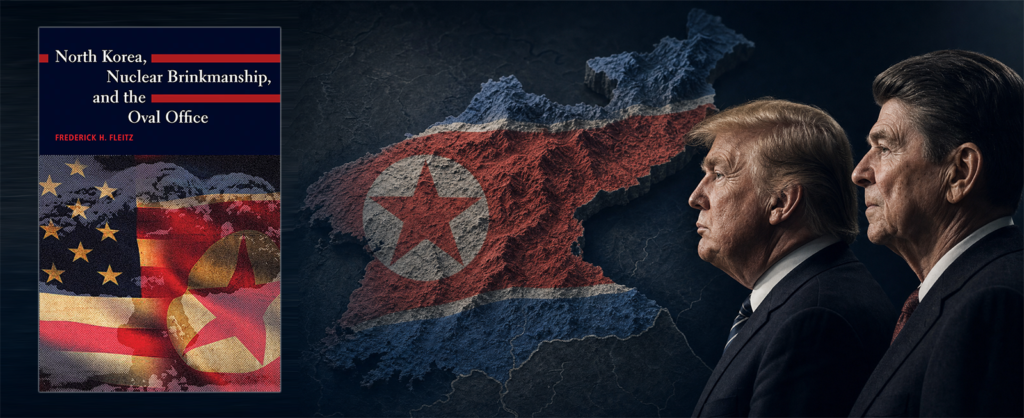
The key takeaway from my America First Policy Institute colleague Frederick Fleitz’ North Korea, Nuclear Brinkmanship and the Oval Office, recently published by Texas A&M University Press, is “Verify—but by no means trust.”
Ronald Reagan understood the nature of the regime he was dealing with—an empire he called “Evil,” and an existential threat to the United States and like-minded countries throughout the world. He also had a clear teleological objective in mind: the collapse of that Evil Empire and Cold War victory.
Too often, we learn from Fleitz’ book, American presidents and negotiators from both Republican and Democratic administrations—at least until the first Trump Administration—failed to understand the nature and intentions of North Korea’s ruling Kim family dynasty. In Fleitz’ blunt assessment, “North Korea has always intended to use its nuclear technology to make weapons.”
In contrast, American negotiators too often project their aspirations onto their negotiating opposites, focusing on obtaining parchment guarantees as career-enhancing, prized baubles. This mindset has led to successive failures—the negotiation process becomes an end in itself, victory measured in terms of commitments (subsequently broken) that at best extend timelines, and concessions made that end up subsidizing what is arguably the most brutal tyranny on the planet, a tyranny that single-mindedly pursued acquisition of Weapons of Mass Destruction (WMDs) and delivery systems capable of threatening adversaries near and far, not least of which has been the United States.
In contrast, the North Koreans have been very consistent in maintaining a three-step approach to nuclear negotiations: Step One—engage in provocative behavior and saber rattling, thereby raising concern levels in capitals; Step Two—obtain concessions, and offer little if anything in return, thereby gaining more concessions; and Step Three—when an agreement is finally brokered, only partially comply, and when counterparts complain, restart the process by renewing provocations.
During the Cold War, the Soviets were said to apply Pavlovian psychology in their approach to negotiations with Americans, such as during the first and second Strategic Arms Limitation Treaty negotiations. Understanding what their American counterparts desired—a deliverable treaty, which could be spun to the voting public as a victory for peace while assuaging nuclear fears—the Soviets would open the door and appear flexible and willing to negotiate, only to then shut the door, creating great angst and agita within the State Department and various administrations (akin to Pavlov’s salivating dogs, per the metaphor), conditioning American negotiators throughout the process and thereby obtaining concessions and controlling outcomes.
Reducing Soviet negotiating tactics to applied Pavlovian psychology always appeared overstated, as competition between the superpowers took place on a global chessboard, where Americans could apply counterpressure and the Soviets would often be forced to make their own concessions, as happened with following the brinkmanship that characterized the Cuban Missile Crisis. However, with North Korea, a country defying global pressure with little to offer whilst plagued by cyclical famine due to blind adherence to Juche ideology—autarky combined with the deification of the ruling Kim family dynasty—viewing tactics through a Pavlovian lens seems almost apt.
Too often American diplomats wound up negotiating against themselves, taking a “carrot and carrot” approach, granting concessions when meeting resistance. Per Fleitz, this characterized the Clinton Administration’s track record when dealing with North Korea, repeatedly cancelling what had largely been annual Team Spirit Exercises with South Korea’s military and offering to help build Light Water Reactors when Pyongyang threatened to withdraw from the Non Proliferation Treaty; it should be noted, however, that the elder Bush Administration also cancelled exercises in 1992. The Clinton team further allowed a loose-cannon interloper—former President Jimmy Carter—to insert himself into negotiations, which locked the Administration into the flawed 1994 Agreed Framework (AF).
In Fleitz’ assessment, the AF, with its “lax” provisions, “was a failure because it gave Pyongyang time to further develop its nuclear weapons program and economic aid that sustained the North Korean regime and funded its WMDs and illegal activities.” James Schlesinger, whose previous record of service included Director of the Central Intelligence Agency (CIA), Secretary of Energy and Secretary of Defense, sardonically quipped at the time “While it was not an unconditional surrender, it was a negotiated surrender.”
Foreign policy realists thus hoped for a change in policy when Republicans took over the White House following the 2000 election. George W. Bush began his first term by labeling North Korea a member of the “axis of evil.” Hawks, including Vice President Dick Cheney, Defense Secretary Donald Rumsfeld and Under Secretary of State John Bolton, pursued a hard line toward the Democratic People’s Republic of Korea, while keeping State Department careerists who had found professional validation in negotiating the misbegotten AF at bay.
That changed, however, in Bush’s second term, when the hawks decamped and blowback from flawed intelligence assessments regarding Saddam Hussein’s WMD program strengthened the bureaucrats’ hands. Fleitz fingers the State Department’s Bureau of East Asian and Pacific Affairs, and Secretary Condoleezza Rice’s appeasement of the bureaucracy, for a softening stance towards repeated North Korean violations and bellicosity. North Korea continued to develop its nuclear program.
The incoming Obama Administration met the growing North Korea threat with ho-hum indifference, focusing attention on negotiations with Iran and downplaying the accelerating development of North Korean nuclear and missile programs. Administration officials would later coin a phrase for this policy: “Strategic Patience,” which aimed at offering Pyongyang, as with Tehran, the carrot of normalized relations.
The Kim regime responded to Administration overtures, including offers by President Barack Obama and Secretary Hillary Clinton to visit North Korea, with increased anti-American vitriol—threatening to engulf Washington DC in a “sea of fire” at one point—and bellicose incidents like the torpedoing of a South Korean vessel that killed nearly half its crew. A “Leap Day” Agreement signed on February 29, 2012, coupled with the ascent of Kim Jong Un—educated at a Swiss boarding school and therefore bearing a presumed openness to the outside world beyond the Hermit Kingdom—brought hope to State Department apparatchiks that there was a deal to be struck that would de-escalate tensions.
Such hopes were dashed within two months, however, when North Korea launched a multi-staged rocket in flagrant violation of the Leap Day Agreement’s missile test moratorium, leading the Obama Administration to withdraw from what had become a dead letter.
The final tally of Obama Administration’s failed Strategic Patience policy: seventy-six missile tests, four nuclear tests, technical advances, and lessened sanctions enforcement, enabling North Korea to better fund its programs.
It is with the first Trump Administration that Fleitz account becomes a primary source for future historians (albeit with a manuscript submitted to the CIA for mandatory vetting, given Fleitz’ former employment with the agency). Writing from the perspective of a national security insider—Fleitz served as John Bolton’s chief of staff at the National Security Council during Trump 1.0—Fleitz recounts what made the Trump approach different. From his (characteristically) brash opening salvos directed at “Little Rocket Man”—a/k/a Kim Jong Un—Trump treated North Korea like the rogue state that it is, and approached negotiations from a position of strength, while at the same time engaging in personal diplomacy that and ego stoking that appeared to charm the heir to the Kim Dynasty.
Confronted in 2017 with Intercontinental Ballistic Missile and apparent hydrogen bomb tests, Trump initiated a maximum pressure campaign; in one meeting Vice President Mike Pence had with an unnamed country that maintained it did not have formal relations with North Korea, Pence pointed out, with granularity, that it conducted $2 million dollars in trade with the Kim regime, asking that that be ended. Chinese and Russian banks which helped the regime evade sanctions and launder funds were also pressured, with China’s Dandong bank sanctioned by the Treasury Department. The U.N. Security Council, with the acquiescence of China and Russia, also passed Resolution 2375, amounting to the “toughest sanctions ever” against North Korea, though the China and Russia softened some of the sharper aspects. “Maximum pressure” meant pressing all buttons simultaneously, short of regime change.
Kim Jong Un opened 2018 by stating that he had a “nuclear button on his desk at all times.” Not to outdone in terms of bravado, Trump replied that he too had a button, but his was “much bigger & more powerful,” plus it actually worked. To which Kim responded not with heightened rhetorical bombast, but with conciliatory gestures, signaling a desire to reduce tensions.
What emerged over the next several months was fascinating, if not dizzying. Both Trump and Kim modulated their rhetoric between signaling cooperation and confrontation, moving towards an on-again, off-again Summit—and it very much was driven by these two large personalities, so much so that the bureaucrats who were expected to arrange these events were often caught off guard and constantly scrambling. Trump’s unpredictability was a diplomatic asset, on whom the Pavlovian playbook would not work, and it led to the two leaders sitting down at the June 2018 Summit in Singapore.
Yet what did the Singapore Summit achieve? For Kim, there were gushing tweets and a promise to cancel military exercises that were scaled back but not fully cancelled. Trump said Kim “trusts me, and I trust him,” but that turned out to be hyperbole. There was a vague promise of denuclearization that was light on details, a general lowering of tensions, and stepping back from the brink. But in terms of implementing the vaguely-worded agreement that was signed, there appears to have been stone-footed reluctance on the part of lower-level North Korean diplomats to actually work towards denuclearization, which had been the ostensible American objective of the Singapore Summit.
Trump and Kim continued to exchange what are often called “love letters”—Fleitz was shown copies by the President, and describes them simply and soberly as “letters between two friendly leaders hoping to improve relations”—which led to the Hanoi Summit in February 2019.
While North Korea offered to shut down the five-megawatt Yongbyon reactor, which had been used to produce plutonium fuel, Bolton, other hawks and in the final analysis President Trump saw the concession as illusory, as by this time North Korea had other nuclear facilities, including one that produced tritium, critical for producing thermonuclear weapons, which the North refused to shut. The President was insisting on complete denuclearization, whereas Kim thought that shutting down Yongbyon would be sufficient in exchange for lifting of sanctions, well short of American expectations. Fleitz states that the parties’ expectations differed so greatly due to the preliminary work done by Special Envoy Stephen Biegun and State Department careerists; their mindsets and middling conceptions of success appeared to revert back to offering concessions in exchange for Agreed Framework-type parchment guarantees. Trump responded as one should when presented with a bad deal; he walked away.
North Korea responded by firing Short Range Ballistic Missiles into the Sea of Japan beginning in May 2019, in apparent violation of U.N. Security Council resolutions. National Security Advisor Bolton criticized the missile launching but was out of step with the negotiating posture of the President, who would meet with Kim Jong Un one more time at the Korean Demilitarized Zone at Panmunjom, followed by promises to continue lower-level negotiations.
By this time, the soon-to-be-fired Bolton was on the outs, and Biegun, the more conventional Special Envoy, led the American effort, but the response from Korean counterparts was lackadaisical at best. COVID, and the 2020 elections, intervened, ending whatever momentum the DMZ meeting had generated.
Thus Fleitz’ scorecard on Trump 1.0 credits his unconventional approach through personal diplomacy as lowering tensions, including delaying North Korea’s nuclear missile testing while negotiations were ongoing. His objective remained complete denuclearization. He considered, but did not offer, concessions; North Korean negotiators thought the old playbook of irascibility and ratcheting up tensions would garner them concessions, as happened in the past, but the Administration remained firm. Fleitz himself questions whether North Korea ever intended to give up its nuclear and missile programs, and speculates that Kim feared Trump and had an interest in lowering tensions. For his part, Trump’s unorthodox approach did create openings where bureaucrats had previously feared to tread.
Fleitz further speculates that had Trump been declared the winner of the 2020 election, there might have been further opportunity to engage constructively with North Korea. That did not happen, and the Biden Administration reverted to “strategic patience,” while the Kim regime expanded its WMD programs.
Fleitz concludes that the North Koreans are determined to acquire and maintain a nuclear arsenal, mindful of the fate of Libyan strongman Muamar Qadaffi when he gave up his arsenal of WMDs in response to Western pressure and guarantees which proved illusory when he was removed from power. North Korea does respect power and exploits weakness, something which the permanent interagency bureaucracy in Washington repeatedly failed to understand, but which the Trump administration did.
Where Trump 2.0 will go with regard to North Korea policy remains to be seen. The President’s choice for ambassador to South Korea, former congresswoman Michelle Steel, had a tenure in congress that was marked by consistent cognizance of the repressive nature of communist regimes and clear-eyed skepticism of promises made by communist rulers. While her arrival in Seoul might create an avenue for reengagement with North Korea, any real initiative would need to come from the President himself, preoccupied as he currently is with the Iran conflict.
Meanwhile, the clearest lesson one can draw from North Korea, Nuclear Brinkmanship, and the Oval Office is that the leadership of Communist North Korea—in other words, no member of the ruling Kim family—can be trusted. Negotiations and any potential agreement should begin from a position of deep skepticism; the nature of the regime being what it is, query whether any deal leading to “denuclearization” in toto is possible. At best, one should recognize that maximum pressure and steely negotiating posture will likely gain some ground in terms of curtailing North Korea’s nuclear ambitions, at least in the short term. Never, however, can one take North Korea’s promises at face value: the policy must be one of distrust, and holding North Korea accountable where it fails to abide by promises or concessions it makes. Long-term, however, the unsettled and unsettling question remains: what ultimately should be the teleological goal when faced with a regime which, to borrow a phrase used by Ronald Reagan to describe the old Soviet Union, truly is evil?


