




Strategy or Semantic Trap?
By David Maxwell
Executive Director of the Korea Regional Review
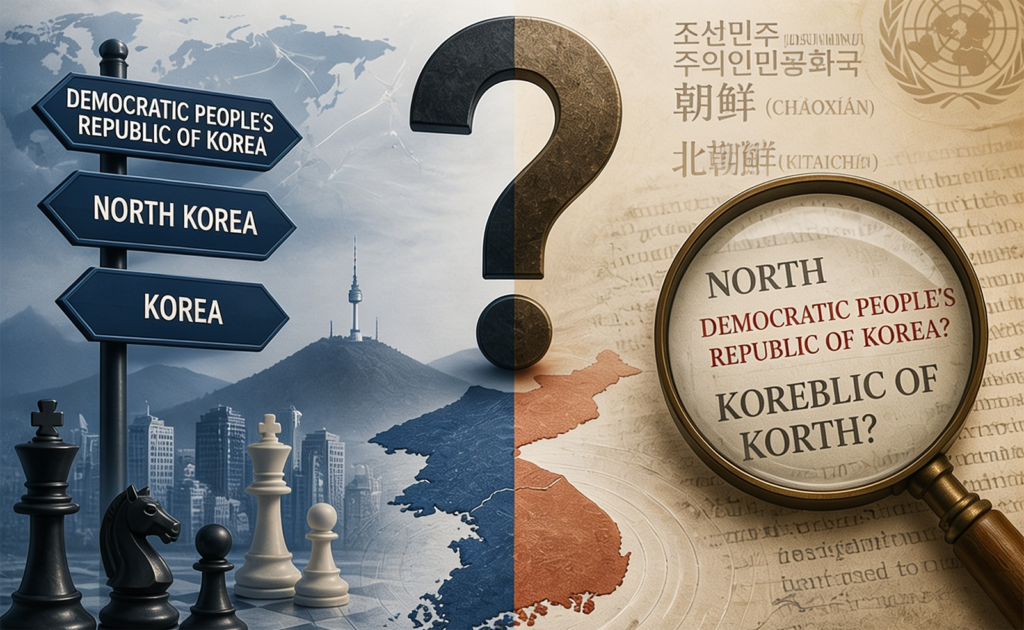
Words matter in strategy. Names frame legitimacy, shape political narratives, and influence how governments, populations, and the international community understand a conflict. The recent debate in South Korea over whether to refer to north Korea by its official name, the Democratic People’s Republic of Korea (DPRK), rather than the commonly used “North Korea,” therefore deserves far more attention than a simple discussion of diplomatic etiquette. It raises a fundamental strategic question. Is adopting official nomenclature a pragmatic step to facilitate dialogue, or does it unintentionally reinforce Kim Jong Un’s effort to institutionalize permanent division on the Korean Peninsula?
The issue has gained prominence following polling by South Korea’s Ministry of Unification and Senior Vice Chairman Kang Chang-il’s call for the reciprocal use of official state names. Supporters argue that mutual respect in terminology could reduce tensions and create conditions for renewed dialogue. They contend that diplomacy often begins with symbolic gestures and that acknowledging official names does not necessarily constitute legal recognition or acceptance of an adversary’s political system.
This argument deserves careful consideration. Diplomacy frequently requires engagement with hostile regimes. Governments routinely negotiate with adversaries whose legitimacy or internal practices they reject. The United States maintained dialogue with the Soviet Union without endorsing communism. It negotiated with the People’s Republic of China decades before normalization. Practical diplomacy often demands separating communication from political endorsement.
Yet the Korean Peninsula presents a profoundly different strategic context.
Kim Jong Un has fundamentally altered the political framework governing inter-Korean relations. His abandonment of peaceful unification, constitutional revisions declaring the Republic of Korea a hostile foreign state, destruction of symbols of reconciliation, and embrace of a permanent “two hostile states” framework represent one of the most consequential strategic shifts in decades. These actions are not rhetorical flourishes. They constitute an integrated political warfare campaign designed to redefine the Korean question itself (as defined in paragraph 60 of the 1953 Armistice Agreement).
Within this context, terminology becomes part of the battlefield.
If Seoul begins routinely referring to the regime exclusively by its official state title while Pyongyang continues advancing the narrative that two sovereign Korean states permanently exist, then language risks becoming an instrument supporting Kim’s strategic objectives rather than advancing South Korea’s.
This is precisely why debates over nomenclature cannot be divorced from broader national strategy.
The Republic of Korea’s Constitution does not recognize permanent partition. Article 3 defines the territory of the Republic of Korea as encompassing the entire Korean Peninsula and its adjacent islands. Article 4 commits the Republic to pursuing peaceful unification based on freedom and democracy. These constitutional principles are more than legal technicalities. They express the moral and political foundation of the Republic itself.
Recognition and respect for the north Korean political system as a permanent and legitimate national alternative risks undermining these constitutional commitments. More importantly, it risks abandoning the 26 million Koreans living under one of the world’s most repressive dictatorships.
This distinction is essential.
Respect for the Korean people living in the North should never be confused with respect for the Kim family regime. The former is a moral obligation. The latter is a political choice with profound strategic consequences.
The Kim regime has consistently sought international recognition not simply as a government exercising de facto control over territory, but as the permanent representative of a separate Korean nation. That objective serves multiple purposes. It weakens the legitimacy of the Republic of Korea’s constitutional claim to national unity. It diminishes international attention to the regime’s systematic human rights abuses. It reframes the Korean issue as one of coexistence between two equal states rather than one of liberation, reconciliation, and eventual reunification.
Language can either reinforce or resist that narrative.
This is why the growing body of “Voices for Unification” essays offer an important alternative framework. Rather than treating division as permanent, these essays consistently emphasize the Korean Dream of a free and unified Korea. They begin with the premise that all Koreans belong to one nation whose division resulted from history, foreign intervention, and dictatorship rather than the existence of two separate national identities.
Within this framework, terminology should support long-term strategic objectives rather than merely facilitate short-term diplomatic engagement.
This does not require abandoning diplomacy. It requires conducting diplomacy from a position of strategic clarity.
South Korea should remain prepared to negotiate with Pyongyang whenever conditions warrant. It should continue humanitarian engagement where appropriate. It should maintain military deterrence while leaving open the possibility of dialogue. None of these objectives requires accepting Kim Jong Un’s redefinition of the Korean question.
Indeed, history suggests the opposite.
During the Cold War, West Germany maintained engagement with East Germany while never abandoning the long-term objective of national unity. Ostpolitik sought practical cooperation without surrendering the larger political vision that Germany remained one nation. The lesson is not that the Korean Peninsula perfectly mirrors Germany. Rather, it demonstrates that diplomacy and strategic principle can coexist when policymakers clearly distinguish tactical engagement from enduring national objectives.
South Korea should adopt a similar approach.
Any discussion of official nomenclature should be evaluated through a simple strategic test. Does it strengthen or weaken the long-term objective of achieving a free and unified Korea?
If adopting official terminology merely improves diplomatic communication while preserving Seoul’s constitutional commitment to unification, then it may be manageable. If, however, it gradually normalizes Kim Jong Un’s “two-state” narrative, legitimizes permanent division, or erodes international support for eventual unification, then it becomes a strategic liability rather than a diplomatic asset.
The debate, therefore, is not fundamentally about vocabulary.
It is about national strategy.
The Korean Peninsula remains divided not because two Korean nations naturally evolved, but because one Korean people continue to live under radically a different political system under the rule of the Kim family regime. The Republic of Korea should never lose sight of that distinction. Strategic patience, diplomatic flexibility, and precise language all have their place. But they must remain subordinate to a larger vision.
It is also imperative to call attention to the fact that the official name of north Korea is both a lie and a contradiction. It is no way democratic. It does not belong to the people, nor does the regime care about the welfare of Koreans in the north or the South. As a dictatorship it does not have checks and balances or separation of powers thus contradicting the name republic. The only word in the name that is the truth is Korea. However, the only way to honor that word is by a achieving a free and unified Korea.
Lastly, adopting the official name of the north and accepting a two state arrangement in the name of “peaceful co-existence” means the abandonment of 26 million Koreans in the north and sentencing them to a life of suffering that can only be described as a crime against humanity.
The ultimate objective should not be managing permanent division more politely. It should be creating the conditions under which all Koreans can eventually live together in freedom, peace, and dignity under a unified democratic state. Every policy, every diplomatic initiative, and every word should be judged by whether it advances or delays that enduring national purpose.
David Maxwell, executive director of the Korea Regional Review, is a retired U.S. Army Special Forces colonel who has spent more than 30 years in the Asia Pacific region. He specializes in Northeast Asian security affairs and irregular, unconventional and political warfare. He is vice president of the Center for Asia Pacific Strategy and a senior fellow at the Global Peace Foundation, where he works on a free and unified Korea. After he retired, he became associate director of the Security Studies Program at Georgetown University. He is on the board of directors of the Committee for Human Rights in North Korea and the OSS Society and is the editor at large for the Small Wars Journal.


