




Where Is Seoul’s Information Control Heading?
By Hyun-seung Lee
Director of Policy & External Affairs, The Korea Signal
On June 9, 2025, South Korea’s Ministry of Unification issued a forceful demand to civic organizations: stop sending anti-North Korea leaflets across the border. It was the fifth day after President Lee Jae-myung had taken office. Two days later, at 2 p.m. on June 11, the president ordered the military to halt the loudspeaker broadcasts it had been directing toward North Korea. The order ended broadcasts that had resumed fifteen years earlier, following North Korea’s sinking of the South Korean warship Cheonan in 2010.
In early July, the National Intelligence Service shut down radio and television broadcasts it had transmitted into North Korea for more than half a century. The radio services went off the air one after another, and the television broadcasts ended completely at midnight on July 14, after the South Korean national anthem played for the final time. Unlike the military’s loudspeakers, which successive governments had installed and removed depending on their political orientation, the National Intelligence Service’s broadcasts to North Korea had continued for fifty years regardless of who governed in Seoul. At 10 p.m. on August 31, the “Voice of Freedom” also ended its broadcasts. Of the radio services operated by the South Korean government and public institutions for North Korean audiences, only KBS Hanminjok Radio remained.
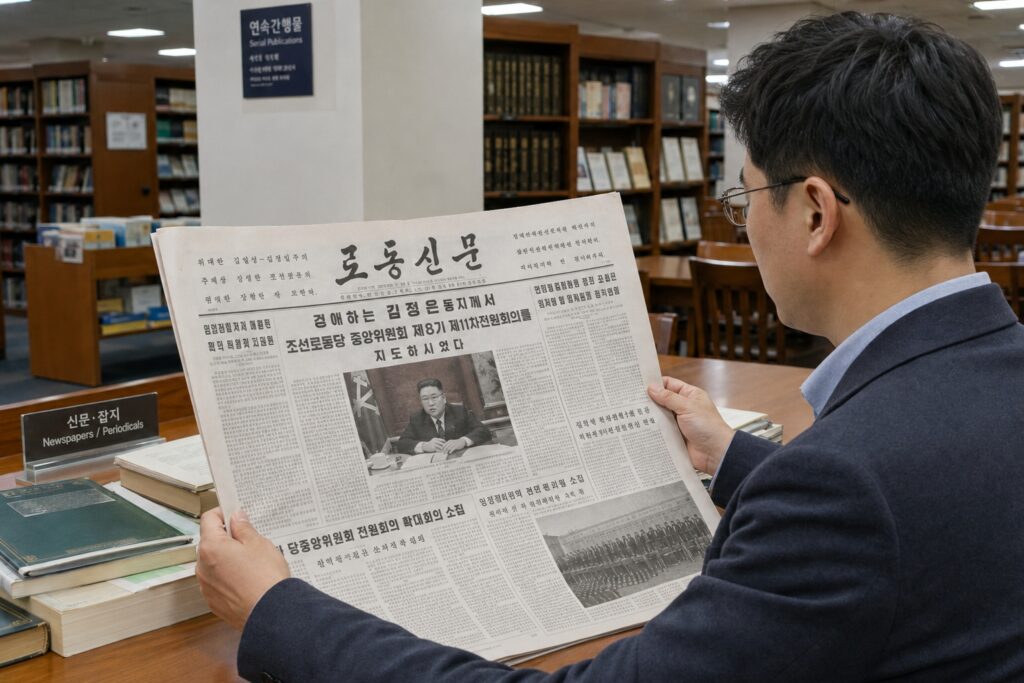
During the same period, the government opened a door in precisely the opposite direction. On December 30, 2025, the Ministry of Unification reclassified the Rodong Sinmun, the official newspaper of the Central Committee of the Workers’ Party of Korea, from restricted special material to general material, lifting access controls that had remained in place since 1970. Until then, the newspaper had been kept in closed archives and could be reviewed only for media reporting or academic research after the submission of a written pledge or formal application.
Now, anyone can enter the National Library of Korea, the National Assembly Library, national university libraries, and approximately 180 other institutions, read the Rodong Sinmun without any formal procedure, make copies, and take those copies outside. The decision came eleven days after the president said during a Ministry of Unification policy briefing that reading the Rodong Sinmun did not turn a person into a communist. During the same briefing, the president also ordered that Korean Central Television be opened to the South Korean public.
One point must be stated clearly. The Rodong Sinmun is not journalism. It is the official organ of the Central Committee of the Workers’ Party of Korea and exists to praise the supreme leader and the party. Whatever journalistic function it may once have performed disappeared long ago. Its pages are filled with honorifics such as “respected” and “great.” It conducts no independent reporting, performs no factual verification, and possesses no editorial autonomy. This is precisely what Reporters Without Borders described when it ranked North Korea 179th in the world.
Every media outlet in North Korea operates under the censorship and control of the Workers’ Party. Reporting is permitted only when it praises the party and its leadership, making independent journalism virtually impossible. South Korea’s vice minister of unification explained that the decision was intended to move away from a system in which state institutions monopolized and filtered North Korean information, allowing citizens instead to compare the information themselves and reach their own judgments. But what the government opened to the public was not independently reported and verified information about North Korea. It was propaganda produced to glorify Kim Jong Un and the Workers’ Party.
A further measure remains under way. The Ministry of Unification announced that it is seeking to lift access restrictions on approximately sixty North Korean websites, including the Rodong Sinmun and the Korean Central News Agency, and that it will work with the National Assembly to revise the Information and Communications Network Act, which provides the legal basis for blocking those sites. That same law already allows damages of up to five times the amount of actual harm, as well as administrative fines of up to 1 billion won, to be imposed for statements South Koreans make online. Yet the government now intends to revise other provisions of that law so that anyone in South Korea can access the Rodong Sinmun and the Korean Central News Agency, which have until now been blocked. The government is imposing heavier legal responsibility on the online statements of South Korean citizens while removing access restrictions on propaganda produced directly by the Kim Jong Un regime. Meanwhile, when civic organizations attempted to send outside information to North Koreans through leaflet campaigns, the state responded with police power. Border areas, including Imjingak, were designated as danger zones under disaster and safety legislation. Restriction notices were posted prohibiting the balloons and helium tanks used to send leaflets into North Korea. Police announced that they would investigate attempted leaflet launches under the Aviation Safety Act and other laws, and hundreds of officers were deployed to the sites. Last month, an amended Police Duties Execution Act also took effect, giving police explicit legal authority to stop leaflet-related activities in border areas. The head of an organization representing the families of South Koreans abducted by North Korea said that the leaflet campaign was an act of expression protected by the Constitution and vowed to proceed. That claim was physically blocked.
The False and Manipulated Information Law
On July 7, 2026, the state turned its attention toward its own citizens. The amended Information and Communications Network Act, widely referred to as the “False and Manipulated Information Law,” took effect. The law permits damages and administrative fines to be imposed when online posts, videos, or statements made by South Koreans are judged to constitute false or manipulated information.
The government explained that ending broadcasts to North Korea was intended to reduce tensions on the Korean Peninsula, opening the Rodong Sinmun served the public’s right to know, blocking anti-North Korea leaflets protected the safety of border-area residents, and revising the Information and Communications Network Act provided relief for victims of false information. Yet over the past thirteen months, broadcasts sending outside information to the North Korean people were shut down one after another. Hundreds of police officers were deployed to stop civic organizations from launching leaflets into North Korea, and a new legal basis was established to block those activities. At the same time, the government opened the Rodong Sinmun after fifty-five years of restricted access and began pursuing the removal of access restrictions on North Korean websites, including the Rodong Sinmun and the Korean Central News Agency. Propaganda produced by the Kim Jong Un regime was opened to the South Korean public, while outside information intended for the North Korean people was blocked and heavier legal responsibility was imposed on the online statements of South Korean citizens.
The amended Information and Communications Network Act is Law No. 21305. It passed the National Assembly in December 2025 solely with the votes of the ruling party after the opposition’s filibuster was forcibly brought to an end. The law was promulgated on January 6, 2026, and took effect on July 7.
The law created two categories that had not previously existed in South Korean law. Content that is wholly or partially inconsistent with fact is classified as “false information.” Content edited or altered in a manner that causes it to be mistaken for fact is defined as “manipulated information.” The two categories are collectively described as “false and manipulated information.”
When a publisher knows that material constitutes false or manipulated information but posts or distributes it for the purpose of harming another person or obtaining an improper benefit, and actual harm results, a court may order damages of up to five times the amount of the actual loss. Under the draft enforcement decree, this provision applies to individuals with more than 100,000 subscribers or more than 100,000 average monthly views. If a person repeatedly distributes material that a final court judgment has determined to be unlawful, an administrative fine of up to 1 billion won may also be imposed.
Platforms with more than one million average daily users, including Naver, YouTube, Instagram, and Google, must operate reporting channels and may delete or block content, limit its visibility, or suspend accounts. They must also establish self-regulatory policies and publish transparency reports. Article 44-7, Paragraph 1, Subparagraph 2-2 classifies as illegal information any material that incites violence or discrimination or seriously promotes hatred on the basis of race, nationality, region, sex, disability, age, social status, income, or property. The opposition floor leader denounced the legislation as an “online gag law” and a modern-day sineonpae, referring to the plaques that tyrants during the Joseon Dynasty forced officials to wear in order to silence them. Criticism online was considerably harsher.
Ambiguity Itself Is a Tool of Control
The most serious problem with the law is not merely the severity of its penalties. It is the absence of clear standards for determining what will be treated as false information or manipulated information in actual enforcement.
The law requires authorities to determine whether a publisher knew that information was false or manipulated and whether the publisher intended to harm another person or obtain an improper benefit. In actual reporting and commentary, however, it is difficult to draw a clear line between an error arising during the reporting process, an interpretation of fact, and deliberate manipulation. It may also become a matter of dispute whether an article that reports some facts while omitting other central issues should be treated as manipulated information, or how a column that interprets or criticizes government statistics differently should be judged.
These questions will ultimately be settled through individual lawsuits and court decisions. But until a court issues a final ruling, news organizations, YouTubers, and individual writers must bear the cost of litigation and the possibility that their accounts will be suspended. Large media companies and corporations can absorb the cost of legal defense. Local newspapers and one-person media operations cannot. For them, the lawsuit itself becomes a substantial burden.
What happens during that process is already known. People retreat toward the safer choice. Lawyers describe this as a chilling effect, and its defining characteristic is that it never fully appears in statistics. Deleted posts can be counted, but articles that were never written cannot. A YouTuber who loses a lawsuit can be identified, but a subject quietly abandoned out of fear of litigation cannot. The clearest evidence that the boundaries of expression have narrowed always appears in the form of what no longer exists.
The law also places the first judgment about false and manipulated information in the hands of major platforms such as Google and Naver. Companies seeking to avoid legal liability and regulatory risk are more likely to delete or block controversial material than to conduct a full examination of the underlying facts. If platforms reach different judgments, identical content may be permitted on one service and removed from another.
The ruling party says the law was modeled on the European Union’s Digital Services Act. But the European law focuses primarily on imposing procedural obligations on platforms responding to content that has already been defined as illegal. South Korea’s law, by contrast, creates a new category of false and manipulated information, imposes punitive damages and administrative sanctions, and strengthens the direct review and enforcement authority of the Broadcasting, Media and Communications Commission. The two laws differ both in what they regulate and in how they are enforced.
There will also be a disparity in who is capable of using the law. Major corporations and senior public officials can afford litigation expenses and lengthy legal proceedings. Local newspapers, one-person media organizations, and newly established investigative outlets cannot. When complaints and lawsuits are repeatedly directed at a particular publication or individual, the target can be forced to spend considerable time and money long before any final judgment is reached.
The new law requires a complainant to identify the location of the disputed content, explain specifically why it should be considered false or manipulated, and provide supporting evidence. But it contains no adequate mechanism to deter organized reporting campaigns directed at a particular publication or individual. The time and expense required to respond to repeated complaints can themselves become a form of punishment.
On the day the law took effect, Prime Minister Han Seong-sook said the government would respond firmly to clear falsehoods and unlawful conduct while protecting criticism and freedom of expression to the greatest extent possible. There is no reason to doubt the sincerity of that statement. But institutions should not be designed on the assumption that those exercising power will always act in good faith. Even if today’s government uses this authority with restraint, the authority created by the law will pass unchanged to the next administration, and then to the administration after that. Those who defend the law today may find themselves subjected to the same law when political power changes hands.
How North Korea Silences Its People
North Korea stands as a warning whenever the erosion of freedom of expression in South Korea is discussed. In its 2026 World Press Freedom Index, Reporters Without Borders ranked North Korea 179th out of 180 countries and gave it a score of 12.67 out of 100. Only Eritrea ranked lower.
The reason North Korea must be examined is simple. It is a laboratory that displays, in its purest form, how information control actually works.
Every smartphone in North Korea comes with an application called “TraceViewer” installed by default. While the phone is turned on, the application randomly captures screenshots and saves the images in a directory the user cannot delete. A change in recent versions is particularly revealing. In earlier versions, users could view the captured images. In the version installed on newer devices such as the Pyongyang 2425, they cannot. Only icons marked with timestamps remain, and nothing happens when the user presses them.
The meaning of this design deserves close attention. It does not matter whether the authorities possess the personnel and computing capacity required to review thousands of screenshots. The purpose of the system is not to monitor every person in practice. Its purpose is to make people aware that they are being monitored. Enforcement can be rare. Behavior changes simply because people do not know what has been recorded or when the record may be used against them. Control functions most effectively not when it is constantly enforced, but when no one can predict when enforcement will occur.
Survey findings showing that North Korean residents do not know the precise provisions of the Reactionary Ideology and Culture Rejection Act must be understood in the same context. According to field reporting by Daily NK, residents receive no proper education about the law’s provisions or human-rights standards. Instead, they internalize fear of punishment through the state’s ideological education. Arrest and punishment often proceed without warrants, notification of family members, or access to legal counsel. The widespread use of bribery and arbitrary discretion among enforcement personnel destroys any possibility of procedural fairness. Ambiguity is not a defect in that system. It is one of the functions that makes the system work.
North Korea’s punishments, of course, exist on an entirely different level. The Reactionary Ideology and Culture Rejection Act, enacted in December 2020, punishes the viewing or distribution of content from South Korea, the United States, and Japan. Under Article 27, a person who distributes such material may be sentenced to life imprisonment or death. A 2015 amendment to the criminal code increased the maximum term of labor reeducation for viewing or distributing outside content from four years to ten years. When cumulative sentencing is applied, the term can reach fifteen to twenty years. In November 2021, secondary-school students in Chongjin, North Hamgyong Province, were caught watching Squid Game. The Youth Education Guarantee Act of 2021 and the Pyongyang Cultural Language Protection Act of 2023 expanded the range of punishable conduct to include hairstyles, clothing, and speech patterns. Research published by 38 North has documented that facial-recognition technology is being used and that biometric databases containing photographs and fingerprints are being constructed.
South Korea’s Information and Communications Network Act cannot be equated with all of this.
But one fact deserves to be placed beside another. What North Korea has attempted to block with such elaborate equipment and systems is outside broadcasting signals and foreign media. Pyongyang devoted resources to radio jamming for decades because the inflow of information was effective. It embedded censorship software at the level of the mobile operating system and wrote the death penalty into the Reactionary Ideology and Culture Rejection Act. Seoul closed those channels itself. What the North Korean authorities spent half a century trying to stop, the South Korean government ended through a single administrative decision.
The exchange was one-sided. While North Korea continued to block South Korean broadcasts and outside information, the South Korean government opened the doors of North Korean Workers’ Party organs and propaganda media to its own citizens. North Korea, meanwhile, intensified its efforts to block South Korean culture through the Reactionary Ideology and Culture Rejection Act, the Youth Education Guarantee Act, and the Pyongyang Cultural Language Protection Act. In December 2023, North Korea redefined inter-Korean relations as a relationship between two hostile states at war. Commentators in Seoul also pointed to this imbalance. One side can now distribute its propaganda newspaper to the other side’s public, while citizens on the other side can receive sentences of labor reeducation merely for watching a single South Korean drama. Whether this was a wise decision is a separate debate. What is clear is that this series of decisions did not arise from any consistent principle of freedom of expression or freedom of information.
A theme appears repeatedly in the testimony of North Korean defectors. What they remember is not a single moment when everything was suddenly prohibited. They remember the process by which they gradually learned to silence themselves in a state where no one could say precisely what was dangerous. Control is not completed through orders alone. It is completed through calculation. Am I permitted to say this? Is this much still safe? Is it worth taking the risk? Once that calculation becomes habitual, direct coercion is no longer necessary.
That is why I fear South Korea’s new law could regress into a form resembling North Korean control. The law requires precisely this type of calculation from citizens and the press. The figures—five times the amount of actual damages and an administrative fine of 1 billion won—are already operating regardless of whether the penalties are ever imposed. They are operating inside the mind of the person deciding whether to publish a particular article.
Why This Is an American Problem
If Washington classifies this issue as a matter of South Korea’s domestic politics, it will be making a serious miscalculation.
First, the issue is already a bilateral matter. On July 8, the U.S. Department of State issued a statement through its spokesperson expressing serious concern that the amended law could lead to excessive content regulation and weaken freedom of expression. The department added that South Korea should not impose excessive burdens on American companies and should not use enforcement of the law as a means of requiring censorship of protected speech. Under Secretary for Public Diplomacy Sarah Rogers raised the same concerns during a visit to Seoul in April. The United Nations special rapporteur on freedom of expression publicly stated that the new law was being closely monitored, and the International Press Institute criticized the legislation in January, warning that its central concepts were so vague that they would make it easier for powerful figures to take action against the press. With friction already growing over the Coupang personal-data breach, this law may become another point of conflict.
Second, the issue concerns the credibility of North Korea policy. Washington has treated access to information for the North Korean people as a central pillar of its human-rights policy and has transmitted broadcasts into North Korea through what is now the U.S. Agency for Global Media since the 1940s. The premise of that policy is that the inflow of outside information is one of the least violent and least costly means available to change North Korean society. Yet the ally that should share that premise ended its own broadcasts, which had operated for half a century, within a matter of weeks. It did so quietly. This was less a policy adjustment than an abandonment of the premise itself. When the United States defends the budget and legitimacy of its North Korea information programs, the fact that Seoul has halted comparable activities and is using police power to stop its own citizens from attempting them raises a practical question about how reliable an ally South Korea will remain as a liberal democracy.
When domestic legislation is added to this record, the problem spreads across South Korea’s broader human-rights diplomacy. The further Seoul moves toward using state authority to determine the boundaries of its own public debate, the more Pyongyang will exploit those actions as propaganda assets. It will not take long before North Korean commentary begins citing South Korea’s “gag law” to relativize and excuse the North’s own controls. The value of human-rights diplomacy comes from consistency, and consistency comes from principle. A precedent already exists. When the anti-leaflet law was enacted in 2020, American figures, including Suzanne Scholte, publicly described it as a crackdown on North Korean human-rights organizations. When the Ministry of Unification revoked the legal incorporation of two organizations led by North Korean defectors, voices in the United States asked whether South Korea was still the democracy Americans had known. The question raised then was never resolved. It is merely appearing again.
Third, there is the question of precedent. Governments across Asia are considering legislation in the name of combating false information. Many of those countries do not possess judicial-review systems as strong as South Korea’s or a press as active as South Korea’s. A law enacted by one of Asia’s most mature democracies becomes, by itself, an exportable model. Whatever justification Seoul offers, governments with far weaker institutional checks will cite the same justification.
Fourth, there is the issue of American companies. The threshold of one million average daily users effectively targets Google, Meta, YouTube, and Instagram. Under South Korean law, these companies are now placed in the position of making the first judgment about the legality of expression. This is a trade issue, but it is also a matter of principle.
It Must Be Corrected While It Can Still Be Reversed
The concern arising from Seoul’s actions is not their final destination, but the fact that the measures are accumulating. The suspension of broadcasts to North Korea was treated as a national-security policy. Opening the Rodong Sinmun was treated as an issue of the public’s right to know. Restrictions on anti-North Korea leaflets were treated as a matter of protecting residents in border areas. The Information and Communications Network Act was treated as consumer-protection legislation. Examined separately, each explanation may appear plausible. But when all four decisions are placed along the same axis, their common feature becomes visible. In four decisions concerning what may leave the country, what may enter it, what citizens may send, and what citizens may say to one another, the authority to make the judgment moved to the government.
The worst condition South Korea could reach is not necessarily North Korea. It may be something far more ordinary: a country where journalists first examine the political climate before filing an article; where a platform receiving a complaint chooses deletion instead of disputing the facts; and where citizens think first about administrative fines and the possible loss of their accounts before publishing a post. In such a country, no one calls it censorship because no one is arrested. No democracy closes its doors in a single night.
There is not much time. The actual reach of the law will be determined not by the text of the statute but by its earliest court precedents. The enforcement record established during the first one or two years will draw the boundaries applied for decades to come, and that period has already begun. The direction of revision is also clear. The definitions of “false” and “manipulated” information should be limited to verifiable factual claims, while opinion and satire should be explicitly excluded. Final judgment should be made by courts, not platforms. A sunset provision should also be added, requiring the National Assembly to reassess the results of this experiment on a specified date.
A democracy remains a democracy when it can acknowledge the consequences of the laws it has enacted and reverse them. Freedom of expression does not collapse in a single moment. That is precisely why defending it is not a single act of resolve, but a continuing series of choices. Seoul still has an opportunity to choose. Washington’s responsibility is not to remain silent while that choice is being made.
Hyunseung Lee is a North Korean escapee, human rights advocate, and lead strategist at the Global Peace Foundation, where he works on North Korea policy, human rights, and Korean unification. He is the founder of the North Korean Young Leaders Assembly and has advised the U.S. government and policy community as a consultant on North Korean affairs. Before defecting in 2014 amid a wave of severe regime purges, Lee held significant roles in North Korea’s shipping and mining sectors, facilitating trade between North Korea and China, and served as a sergeant in the special forces of the Korean People’s Army. He is a regular contributor to United Press International (UPI), Voice of America, and Radio Free Asia, among other global media outlets. Lee holds a bachelor’s degree in international trade and economics from Dongbei University of Finance and Economics in China and a master’s degree in public administration from Columbia University.


