




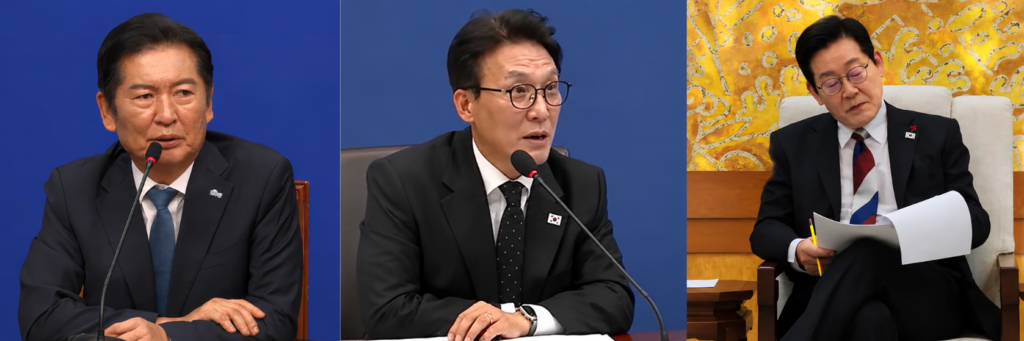
The Internal War Among Pro–North Korean and Pro-Beijing Forces That Could Bring Down the Lee Jae-myung Regime
By Young-il Kwon
Editorial Writer, News and Post
Politics is commonly understood as a contest between “our side” and the enemy. The history of power, however, tells a different story. Great concentrations of political power are often brought down far more disastrously by internal fractures than by attacks from outside. The more impregnable a fortress appears after being built through dictatorship and arrogance, the more likely it is to fall not to artillery fired from beyond its walls, but to mistrust and blades emerging from those closest to power.
The death of Julius Caesar, which marked the end of the Roman Republic, came not at the hands of a foreign enemy but at the point of daggers wielded by his fellow senators. Joseph Stalin, who exercised absolute power, feared his own associates and rivals more than enemies abroad and purged anyone who might one day threaten his rule. Mao Zedong likewise eliminated Liu Shaoqi and Lin Biao, both of whom had helped him establish the Communist regime in China.
Power tends to consolidate when it is attacked from the outside. But once power must be divided, those closest to it become the first objects of suspicion. When a common enemy disappears and competition begins over the presidency, party leadership, candidate nominations, and control of the next government, yesterday’s allies become today’s rivals, and today’s rivals become tomorrow’s targets for elimination.
That same paradox of power is now being reenacted inside the Lee Jae-myung government.
Barely more than a year after taking power, the forces that rose alongside Lee Jae-myung have begun turning their weapons on one another. The battle between Jeong Cheong-rae and Kim Min-seok for control of the Democratic Party is not simply another leadership election. It is an internal war among the anti-American activist forces that have sustained the Lee government, each seeking control of the party organization, the nomination process for the 2028 general election, and the political succession after Lee Jae-myung.
The Lee Jae-myung regime is therefore beginning to fracture from within, as pro–North Korean and pro-Beijing forces inside its own power structure enter a struggle to eliminate one another.
Lee Jae-myung’s Coalition Splinters Barely a Year After Taking Power
The Democratic Party will elect a new party leader on August 17. Jeong Cheong-rae stepped down as party chairman on June 24 to prepare for a bid for another term. Kim Min-seok, who served as the first prime minister of the Lee Jae-myung government, also left office and declared his candidacy for party leader on July 6. On the first day of his campaign, Kim attacked Jeong’s leadership over the previous year as an example of the “harm caused by self-serving politics” and called instead for “perfect unity between the party and the government.”
The phrase “perfect unity between the party and the government” may sound reasonable. Its actual meaning is far more dangerous. Kim Min-seok, Lee’s first prime minister, is seeking control of the ruling party so that the Presidential Office can directly dominate not only the executive branch but also the Democratic Party’s organization, legislative agenda, elections, and candidate nominations.
Should Kim win the party leadership, the president’s closest political ally would take control of the Democratic Party itself, reducing the party to a legislative and electoral organization devoted to strengthening Lee Jae-myung’s personal power. That would complete the construction of a Lee Jae-myung dictatorship in South Korea.
If Jeong Cheong-rae wins another term, however, the Presidential Office’s attempt to take full control of the party will face a serious obstacle. Jeong has repeatedly described himself and Lee as members of a “political community bound by a shared destiny.” But he has no intention of handing over the militant party members, organizational machinery, and nomination authority he has consolidated to Kim Min-seok.
Jeong has publicly professed loyalty to Lee, but there has long been a clear current of mutual restraint and suspicion between the two men. Jeong has now entered this fight to prevent the president’s closest ally from taking the party leadership and destroying the political base he has built for himself.
This convention is therefore not an election to determine which candidate is more loyal to Lee Jae-myung. It is a fierce internal struggle over whether Lee will complete his dictatorial control of the party through Kim Min-seok or whether Jeong Cheong-rae, with ambitions of his own for the next stage of power, will retain control of the Democratic Party organization.
If Kim wins, Jeong’s faction will face the prospect of losing control of candidate nominations. If Jeong wins, Lee’s plan to place Kim at the head of the party, seize complete control of the Democratic Party, and build an autocracy will fail. Yet regardless of which side wins, the pro–North Korean and pro-Beijing forces inside the party will remain.
This struggle will not be settled when the convention ends. It is more likely to develop into an even harsher fight for political survival.
Men Linked to the Occupation of the U.S. Information Service and the U.S. Ambassador’s Residence
To understand the character of this struggle for party control, one must first examine the political histories of Jeong Cheong-rae and Kim Min-seok.
Neither man is an ordinary politician who simply rose through the ranks of the Democratic Party. Both were central participants in the anti-American student movement of the 1980s. Both were convicted in connection with the occupation of American facilities, either by participating directly or by supporting those involved.
In 1985, Kim Min-seok was sentenced to five years and six months in prison on charges that included supporting the occupation of the U.S. Information Service building in Seoul. Kim has maintained that he did not personally enter the building or participate in the occupation itself. He cannot, however, deny that as president of the Seoul National University Student Council and chairman of the national student coalition, he received information about the progress of the occupation and helped prepare subsequent support rallies and outside activities.
Kim Min-seok’s older brother, Kim Min-woong, has also led anti-American demonstrations and attacks on the United States while serving as the standing representative of Candlelight Action. He has openly attacked President Trump and the U.S. government in street demonstrations and on social media and has been identified by South Korean conservatives as a prominent anti-American and pro–North Korean activist.
More recently, Kim Min-woong provoked controversy by publishing a post openly mocking the Trump administration’s request for allied countries to deploy naval vessels. He has described the U.S.–South Korea alliance as a mechanism for subordinating South Korea to American imperialism and has even published calls to “drive Yankee imperialism out of this land.”
Jeong Cheong-rae, meanwhile, was a member of the “Anti-American National Salvation Corps,” a group affiliated with Jeondaehyop, the National Council of Student Representatives. In 1989, he led the occupation of the residence of the U.S. ambassador to South Korea and was sentenced to two years in prison on charges that included violating the National Security Act.
The criminal record Jeong submitted to the National Election Commission also lists convictions for causing bodily injury while obstructing officials performing special public duties, preparing to set fire to an occupied structure, and violating laws governing the use of Molotov cocktails.
In 2013, Jeong was unable to participate in a National Assembly Foreign Affairs and Unification Committee inspection of South Korean diplomatic missions in the Americas because he was not issued a multiple-entry visa to the United States. The U.S. government did not disclose an official reason for the decision, but diplomatic sources at the time suggested that his role in the 1989 occupation of the U.S. ambassador’s residence may have affected the visa determination.
Both men now fighting for control of the Democratic Party therefore trace their political roots to the anti-American activist movement of the 1980s, which attacked the U.S.–South Korea alliance. Kim Min-seok, who supported the occupation of the U.S. Information Service, and Jeong Cheong-rae, who led the occupation of the U.S. ambassador’s residence, are now fighting one another for control of South Korea’s ruling party, its legislative authority, and its nomination power in the 2028 general election.
Jeong’s political record has more recently included openly pro-Beijing positions. He described Lee Jae-myung’s remarks concerning the “One China” principle as “an extremely strategic and important statement” and declared that the Democratic Party shared the same position.
In 2025, Jeong also argued that Lee Jae-myung should attend China’s Victory Day commemorations, openly revealing his position as a pro-Beijing politician.
It is therefore not an unfounded ideological attack when conservatives describe Kim Min-seok as an heir to South Korea’s anti-American and pro–North Korean activist tradition and Jeong Cheong-rae as a politician whose anti-American past has been followed by an increasingly pro-Beijing political agenda.
If Kim wins, Lee Jae-myung’s closest ally will take control of the Democratic Party and complete Lee’s dictatorial system. If Jeong wins, the Presidential Office will no longer be able to disregard the militant party members and organizational machinery under his control.
Jeong’s support for the “One China” principle and his favorable position toward Beijing could then be reflected more strongly in Democratic Party policy and government decisions, creating wider channels through which China could expand its influence over South Korean politics.
South Korea therefore stands at a critical crossroads. Will Lee Jae-myung complete his monopoly over political power through Kim Min-seok, or will Jeong Cheong-rae take control of the Democratic Party organization, force Lee to share power, and further strengthen the party’s pro-Beijing direction?
Washington must closely watch the fact that anti-American, pro–North Korean, and pro-Beijing forces have now begun fighting for control of the core institutions of the Lee Jae-myung government.
The Lee Government’s Ugly Self-Interest Exposed Amid Allegations of Election Fraud and National Election Commission Corruption
The decisive reason the struggle inside the Lee Jae-myung government and the Democratic Party is becoming uglier by the day is that the government is refusing to answer the most fundamental question now being raised by the South Korean people.
The public is not asking who will control the party leadership or who will distribute candidate nominations. It is asking a question that goes to the survival of democracy itself:
“Was my precious vote properly cast and fairly counted?”
The June 3 local elections revealed a level of administrative breakdown and allegations of wrongdoing rarely seen in the history of South Korean elections.
A shortage of 7,194 ballots was reported at 91 polling stations across the country. Voting was suspended at 26 locations, and more than 4,700 voters were deprived of the opportunity to exercise their voting rights.
It was later revealed that the scale of the disruption was far greater than the National Election Commission had initially announced. Public anger intensified further after video footage circulated showing large bundles of ballots, already marked for two specific candidates, concealed at a polling location.
Even more disturbing are indications that these failures were not simply administrative mistakes.
According to findings by a joint prosecution-police investigative task force, local election commissions had warned in advance that ballot shortages could occur, but there were indications that officials at higher levels ignored those warnings.
Despite emerging signs of organized neglect and serious misconduct inside the National Election Commission, the government has not moved to uncover the full truth. Instead, it has concentrated on using state power against citizens who have taken to the streets to demand new elections and a complete investigation, dismissing their demands as “false claims.”
“My Position” and Nomination Power Matter More Than the People’s Right to Vote
The legitimacy of the election is being shaken at its foundation, and serious allegations that threaten the basic structure of South Korean democracy continue to emerge. Yet the ruling Democratic Party has shown no willingness even to bow before the public and accept responsibility.
Instead, its leaders are preoccupied with three questions:
Who will receive credit for victory in the local elections?
Who will be blamed for the failures that disrupted the voting process?
Who will take control of the party and the nomination process for the 2028 general election at the August convention?
For the public, whether each vote was properly cast and counted is a question of political legitimacy directly connected to the survival of democracy. For politicians inside the Lee Jae-myung government and the Democratic Party, however, control of their own nominations and the survival of their factions matter far more than the will of the voters.
This extreme selfishness—wearing the mask of democracy while abandoning the rights of the people and fighting exclusively over the spoils of power—is the true face of the Lee Jae-myung government.
A government that cannot properly administer an election, treats citizens who raise questions as enemies, and devotes itself to an internal struggle for power is denying its own reason for existence.
Public anger is now filling the streets. Those intoxicated by power while attacking one another in an increasingly vicious internal struggle will ultimately face the judgment of the people.
A Government That Ignores an Impeachment Petition Signed by 500,000 Citizens
Some conservatives have gone so far as to allege that Lee Jae-myung took the lead in impeaching former President Yoon Suk-yeol and then reached the presidency through a fraudulent election.
As of 2:00 p.m. on July 9, a National Assembly public petition demanding President Lee Jae-myung’s impeachment had received 506,094 signatures.
That is more than ten times the 50,000 signatures required for referral to a standing committee of the National Assembly. The petition has already been formally referred to the Legislation and Judiciary Committee.
Yet the way South Korea’s political establishment and major media organizations are treating those numbers is entirely different from the way they responded in 2024.
When a petition demanding President Yoon Suk-yeol’s impeachment surpassed 200,000 signatures in 2024, Democratic Party floor leader Park Chan-dae publicly declared that it showed how intensely “public sentiment was boiling.”
When participation exceeded one million, the Democratic Party held two hearings through the Legislation and Judiciary Committee and summoned numerous witnesses and other individuals to testify. It placed the impeachment petition at the center of its political offensive against the Yoon government.
Jeong Cheong-rae, who was then chairman of the committee, led the proceedings.
If 200,000 signatures represented “boiling public sentiment” in 2024, why are the 500,000 citizens who signed the petition to impeach Lee Jae-myung now being treated as though they do not matter?
Some media organizations have reported the existence of the petition in brief articles. But there has been nothing comparable to the coverage in 2024, when the media repeatedly reported the rising number of signatures, gave extensive attention to the Democratic Party’s attacks, and elevated demands for impeachment hearings into a major national issue.
This selective silence toward an official petition supported by more than 500,000 citizens makes it difficult for major media organizations to avoid criticism that they are acting as servants of the Lee Jae-myung government rather than independently reporting the voices of the public.
Is the “will of the people,” so often invoked by the Democratic Party, valid only when the party is using it to attack those in power?
Once the Democratic Party itself takes power, may it simply ignore an official petition signed by 500,000 citizens?
The double standard could not be clearer. A government that disregards public anger will eventually be consumed by the greed inside its own ranks.
Han Feizi’s Warning About the Self-Destruction of Power
This struggle will not be resolved when the party convention is over.
The winner will attempt to eliminate the loser’s organization in order to seize complete control of the party and its nomination authority. The defeated side will continue attacking the Presidential Office and the new party leadership in order to survive politically.
If Lee Jae-myung chooses one side, the other becomes his enemy. If he attempts to embrace both, his control over the party will weaken.
Every choice leads to division. Every compromise reduces his power.
Lee is approaching the moment when the political power he created turns back toward him as a blade.
Han Feizi identified three elements required for a ruler to maintain power: law or standards, fa; the authority inherent in office, shi; and the techniques used to control ministers, bureaucrats, and close associates, shu.
Fa refers to the rules by which the state and its institutions operate. Shi is the power that comes from holding office. Shu is the ruler’s method of supervising and controlling subordinates.
Han Feizi argued that law alone could not control officials. When a ruler loses the ability to manage his own organization and restrain his closest aides, those aides begin appropriating state power for themselves.
The Lee Jae-myung government is beginning to fail at the most important of these elements: shu, the ability to control the people and organizations operating under the ruler’s authority.
President Lee possesses shi through his appointment authority and his control over the investigative and administrative powers of the government. The Democratic Party possesses fa through its parliamentary majority, party charter, and internal rules.
Yet Lee’s ability to control his associates and the party organization is being undermined by the clash between Jeong Cheong-rae and Kim Min-seok. The forces that grew by borrowing the president’s authority are now fighting over who owns that authority.
When a ruler cannot control his closest associates, those associates use the ruler’s power to build organizations of their own. The ruler then depends on one faction to eliminate another. Once the rival has been removed, the surviving faction demands even greater power.
In the end, the ruler becomes surrounded by the very people he elevated.
The coming party convention will not demonstrate the unity of the Lee Jae-myung government. It will be a scene of self-destruction in which those who rose in the shadow of Lee’s power attempt to destroy one another to claim a larger share of it.
The History of Governments Destroyed by Internal Division
History has repeatedly shown how struggles inside a ruling party can bring down a government.
In the 1980 Democratic presidential contest in the United States, incumbent President Jimmy Carter and Senator Edward Kennedy fought to the end over the presidential nomination.
Carter retained the nomination, but the Democratic Party failed to reunite after the convention. Many Kennedy supporters remained alienated, and Ronald Reagan defeated the divided Democratic Party in a landslide.
South Korea witnessed a similar pattern in 2003. A struggle inside the ruling camp divided the Millennium Democratic Party and led to the creation of the Uri Party.
Supporters of the president clashed with forces seeking to preserve the existing party leadership. The ruling party split apart, and the Uri Party itself disappeared only a few years later after internal conflict, arrogance, and policy failures combined to destroy it.
The struggle between Jeong Cheong-rae and Kim Min-seok is entering the same course.
It may begin as a contest for party leader, but it can develop into mass exclusion of rival-faction candidates, factional purges, and direct confrontation between the Presidential Office and the party leadership.
The defeated side will create separate organizations to survive the next general election. Incumbent lawmakers will begin aligning themselves not with the political success of the president but with whichever leader controls their nominations.
The Lee Jae-myung government is already standing at the entrance to lame-duck status.
The Opportunity and Responsibility Facing South Korean Conservatives
The internal division of the Lee Jae-myung government presents an enormous opportunity for South Korea’s conservative movement.
But the collapse of the Democratic Party will not automatically lead the public to choose conservatives. If the People Power Party once again becomes consumed by factional conflict and struggles over control of candidate nominations, this opportunity will disappear.
The conservative camp itself remains deeply divided.
The Lee Jae-myung government is beginning to destroy itself, creating a rare political opportunity. If the People Power Party wastes this moment on another internal power struggle, the consequences will extend far beyond another conservative political failure.
If the Democratic Party and the People Power Party are both consumed by struggles for internal power, South Korea will enter a wider political crisis and a serious national security emergency in which the public can find no political force capable of governing the country.
Conservatives must unite now and devote their full strength to uncovering the complete truth about the ballot shortages and violations of voting rights that occurred during the June 3 local elections.
They must demand that the impeachment petition signed by more than 500,000 citizens be considered according to the same standards the Democratic Party applied to the petition against Yoon Suk-yeol.
They must also accurately inform the United States and the international community about the pro–North Korean and pro-Beijing direction of the Lee government, which has been taken over by figures who emerged from South Korea’s anti-American activist movement.
The destruction of the Lee Jae-myung regime has already begun from within.
South Korea now faces a grave danger that it could fall completely under the control of communist dictatorial forces. If conservatives repeat the same pattern of killing their allies before defeating their enemies, anti-state forces will seize the Republic of Korea, and restoring liberal democracy may become extraordinarily difficult.
The future of the country will now depend on whether the People Power Party ends its divisions, unites, and prepares itself to govern the Republic of Korea—or once again throws away a historic opportunity through another internal fight.
The countdown has already begun.


