




By Fred Fleitz
Vice Chair, American Security
America First Policy Institute (AFPI)
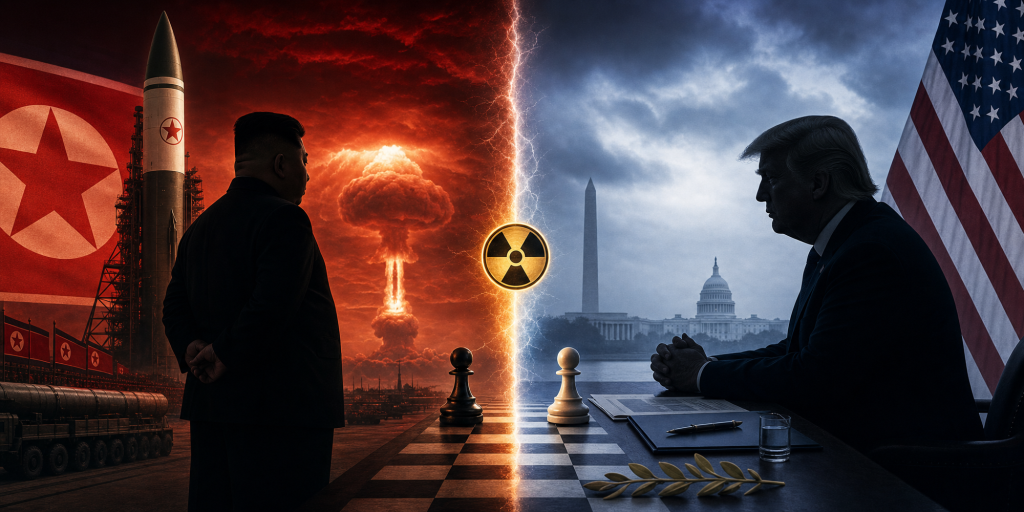
The strong US global leadership that President Trump brought restored when he returned to the White House in January 2025 is urgently needed to address the continuing and growing threat from North Korea’s nuclear weapons and missile programs. With an estimated 50 or more warheads, active fissile material production, and advancing ICBM capabilities, Pyongyang has enshrined its nuclear status in its constitution and deepened ties with Russia and China.
For the second Trump administration, the challenge is not merely to build on the first term’s diplomatic openings with North Korea, but to craft a realistic, results-oriented strategy grounded in “peace through strength” and transactional diplomacy. As I argued in my book “North Korea, Nuclear Brinkmanship, and the Oval Office,” success depends on strong presidential leadership, clear-eyed realism, disciplined leverage, and a refusal to be manipulated by Pyongyang. Washington must also reject the defeatist consensus that quickly declares “North Korea has already won.”
Lessons from Past Failures
U.S.-North Korea nuclear negotiations have followed a recurring and frustrating pattern for more than three decades. This was evident in the 1994 Agreed Framework, the Six-Party Talks (2003–2009), and the George W. Bush administration’s late-term efforts to secure a nuclear agreement in its second term. American diplomats repeatedly came up short because they underestimated North Korea’s determination to acquire nuclear weapons and were outmaneuvered in the negotiating process. At the same time, U.S. officials pursued weak agreements and offered significant concessions in the hope of producing a diplomatic success that could be presented as political wins. Some observers have drawn parallels to the Obama administration’s 2015 nuclear agreement with Iran (the JCPOA), contending that the priority in both cases was to secure any deal rather than insist on fully verifiable and irreversible disarmament.
North Korean officials recognized this approach and leveraged it effectively. They routinely accepted weak, easily reversible commitments in exchange for substantial benefits such as heavy fuel oil, food aid, and promises of light-water reactors. The limited steps Pyongyang took—most notably the dramatic demolition of the cooling tower at its 5-megawatt reactor at Yongbyon in 2008—were largely symbolic and readily reversible. North Korea consistently refused to make serious, irreversible concessions, such as the permanent disablement of key plutonium-production facilities or the surrender of its spent nuclear fuel rods, which it used to produce plutonium for its nuclear weapons.
Trump Changed the Game with Pyongyang in His First Term
President Trump fundamentally changed the dynamics of U.S.–North Korea relations during his first term. Through a policy of “maximum pressure”—including tightened sanctions, coordinated international diplomacy, and tough rhetoric, such as his 2017 “fire and fury” warning and his “Rocket Man” remarks at the UN General Assembly—he created the conditions for three unprecedented face-to-face summits between a sitting U.S. president and Kim Jong Un (Singapore in 2018, Hanoi in 2019, and the Korean DMZ in 2019).
The results were significant but incomplete. North Korea conducted no nuclear tests after September 2017. It also observed a self-imposed moratorium on long-range ballistic missile and ICBM tests that lasted until March 2022. Shorter-range missile testing was suspended for roughly nine months after the Singapore summit before resuming in May 2019. The risk of war that had escalated in 2017 eased dramatically, and the door opened to the possibility of improved bilateral relations.
Those gains proved temporary. Lower-level North Korean officials showed little interest in implementing the broad principles agreed at the summits. Inside the U.S. government, internal tensions over negotiating strategy—particularly around compromise formulas floated by a State Department official with his North Korean counterparts ahead of the Hanoi summit, which President Trump ultimately rejected—contributed to the breakdown. Diplomacy effectively collapsed in 2020 amid the COVID-19 pandemic, North Korea’s self-isolation, and the U.S. election cycle.
North Korea’s Growing Threat and Perceived U.S. Weakness Under Biden
Joe Biden mocked Trump’s North Korea policies and tried to ignore the country. The Biden administration named a part-time special envoy for North Korea and held no high-level talks with the regime during Biden’s term. Serious diplomatic engagement only appeared after tensions escalated sharply in 2023.
The Kim regime viewed the chaotic U.S. withdrawal from Afghanistan in 2021 as evidence of American weakness. That perception coincided with a dramatic surge in North Korean missile tests that began in 2022 and intensified through 2023. In late 2022, Kim Jong Un moved closer to Russian President Vladimir Putin, openly supporting Russia’s invasion of Ukraine and supplying Moscow with large quantities of missiles and artillery shells. North Korea simultaneously deepened ties with China between 2021 and 2024 and aligned itself with the emerging Russia-China-Iran axis.
At the 9th Workers’ Party Congress in February 2026, North Korea formally reaffirmed Kim’s “two hostile states” doctrine, first announced in December 2023. It declared its nuclear weapons program permanent and non-negotiable, while leaving a narrow door open to future talks and coexistence with the United States—if Washington accepted North Korea’s nuclear status. The Congress also called for a major expansion of nuclear warheads and delivery systems and reiterated the “nuclear trigger” doctrine mandating automatic nuclear retaliation against any threat to the regime’s leadership or command-and-control systems.
How US-North Korea Diplomacy Can Succeed in the Second Trump Term
North Korea remains a growing and increasingly intractable threat to regional and global security. However, the second Trump administration has several realistic strategies available to reduce tensions and make meaningful progress toward curbing the regime’s nuclear and missile programs. Moreover, Trump’s second-term national security team is far more unified than during the first term and is unlikely to repeat the internal infighting that hampered earlier diplomatic efforts with North Korea.
President Trump could increase the chances of negotiating an agreement to lower tensions with North Korea and halt threats from its nuclear and missile programs by striking a deal to end the war in Ukraine. Trump’s envoys are hard at work on this. I believe Russia’s current support for
North Korea is transactional, and that Moscow would end this support in exchange for the U.S. and Europe lifting sanctions on Russia. This probably would make Kim Jong Un more willing to negotiate with the U.S.
The recent nomination of former Congresswoman Michelle Steel, a Korean American with deep knowledge of the North Korean threat, as U.S. ambassador to South Korea is an important step. It signals a renewed focus on the Korean Peninsula and strengthens the U.S.–South Korea alliance. Trump should build on this momentum by appointing a high-profile special envoy for North Korea—ideally a respected former elected or appointed official such as Senator Bill Hagerty (Trump’s former ambassador to Japan), former National Security Adviser Robert O’Brien, or CIA Director John Ratcliffe. This envoy should immediately press for high-level talks with North Korean officials, work to arrange a meeting between Secretary of State Marco Rubio and Kim Jong Un, and lay the groundwork for a potential Trump–Kim summit if early discussions prove productive.
The personal rapport Trump and Kim developed during their three first-term meetings remains an asset. Kim appeared to value the international spotlight those summits provided. A new diplomatic framework could capitalize on this by offering targeted sanctions relief in exchange for verifiable steps from Pyongyang: a freeze on nuclear and long-range missile testing, a halt to new warhead and ICBM production, limits on missile ranges, and an end to military aid for Russia in Ukraine.
This must be accompanied by a continuation of Trump’s Maximum Pressure policy on North Korea, including robust sanctions enforcement, continuing joint U.S.-South Korea military exercises, and credible extended deterrence
In addition, any renewed high-level diplomacy with the Kim regime must be conducted in close coordination with the governments of South Korea and Japan, including frequent consultations to ensure alignment and avoid surprises.
Denuclearizing North Korea and eliminating its ballistic-missile program will be an extraordinarily difficult and time-consuming task—if it is possible at all. The policy failures of the Biden years have made this challenge significantly harder than it was during President Trump’s first term. The immediate priority must therefore be a verifiable freeze on further nuclear and long-range missile development, improved bilateral relations, and the groundwork for a comprehensive agreement. President Trump’s personal leadership and diplomatic track record with Kim Jong Un provide a unique opportunity to pursue these goals. Success will require sustained, focused effort by the special envoy and the broader diplomatic team. Given the grave threat North Korea poses to regional and global security, this work should begin immediately.
Fred Fleitz previously served as Chief of Staff of the Trump National Security Council. He is vice chair of the America First Policy Institute. He is the author of North Korea, Nuclear Brinkmanship, and the Oval Office, which was just released by Texas A&M Press.


