




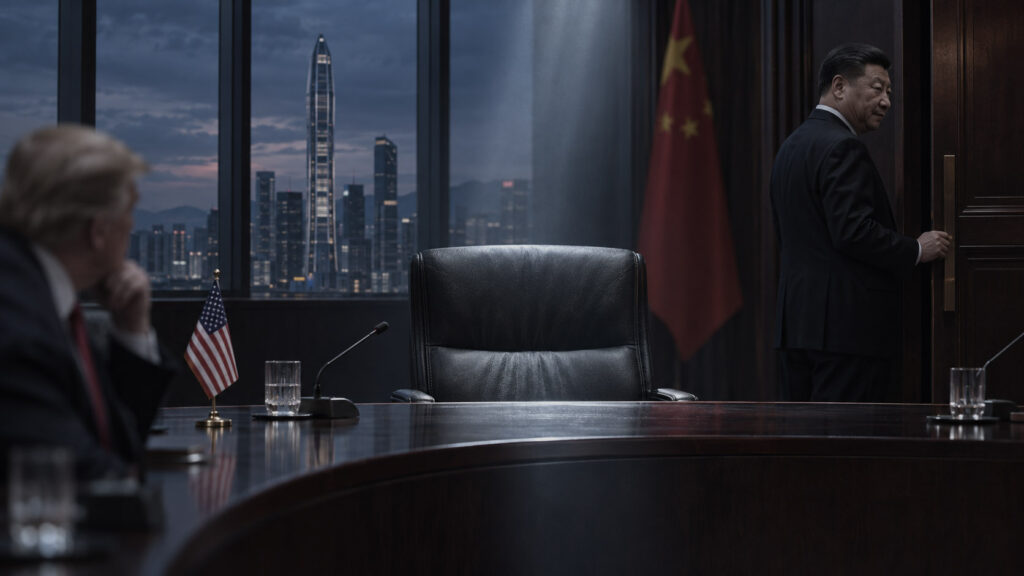
The empty chair at the Shenzhen APEC summit: the key to the failed Trump-Kim meeting was in Beijing, not Pyongyang
By Hyunseung Lee
The 2026 Asia-Pacific Economic Cooperation (APEC) summit in Shenzhen, China, closed on November 19. For months President Trump had been inviting Kim Jong Un to meet, and the meeting never happened. Much of the press has concluded that Kim simply snubbed Trump.
Line up the past month of Pyongyang’s moves by date, though, and a different picture appears. Kim wanted to go to Shenzhen. Xi Jinping was the one who kept the door shut.
A Month in the Record
October 15. The New Yalu River Bridge opened. It had been finished in 2014 and then left unopened for twelve years, and Beijing had long pressed for it to open.
October 24. Kim made a surprise trip across the new bridge to the border city of Dandong. It was his first visit to China in more than a year, and he paid his respects at the Memorial Hall of the War to Resist U.S. Aggression and Aid Korea. In other words, he gave Beijing everything it had been asking for. Xi did not receive him. His host was Wang Huning, China’s fourth-ranking leader, accompanied by Foreign Minister Wang Yi. Wang Huning walked Kim to the midpoint of the bridge to see him off. Kim went home the same day without ever meeting Xi.
November 3–5. Kim Song Nam, the Workers’ Party secretary in charge of relations with China, traveled to Beijing. When he met Wang Yi on November 5, he said North Korea would follow “the will of the top leaders of the two parties and two countries” and work with China to develop their friendship. China’s Foreign Ministry readout did not mention an APEC invitation.
November 14. Pyongyang raised the stakes. Instead of using its diplomatic channel, it sent Jo Yong Won to Moscow. Jo heads the Party’s Organization and Guidance Department and is Kim’s closest aide and effectively the regime’s number two. The trip was framed as a visit at the invitation of Dmitry Medvedev, chairman of the United Russia party. Foreign Minister Choe Son Hui and Kim Song Nam saw him off at the airport.
November 16. Jo met Vladimir Putin at the Kremlin. That same day, Kremlin spokesman Dmitry Peskov said Putin could meet Kim if Kim attended APEC, a statement that assumed Kim might travel to Shenzhen.
November 16 (U.S. time). The same day, Trump told reporters at the White House as he left for Asia that he might meet Kim “in China.” Then he added: “He may come, I don’t know. That’s up to President Xi.”
November 18–19. The APEC summit was held. Kim did not come.
Xi Held the Key All Along
Trump put his finger on it. North Korea is not an APEC member, so Kim could only come to Shenzhen if the host leader, Xi Jinping, extended a special invitation. A Trump-Kim meeting needed Beijing’s permission before Pyongyang’s decision even mattered.
Pyongyang’s top leadership moved from Dandong to Beijing to Moscow, and the sequence points in one direction. Kim opened the bridge China wanted. He sent his China secretary to coordinate. When that went nowhere, he sent his number two to Putin to look for a way around. None of this makes sense unless Kim wanted to go to Shenzhen.
Why Kim Wanted It So Badly
For Kim, the value of meeting Trump depends almost entirely on where it happens.
A stand-alone meeting at Panmunjom or in a third country offers him almost nothing. North Korea already calls itself a nuclear state, and Russia and China tacitly accept that. Any meeting with the United States brings denuclearization onto the table, and Kim would rather not discuss it. The door to sanctions relief is already opening through Moscow and Beijing. And with virtually no trade between the United States and North Korea, even an American decision to lift sanctions would change little in the near term.
Shenzhen was different. Trump, Xi, and Putin, the world’s so-called Big Three, would all be in one place. A single photo beside them would have given Kim international stature as a peer of the world’s leading heads of state. At home, it would have fed years of propaganda about “the great leader the whole world recognizes.” He would not have had to negotiate seriously with Trump or face pressure to denuclearize. All he had to do was show up. That is why he wanted so badly to attend.
Why Xi Kept the Door Closed
For Xi, the Shenzhen summit was this year’s biggest diplomatic stage for showing off China’s global leadership amid strategic rivalry with the United States. The first-ever U.S.-China-Russia trilateral summit was the centerpiece of the event he was hosting.
Imagine Kim, the leader of a nonmember state, making a surprise appearance and sitting down with Trump. The world’s headlines would have been all about a U.S.-North Korea summit. The host would have become a supporting player, and a supporting player would have become the star. Xi could not have missed that.
The cost-benefit math leads to the same conclusion. Xi had nothing to gain by inviting Kim and something to lose:
- He would have lost the spotlight. He would have handed the starring role at his own event to someone else.
- He would have weakened China’s role as intermediary. Beijing has long used its position between Pyongyang and Washington as leverage. A direct Trump-Kim handshake on Chinese soil would have undercut that leverage.
- He still distrusts Kim. In 2024, Kim leaned toward Moscow by signing a treaty with Putin that includes a mutual assistance clause. This time, when things stalled in Beijing, Kim tried to apply pressure through Putin. Xi is unlikely to have taken that kindly.
The distrust between the two men runs deep. From the start of his tenure, Xi looked unfavorably on North Korea’s third-generation dynastic succession and its third nuclear test in 2013. After the execution of the pro-China Jang Song Thaek, Xi effectively turned his back on Pyongyang. Ri Jong Ho, a former senior North Korean economic official who served all three generations of the Kim family, says he heard firsthand that at a Party meeting in Pyongyang in July 2014, Kim unleashed crude denunciations of Xi.
Xi’s visit to Pyongyang this June patched up relations out of strategic necessity. But the trust between the two men did not extend far enough for Xi to invite Kim onto his most important stage and share the spotlight.
Conclusion
The failure of a Trump-Kim meeting in Shenzhen was not Kim turning his back. It was much closer to Xi shutting the door to protect a diplomatic order centered on China. Kim wanted to come. That is why he crossed the bridge, sent his China secretary to Beijing, and sent his number two to Moscow. Beijing was the one that would not open the door.
This episode is another reminder that at every decisive moment on the Korean Peninsula, Beijing’s cold calculations matter as much as the wishes of Washington and Pyongyang. Anyone hoping for the next U.S.-North Korea summit in China should not watch Pyongyang alone. Start by asking what Xi stands to gain, and what he stands to lose.
Hyunseung Lee is a North Korean escapee, lead strategist at the Global Peace Foundation, founder of the North Korean Young Leaders Assembly and a regular contributor to the Korea Regional Review. He has experience in North Korea’s shipping and mining sectors and as a sergeant in the DPRK Army Special Force. He fled in 2014 due to severe governmental purges. He holds a bachelor’s degree in economics from Dongbei University of Finance and Economics and a master’s degree in public administration from Columbia University.


