

The Exit Ban on Morse Tan, a Former U.S. Ambassador-at-Large Under the Trump Administration, Is a Dangerous Warning Sign
By Jean Cummings
Co-Editor and Senior Columnist, The Korea Signal
On June 1, 2026, South Korea’s Ministry of Justice imposed an exit ban on Morse Tan, former U.S. Ambassador-at-Large for Global Criminal Justice. The measure was taken while Tan was in South Korea to monitor and verify alleged election irregularities related to the June 3, 2026 local elections.
Morse Tan, whose Korean name is Tan Hyun-myung, is a Korean-American who served as U.S. Ambassador-at-Large for Global Criminal Justice at the State Department during the first Trump administration, from 2019 to 2021. He is currently a professor at Liberty University School of Law and is widely known for his work on North Korean human rights and international criminal law.
The South Korean Ministry of Justice imposed the exit ban on the grounds that Tan allegedly spread false information about Lee Jae-myung and defamed him.
Key Timeline
In June 2025, at a press conference in Washington, D.C., Morse Tan claimed that President Lee Jae-myung had been involved in serious crimes as a juvenile, including murder and rape, and had been detained in a juvenile facility as a result. When Tan visited South Korea in July of the same year, he made similar remarks at a public meeting held at Eunpyung First Church in Eunpyeong-gu, Seoul.
Tan also stated several times, both at the Washington, D.C. press conference and in later remarks, that he had “evidence and records” related to the allegations concerning Lee Jae-myung’s alleged juvenile criminal history.
The allegation that Lee had been involved in serious crimes as a juvenile and had been detained in a juvenile facility had circulated widely online from late 2021 through the 2022 presidential election period. At the time, the Democratic Party of Korea filed complaints against multiple individuals who had circulated the claim, accusing them of spreading false information. After prosecutors investigated the matter, some of those individuals were indicted on charges including violations of the Public Official Election Act.
Courts reviewed Lee’s criminal and investigative background records, as well as records related to juvenile protective measures, and concluded in several rulings that there was no such record. As a result, from the second half of 2022 through 2023, fines were imposed on several individuals who had circulated the claim, and the allegation was legally judged to be false.
Nevertheless, among citizens who oppose Lee Jae-myung, past photographs and circumstantial materials that they believe support the allegation have continued to be raised. The controversy has not disappeared.
Against this backdrop, Morse Tan stated at the June 2025 Washington, D.C. press conference that he had evidence related to the allegation. After that statement, the controversy over Lee Jae-myung’s alleged past criminal involvement resurfaced.
In July 2025, police opened an investigation into Tan on suspicion of defamation under the Information and Communications Network Act. However, because Tan was a foreign national and the remarks were made in the United States, the case was initially closed due to jurisdictional issues. Then, on May 13, 2026, prosecutors ordered the case reopened, citing the “place where the criminal result occurred,” namely the alleged defamatory effect on the president’s reputation inside South Korea.
On May 28, 2026, one day before early voting began for the June 3 local elections, Tan entered South Korea for the stated purpose of “monitoring and verifying election fraud.” Police asked him to appear for questioning at Incheon International Airport, but he refused, submitted a written statement, and filed a motion to recuse the investigators.
On June 1, 2026, however, the Seoul Metropolitan Police Agency’s Cyber Investigation Unit requested that the Ministry of Justice impose an exit ban, citing Tan’s refusal to appear and the alleged risk that he might flee. The Ministry approved the request. Tan’s legal team challenged the measure and filed for a suspension of the exit ban at the Seoul Administrative Court, but on June 4, 2026, the court rejected the request.
South Korea’s Immigration Act has long applied the rules on exit bans for Korean nationals to exit suspensions for foreign nationals. In criminal investigations and flight-risk cases, police and the Ministry of Justice are granted relatively broad discretion.
The problem is not the existence of the law itself, but how it is being used. Even under the same Immigration Act, the speed and severity with which an exit ban is imposed can vary sharply depending on the political character of the government and the nature of the case. That raises serious concerns about selective law enforcement.
Tan’s legal team is currently pursuing a lawsuit to cancel the exit ban, while also filing motions to recuse the court and complaints with the Corruption Investigation Office for High-ranking Officials.
The central problem in this case is that the South Korean government has treated the political speech of an American citizen as a matter for criminal investigation and exit restriction.
Criticism of political and public figures, disclosure of a president’s past, and allegations concerning elections should fall within the protected space of free inquiry and freedom of expression. In particular, any attempt to punish speech made on U.S. soil under South Korean law inevitably appears to be an attempt to control the speech of an American citizen beyond South Korea’s borders.
Since the Lee Jae-myung administration came to power in 2025, there has been a growing pattern of attempts to regulate not only domestic criticism but also criticism voiced overseas. The United States must pay close attention to this trend. In the digital age, overseas speech and domestic public opinion are connected in real time, but that does not give the South Korean government the right to place American citizens’ speech under Korean legal control.
The Lee administration’s excessive extension of territorial jurisdiction to American citizens is bound to collide with countries such as the United States, where freedom of expression is strongly protected.
The timing and target of this case make the political motive difficult to ignore. In the middle of the 2026 local election period, the government targeted a former senior U.S. official who was involved in election monitoring and criticism of the president. A case that had initially been closed because of jurisdictional problems was suddenly reopened under prosecutorial direction.
In a democratic society, the freedom to raise questions and criticize public officials is not merely an individual right. It is an essential mechanism for monitoring power. If citizens cannot question and publicly debate the conduct, background, and policy decisions of presidents and senior officials, democracy cannot function properly. Freedom of expression must therefore be protected as one of the central constitutional values that sustains a liberal democratic system.
It is especially serious when the South Korean government reaches as far as the speech of an American citizen. Morse Tan is a U.S. citizen who resides in the United States and previously held an ambassador-level position at the U.S. State Department during the first Trump administration. He is also a professor at Liberty University School of Law, with clear family, professional, and property ties in the United States. It is difficult to argue that he poses a serious flight risk.
Yet the South Korean government still imposed an exit ban on him. It is difficult to avoid the criticism that the Lee administration is using Tan as a political example in order to suppress public discussion of allegations concerning Lee Jae-myung’s past.
Tan’s legal team has described the measure as harmful to the U.S.-South Korea alliance and to the national interest. They have also warned that this case could create a chilling effect on Americans, foreign experts, and opposition figures who might otherwise visit South Korea and speak freely. That is precisely why Washington should pay attention.
The Lee Jae-myung administration and South Korea’s National Election Commission have also strengthened online content regulation. Their pressure has not been limited to Korean citizens. There have also been excessive takedown requests regarding Facebook and other social media posts written by American citizens who criticized the Lee administration.
Meta has restricted access in South Korea to posts written by American citizens criticizing the Lee administration. South Korean government requests for formal legal action against Meta have led to repeated cases in which American citizens’ social media posts are made unavailable only inside South Korea.
This is not merely a domestic censorship issue. It is a serious matter in which the South Korean government is directly pressuring the operations of American digital platforms and attempting to place the online speech of American citizens under Korean legal control.
The International Law Perspective
The ICCPR, the International Covenant on Civil and Political Rights, was adopted by the United Nations General Assembly in 1966. It is one of the core international human rights treaties and has been ratified by more than 170 countries worldwide. The treaty sets international standards for protecting civil and political rights, including the freedom of movement and freedom of expression.
(1) Freedom of Movement
Article 12 of the ICCPR provides that everyone has the right to leave any country, including his own. Restrictions on that freedom must be provided by law and must be necessary and proportionate for reasons such as national security, public order, public health, or the rights of others. Such restrictions must not be arbitrary.
Under South Korea’s Immigration Act, there may be a formal legal basis for imposing an exit ban on Morse Tan. However, this measure raises serious concerns under the proportionality principle required by Article 12 of the ICCPR.
The question is whether imposing an exit ban on an American citizen because of an investigation involving political expression and criticism of a public official can truly be considered the “minimum necessary restriction.” Tan’s identity, residence, and professional base are all clear. Under these circumstances, the use of an exit ban can be criticized as excessive under international human rights standards.
(2) Freedom of Expression
Article 19 of the ICCPR protects freedom of expression. Political speech, in particular, must receive the highest level of protection. Criticism of public figures and politicians must be treated with broader tolerance than statements concerning private individuals.
Criminal defamation laws have repeatedly been criticized by the UN Human Rights Committee and the UN Special Rapporteur on freedom of expression. Where civil remedies are sufficient, criminal punishment can excessively chill political speech. That is the core concern under international human rights standards.
The United States has also enacted the SPEECH Act of 2010. That law allows U.S. courts to refuse enforcement of foreign defamation judgments that do not meet the standards of the First Amendment.
Therefore, any attempt by the South Korean government to criminally punish political speech made inside U.S. territory directly conflicts with American standards of free expression.
In other words, the exit ban on Morse Tan raises serious concerns under both Article 12 and Article 19 of the ICCPR. If a restriction on movement is being used to reinforce a violation of freedom of expression, then this should be treated as a dual human rights violation. A politically motivated restriction on the speech of an American citizen may amount to an arbitrary restriction.
From the perspective of UN rules and international human rights standards, this case also raises concerns about judicial harassment and lawfare against an American citizen. The fact that such a measure was taken against a former U.S. State Department ambassador-level official also raises serious questions of international comity.
Tan is not a sitting diplomat. But given his former public position, Washington should not tolerate the Lee administration’s excessive political use of legal measures against an American citizen.
Separate from the question of whether Tan’s claims are true, the use of an exit ban for the purpose of investigation is an excessive political pressure tactic. Over the long term, it can damage trust in the U.S.-South Korea alliance. The Lee administration’s human rights abuses should not be ignored.
On June 10, 2026, the U.S. State Department issued an official position on the matter.
The State Department stated that “the Trump administration places the safety and security of American citizens as its highest priority,” and explained that it takes seriously cases in which U.S. citizens are subjected to exit bans without fair and transparent procedures.
The State Department also said that it continues to monitor exit-ban cases involving American citizens overseas and demands due process from the governments concerned. It added, however, that the final decision on lifting an exit ban rests with the government of the country imposing it.
Is Lee Jae-myung a Transparent Political Leader?
There is a question that must be asked here: Is Lee Jae-myung transparent enough to suppress the freedom of expression of citizens?
Before running for president, Lee had already been on trial over several serious criminal allegations. Separate from the juvenile criminal allegations raised by Morse Tan, Lee had already been linked to far more serious criminal cases. Critics argue that he used the impeachment crisis surrounding former President Yoon Suk Yeol to escape his own legal risks, and that he came to power amid allegations that the election process itself had been manipulated.
Public anger has grown over whether a man criticized for using the presidency as a shield to halt his own legal risks has the moral standing to suppress citizens’ freedom of expression and pressure his critics through defamation charges.
The major cases surrounding Lee include violations of the Public Official Election Act, impersonating a prosecutor and subornation of perjury, alleged favoritism and breach of trust related to Daejang-dong, Wirye, Baekhyeon-dong, and Seongnam FC, the Ssangbangwool illegal remittance-to-North-Korea case, and allegations involving the private use of Gyeonggi Province funds.
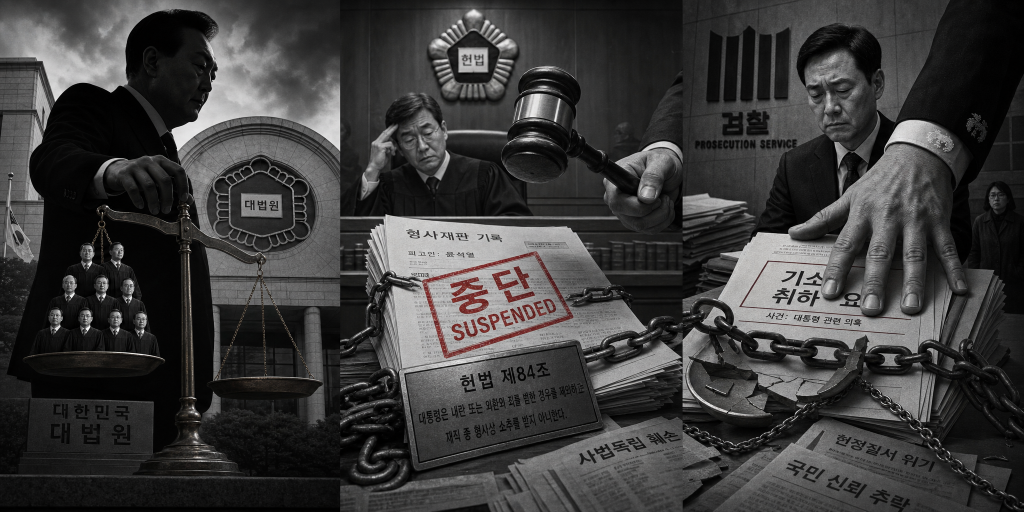
These cases are still awaiting legal judgment. Yet after becoming president, Lee has been criticized for using the constitutional privilege against prosecution to suspend his trials for the five years of his term. The more serious issue is that during that period, he has shown signs of trying to reshape the judiciary, legislature, and executive branch around his own political survival.
Since taking office, Lee has also shown signs of trying to create institutional mechanisms to manage his criminal trial risks over the long term. One representative example is the attempt to sharply expand the number of Supreme Court justices from the current 14. It is difficult to view this simply as an effort to expand judicial staffing.
With the Democratic Party currently holding a majority in the National Assembly, a major increase in the number of Supreme Court justices would inevitably allow the administration to exert stronger influence over the future composition of the Supreme Court. This raises serious concerns about the independence and neutrality of the judiciary. It is difficult to avoid the suspicion that the administration is trying to create a judicial structure favorable to Lee even for trials that could resume after his term ends.
The situation after Lee became president is deeply troubling: the National Assembly is under his party’s control; prosecutorial investigations can be influenced through personnel appointments; criticism is weakened through pressure on the media; and even the structure of the courts is being targeted for change. This shows that South Korea’s separation of powers is being shaken for the sake of one leader’s personal legal risks.
This is the typical process through which dictators consolidate power.
They seize power in order to escape their own criminal allegations, while using defamation laws and speech regulations to suppress the citizens who criticize them. That is exactly why many citizens view Lee as a dictator.
Lee frames all investigations against him as political revenge. Using slogans such as “political prosecution” and “prosecutorial coup,” he attempts to criminalize lawful investigations into himself, while wielding defamation as a weapon against citizens who criticize him.
For dictators, the state is a tool and the people are merely instruments.
Citizens who oppose Lee believe that his purpose in seizing power was to escape the many criminal allegations against him. They also argue that this power is being used to eliminate forces that check or criticize him, to undermine liberal democracy, and to build an authoritarian system.
The words Lee uses — “fairness,” “reform,” and “livelihood” — are, in the eyes of his critics, nothing more than a political disguise. Rather, he cannot avoid the sharp criticism that he is a power addict who is willing to carry out an authoritarian takeover of South Korea’s democratic system.
U.S. State Department Visa Measures
On May 28, 2025, U.S. Secretary of State Marco Rubio announced two important visa-related measures.
First, he announced a sweeping and aggressive crackdown on Chinese student visas. The measure specifically targeted students linked to the Chinese Communist Party or studying in key strategic fields in the United States, and included visa revocations.
Secretary Rubio emphasized that the measure was intended to block the expansion of Chinese Communist Party influence inside the United States and to ensure that Chinese students in critical technology and national security-related fields could not threaten American interests.
Second, the Secretary of State announced a new diplomatic measure: foreign government officials who attempt to censor U.S. social media platforms would face visa bans.
This was not merely a diplomatic message. President Trump and Secretary Rubio made clear that the United States would now directly target not only foreign authoritarian forces that suppress freedom of expression, but also governments that speak the language of democracy while suppressing opposing views, including China, certain European governments, and other foreign governments.
South Korea’s left-wing forces have been criticized in recent years for acting in coordination among government agencies, civic groups, and media outlets to censor content on American platforms and to systematically pressure conservative YouTubers and social media accounts.
Under the Lee Jae-myung administration, these measures have become more blatant. Under the banner of fighting “fake news,” they have blocked conservative public opinion inside South Korea, and now they are expanding the target to posts written by American citizens. The South Korean government is flooding the headquarters of American digital platforms with takedown requests and inserting itself into an area protected by the U.S. Constitution: freedom of speech.
South Korea’s left-wing governments have long justified broad censorship on Facebook, YouTube, and other platforms in the name of “democracy.” Under the Lee administration in particular, politically inconvenient information is labeled “fake news” and blocked, while conservative voters’ voices are deleted under the label of “hate speech.”
Pro-Lee media outlets in South Korea have also repeatedly distorted reporting about President Trump personally, as well as about the policies and directives of the U.S. administration. They have also been criticized for working with anti-Trump activists inside the United States and continuing attacks against the American conservative movement.
This is not merely a media issue. It can only be seen as an attempt to intervene in American domestic politics under the cover of foreign journalism and to participate in an information campaign aimed at the American conservative movement. If the Lee administration’s double standard is left unchecked, the problem could extend beyond freedom of expression and affect U.S. domestic politics and national security. Washington, and the U.S. State Department in particular, should no longer treat this as a purely internal Korean matter. They should consider a firm response.
Alliance Fracture Begins With Information Control
Today’s great-power competition is not fought only on battlefields. It begins with what citizens in each country are allowed to see, what they are encouraged to believe, and whom they are led to distrust.
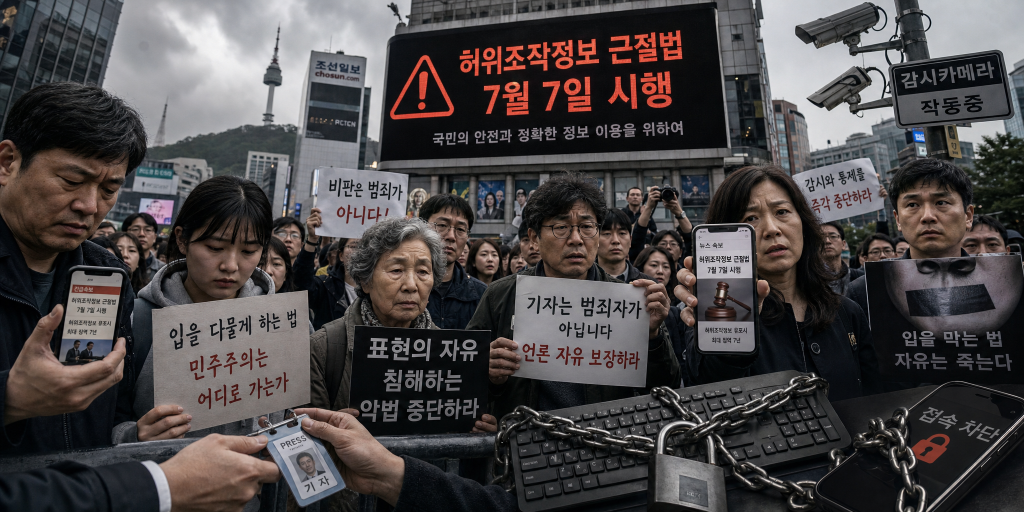
Beginning July 7, South Korea is scheduled to enforce the Partial Amendment to the Act on Promotion of Information and Communications Network Utilization and Information Protection, Act No. 21305, commonly referred to as the “Anti-Fabricated Information Act” or the “False and Manipulated Information Regulation Act.”
The amendment passed the National Assembly in December 2025, was promulgated in January 2026, and is scheduled to take effect on July 7, 2026.
The amendment newly defines “false and manipulated information,” prohibits its distribution, and adds hate and discriminatory expression to the category of illegal information. It also introduces punitive damages of up to five times the amount of damages for malicious dissemination of false or manipulated information. This significantly strengthens legal liability not only for platform operators, but also for YouTubers, influencers, and other online speakers.
The Lee administration describes the measure as a response to social conflict and fake news. But the real danger lies in who holds the power to decide what is false, and who becomes the target of punishment.
If journalists, YouTube hosts, and civic activists who criticize the government begin to be branded as spreaders of false information or hate incitement, the law no longer protects democracy. It becomes a tool for silencing the opposition.
In practice, those pressured under this type of law are mainly people who have criticized Lee administration policies that negatively affect the U.S.-South Korea alliance, criticism directed at the president, and allegations involving China and North Korea. Investigative agencies question them, while platforms restrict their posts and accounts. The result is a chilling effect in the online space, where demands for government transparency and criticism of the administration are being suppressed.
Yet the Lee administration does not apply the same standard to media outlets and supporters favorable to itself.
Major media outlets that have repeatedly spread false claims about U.S. policy, anti-American narratives, and distorted or hostile coverage of President Trump have largely been left alone. Online spaces where violent statements against the United States appear have also faced little meaningful action.
On Facebook and other social media platforms in South Korea, explicit hateful statements have appeared, including remarks insulting President Trump and saying that a nuclear bomb should fall on his head. Such remarks have been left alone. When there was a recent assassination attempt against President Trump in the United States, some Lee supporters even defended the assassin or openly said it was “unfortunate” that the attempt failed. Yet the Lee administration’s standards on “false and manipulated information” and “hate speech” were not applied to them.
The Lee administration’s political double standard has gone too far. Speech unfavorable to the administration is targeted with the labels of false information and hate expression, while anti-American incitement and hostile speech toward the United States are ignored.
On May 23, 2026, Lee Jae-myung used his X account to directly mention punishment, punitive damages, fines, and even site shutdowns in response to citizens’ free criticism and public questioning of the government. This is not a simple matter of online order. It is a dangerous sign that, in a liberal democratic society, citizens’ freedom of expression can be suppressed through law, police power, and pressure on digital platforms.
The South Korean government’s use of false information and hate speech as grounds to regulate online speech — and the expansion of that pressure to the posts of American citizens and American platforms — must be stopped. This issue must not be viewed as a purely domestic Korean matter, especially because it can lead to demands for content removal, account restrictions, fines, and site blocking against American platforms such as YouTube, Facebook, and X.
If an allied government remains silent about threats from China and North Korea while applying legal pressure against its internal critics in the name of false information and hate speech, that is not the normal behavior of a liberal democratic ally.
It is a dangerous direction more commonly seen in authoritarian states seeking to control society, and it can create a serious crisis for security on the Korean Peninsula.
A government that is not watched by its citizens is always dangerous.
If the United States fails to stop the Lee Jae-myung administration as it moves rapidly into China’s sphere of influence, this will become more than a Korean free speech issue. It will become a threat to American security.
Conclusion
Morse Tan is a former U.S. Ambassador-at-Large for Global Criminal Justice. If the Lee administration is willing to use an exit ban against someone with that background, it will be far easier for it to use investigations and legal pressure against ordinary citizens.
The Morse Tan case is a public example showing that the Lee administration’s speech controls may not stop with Korean citizens. They can extend to American citizens, American platforms, and even former senior U.S. government officials. If Washington treats this case as a routine defamation investigation, American experts, former officials, election observers, and North Korean human rights advocates visiting South Korea may have to accept the risk of similar investigations and exit restrictions.
The “False and Manipulated Information Regulation Act,” scheduled to take effect on July 7, could make this trend even more dangerous. If that law is combined with the precedent set by the Morse Tan case, the South Korean government will have a broader channel to pressure not only domestic critics, but also overseas speakers and American platforms.
When the speech of an American citizen becomes the target of a South Korean government investigation, and a former senior U.S. official is barred from leaving the country, this is not merely a Korean political dispute. It is a matter that touches both freedom of expression and the trust at the heart of the U.S.-South Korea alliance. Washington must no longer tolerate the Lee regime’s reckless overreach.