




Outraged by the Ballot Shortage, Citizens Spark the “Jamsil Democracy Uprising”
The spontaneous blockades and protests that erupted like wildfire in response to the ballot shortage during the June 3 local elections have evolved into a modern-day “democracy uprising” aimed at safeguarding the people’s most sacred right—the right to vote—going far beyond mere dissatisfaction with an administrative error.
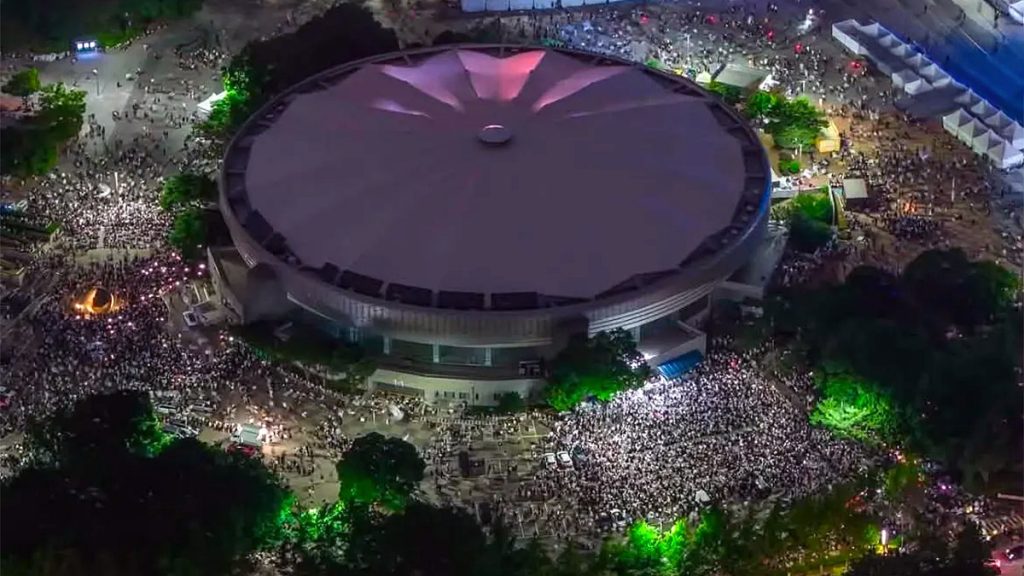
Tens of thousands of citizens have been gathering daily in front of the vote-counting center at the Handball Stadium in Olympic Park, Songpa-gu, Seoul, chanting for “a re-election” and the “dissolution of the National Election Commission,” waging an “uprising to defend sovereignty” unprecedented in constitutional history.
It is reported that this is the location where ballot boxes from Jamsil Polling Station No. 2—where voting was suspended due to a shortage of ballots during the June 3 local elections—were illegally moved to conduct a forced vote count. It is presumed that ballot boxes remain on-site, and citizens have begun gathering to prevent these boxes from being removed and to secure them as evidence of this fraudulent election.
An unprecedented situation not even seen during the Liberal Party era
The 9th National Simultaneous Local Elections held on June 3 left the most shameful stain on the history of Korean democracy. An unprecedented situation occurred where voting was suspended due to a shortage of ballots at approximately 50 polling stations nationwide, including Songpa, Gangnam, and Gwangjin districts in Seoul, as well as Incheon, Ulsan, and South Gyeongsang Province.
Amid a heatwave exceeding 30 degrees Celsius, voters had to wait for hours holding numbered tickets for their turn to receive a ballot, and many citizens eventually gave up and turned away. This is an unprecedented situation that did not even occur during the Liberal Party era, when Lee Ki-bung and political thugs manipulated elections.
“Give Me Back My Vote”… A ‘Pure Civic Movement Beyond Left and Right’ Led by the 20s and 30s Generation
Public outrage spread like wildfire over the National Election Commission’s complacent response and shoddy administration. In particular, it was young people in their 20s and 30s who were the first to raise their voices against this situation.
In major university districts across Seoul, statements condemning the Election Commission poured in, and the “Movement to Defend the Right to Vote” spread nationwide to places like Dongseong-ro in Daegu and university districts in Gwangju.
They do not represent the interests or ideologies of any specific political party. The young people gathered in the plaza declared, “We are pure citizens, free from left or right,” expressing their outrage that the principle of “one person, one vote”—the foundation of democracy—has been undermined by the incompetence of state institutions.
Fourth Day of Polling Station Blockade… Olympic Park Becomes a Modern-Day Mecca of Democratization
As vote counting proceeded despite some voters being deprived of their right to vote, citizens took to the streets in protest. In front of the polling station at the Handball Stadium in Olympic Park, Songpa-gu, Seoul, a crowd of approximately 30,000 protesters (an unofficial police estimate) gathered within three days, transforming the area into a massive plaza of resistance.
According to YouTubers who live-streamed the scene, approximately 200,000 people gathered on-site, and when accounting for the total number of people who passed through, far more citizens participated in this “Jamsil Democracy Uprising.”
Citizens are continuing their overnight protest, guarding the seals on ballot boxes transported from areas such as Jamsil 7-dong, and demanding a halt to the vote counting and an investigation into the truth. The fact that citizens have blockaded the square to defend their sovereignty against the collapse of the democratic system itself—rather than against coercive state power—gives this event the character of a “democratization struggle” that sets a new milestone in the history of South Korea’s civic movement.
The scene appears to be under the complete control of the citizens. A so-called “Citizens’ Leadership Committee” has been voluntarily formed to engage in dialogue with the police, control police access, and even take responsibility for preventing safety accidents and maintaining the cleanliness of the site.
This citizens’ movement, which began with the absurd situation of a shortage of ballots, is expected to be recorded as a great milestone of democracy, demonstrating to the world that the people of the Republic of Korea are alive and well as sovereign citizens.
The Establishment’s Response and Historical Challenges
As public resistance intensifies, the political sphere and the government are responding immediately. President Lee Jae-myung has defined this situation as a “serious matter that undermines the foundation of popular sovereignty” and ordered the formation of a joint prosecution-police investigation headquarters. Meanwhile, both the ruling Democratic Party of Korea and the opposition People Power Party are pushing for an immediate parliamentary inquiry and the appointment of a special prosecutor.
However, the ruling and opposition parties show differing stances on the central demand being chanted by citizens on the ground: the holding of a “re-election.”
The People Power Party is calling for a “re-election,” describing the situation as “an unprecedented deprivation of voting rights in constitutional history.” Led by Party Leader Jang Dong-hyuk, the opposition officially demanded an immediate halt to vote counting and the holding of a re-election immediately after the incident.
This includes Lee Jin-sook, who was elected in the Dalsung County in Daegu City by-election with 62.91% of the vote. Lee visited the Olympic Stadium and called for a re-election in front of citizens, receiving a round of applause.
On the other hand, the Democratic Party of Korea maintains that this is “merely an administrative error” and that a “re-election is unnecessary.”
The Democratic Party officially dismissed the opposition’s calls for a re-election or election postponement, stating that “this does not constitute a legal grounds for a re-election.”
Is a re-election actually possible?
The National Election Commission also issued a public apology regarding the ballot shortage but drew a clear line, stating, “A shortage of ballots does not constitute grounds for postponing or holding a re-election,” and is maintaining a firm stance that the vote counting, which has already begun, must be completed without interruption.
According to Article 219 of the Public Official Election Act, the deadline for filing an election appeal for local elections is within 14 days of the election date. In other words, a re-election becomes realistically possible only if a comprehensive lawsuit challenging the election results is filed within this deadline.
Amid this situation, President Lee, the head of the executive branch, has left the country to attend the G7 Summit and tour Europe, and is scheduled to return on the 18th. He is facing criticism that he is fleeing abroad until the deadline for filing an appeal has passed.
Some argue that, since the petition for election invalidation is not being filed by a party directly involved in the election, the claim that the election was fraudulent and tainted would be more persuasive as a basis for holding a re-election.
In fact, the slogans echoing from the sites of the pro-democracy protests initially unified around the call for a “re-election,” but by the following day, they had shifted to “fraudulent election, re-election.”




