




Kim GumHyok, People Power Party Media Spokesperson
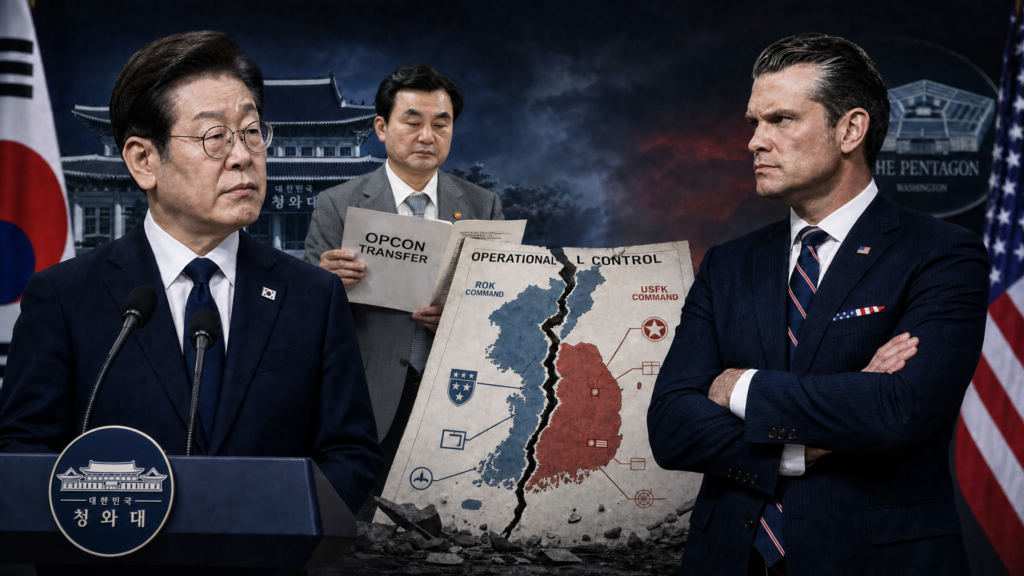
The Lee Jae-myung administration is moving rapidly to complete the transfer of wartime operational control, or OPCON, within President Lee’s term.
At a meeting of the Future Defense Strategy Committee in May, Defense Minister Ahn Gyu-back remarked, in language that left room for ambiguity, that there would be no major problem even if South Korea were to assume OPCON tomorrow. After being informed of the remark, President Lee went so far as to publicly rebuke the defense minister’s equivocal position, saying that a defense minister should declare that “there would be no problem at all even if we were to take it over tomorrow.”
Washington also appears to view the transfer of OPCON to South Korea favorably. At the Shangri-La Dialogue later that month, U.S. Secretary of War Pete Hegseth described South Korea’s desire to assume more operational control, more quickly, as encouraging and said that the United States should continue to support such moves. On the surface, Seoul and Washington appear to be speaking with one voice for the first time in years.
Hegseth’s support reflects the Trump administration’s desire for allies to shoulder a greater share of the regional security burden. As the United States seeks to reduce the burden of involvement in conflicts around the world, it is urging South Korea to step forward and assume greater responsibility after seventy years of sharing responsibility for the country’s defense.
Yet Hegseth’s welcome for an earlier transfer does not mean that he endorsed the specific political timetable being pursued by the Lee administration. He emphasized that a balance must be found in a manner that respects the operational plans and responsibilities the U.S. military has carried for decades, while the Trump administration’s position also remains that any OPCON transfer must be based on conditions. Seoul and Washington may agree on the general direction of the transfer, creating a positive atmosphere and making the underlying rationale appear reasonable, but there are still critical questions that must be examined.
I, too, believe that, when the necessary time comes, South Korea should regain control over wartime operations so that it can fight a war under its own command. There is also some validity to the argument that genuine self-reliant defense can be achieved only when a country possesses the operational capability to conduct a war. This effort has continued for nearly two decades since the Roh Moo-hyun administration formally advanced it through an agreement between the South Korean and American presidents in 2006. For a country whose military is ranked among the five strongest in the world, the desire to command its own forces in wartime may be entirely natural.
The problem is not the legitimacy of transferring OPCON, but the Blue House’s impatience in forcing a decision of such magnitude into the timetable of a presidential term. The concern is that the administration, as though racing against some unseen deadline, has set the timetable first and believes it can simply reach the desired conclusion while disregarding preparation and process, ultimately creating a major breach in national security. The first and most fundamental question is whether South Korea is truly prepared to assume wartime operational control.
In 2014, South Korea and the United States agreed on three conditions for the transfer: the South Korean military’s ability to lead the combined defense of the peninsula, the alliance’s comprehensive ability to respond to North Korean nuclear and missile threats, and a stable security environment. The first condition—whether the South Korean military can lead combined operations—is evaluated through a three-stage assessment of the future Combined Forces Command under a South Korean four-star general: Initial Operational Capability, or IOC; Full Operational Capability, or FOC; and Full Mission Capability, or FMC.
The IOC assessment was completed in 2019, but the FOC assessment conducted in 2022 has yet to be concluded, while a date for the final FMC assessment has not even been set. Nevertheless, the government is seeking to rush through the remaining evaluations this fall and complete the transfer as early as 2027. Just how far this timetable has moved ahead of military reality can be seen in the concerns expressed by American officials involved in evaluating South Korea’s readiness. General Xavier Brunson, commander of U.S. Forces Korea, told the Senate Armed Services Committee that political objectives must not overtake the agreed conditions. At a military symposium in Hawaii, he also said that one of his greatest concerns was being forced by a timetable to carry out a mission for which the forces involved were not ready. Mary Kissel DeSombre, the State Department’s assistant secretary for East Asian and Pacific affairs, and Deputy Assistant Secretary David Wilezol likewise made clear that the conditions agreed upon by Seoul and Washington must come first and that the transfer must be approached cautiously. The Senate Armed Services Committee even included a provision in the National Defense Authorization Act requiring reports on the implementation of the transfer every ninety days through 2030.
And how has North Korea responded?
In March, North Korea revised its constitution to remove the language of unification, designate South Korea as its principal enemy, and codify the authority to expand and use its nuclear arsenal. It is producing nuclear attack submarines and 5,000-ton destroyers while maximizing its offensive capabilities through repeated tests of various missile systems.
Through deepening military cooperation with Russia, North Korea is rapidly modernizing the conventional forces that had long been regarded as one of its greatest weaknesses. It is fortifying the Demilitarized Zone, deploying new-caliber long-range artillery and surface-to-surface missiles, and steadily raising the level of its military threat against South Korea. At a time when the enemy’s threat is multiplying, the Lee administration is racing to alter the combined command structure that has supported the rapid intervention and reinforcement of U.S. forces in a crisis, even though South Korea has not completed the necessary preparations.
Whatever the administration’s political motives may be, its approach risks placing the U.S.–South Korea alliance under severe strain and leaving South Korea more vulnerable. At a time when the mission of U.S. Forces Korea is expanding beyond the deterrence of North Korea to include competition with China and broader Indo-Pacific missions, a premature OPCON transfer would inevitably give the United States greater flexibility to deploy some U.S. forces stationed in Korea to operations outside the peninsula.
As a result, the likelihood would increase that, when Washington deems it necessary, portions of U.S. Forces Korea could be reduced or moved beyond the Korean Peninsula. Under the worst circumstances, the South Korean military could find itself conducting a substantial share of wartime operations independently, without sufficient American support.
The U.S.–South Korea Mutual Defense Treaty and the wartime operational control structure have served to deter North Korean aggression. The essence of deterrence is to make a belligerent nuclear dictator such as Kim Jong Un believe that the United States will enter the war if North Korea attacks.
Any transfer of wartime operational control must therefore proceed cautiously and in stages, under conditions that fully preserve this deterrent effect. In addition, the South Korean armed forces—the institution that will assume OPCON—must be completely prepared to carry out the mission. It is encouraging that the South Korean military’s operational capabilities have improved considerably over the years. Yet serious deficiencies remain.
For example, the South Korean military cannot independently conduct real-time surveillance and reconnaissance across the entirety of North Korea. Although South Korea has begun building a reconnaissance satellite network, it still lacks the ability to continuously track mobile missile systems and other critical targets. It also remains heavily dependent on U.S. assets for signals intelligence, early warning, and the real-time analysis and sharing of collected intelligence.
North Korea, meanwhile, is gaining experience in modern warfare through its participation in the war in Ukraine, where its forces are learning drone operations, electronic warfare, long-range firepower, and small-unit tactics under actual combat conditions. The South Korean military has no experience in modern warfare, and its practical understanding of a rapidly changing operational environment remains far behind that of the U.S. military. Before OPCON is transferred, South Korea must therefore expand its independent surveillance, reconnaissance, and early-warning capabilities; verify its military-wide command-and-control system and joint-fire operations; and thoroughly test its ability to conduct drone, electronic, and cyber warfare while sustaining ammunition supplies and logistical support in a prolonged conflict. These capabilities must be tested through combined exercises conducted under conditions that simulate an actual war.
An OPCON transfer pursued before South Korea is ready cannot fulfill its intended purpose, no matter how often it is presented under the banner of self-reliant defense. National security permits no mistakes. An adversary interprets every mistake as an opportunity, and a security crisis arising from even a small error can inflict enormous losses on the country and its people.
What matters, therefore, is not the speed of the transfer, but the certainty that deterrence on the Korean Peninsula and the alliance’s combined defense capability will not be weakened after the transfer takes place. Until the South Korean military has acquired sufficient capability to command combined forces in an actual war and sustain operations over an extended period, a political timetable dictated by a president’s term must not replace military judgment. The transfer of command must come afterward.
France and Germany, both NATO members, do not place forces under a combined command led by an American general because they lack national pride. They do so because they understand the reality that, although they possess their own forces and weapons, they would find it difficult to independently command and sustain a prolonged, high-intensity war against Russia without the United States. More important than national pride is the firm assurance that American military power will support NATO’s defense through the end of an actual war. South Korea must judge the transfer of wartime operational control by the same standard. Far more important than signing an agreement within a presidential term and claiming a political achievement is maintaining a defense posture so formidable that North Korea would not dare choose war after the transfer. No political objective can take precedence over protecting the safety and lives of the South Korean people.
GumHyok Kim is the Media Spokesperson for South Korea’s People Power Party and a Fulbright Scholar at the Henry M. Jackson School of International Studies at the University of Washington.
Born in Pyongyang, North Korea, he attended Kim Il Sung University. While studying in China, he organized secret discussions with fellow North Korean students on human rights and democracy. After coming under pursuit by the North Korean authorities, he escaped to the Republic of Korea in 2012. He later studied Political Science and International Relations and Chinese Language and Literature at Korea University.
He currently works as a television political affairs commentator, a North Korea analyst for Radio Free Asia, and a North Korean human rights activist. His research and writing focus on North Korean politics, security, human rights, Korean Peninsula strategy, and unification issues.
Earlier, he served as a policy advisor to the Minister of Patriots and Veterans Affairs, a member of the Unification Future Planning Committee, and a policy advisory committee member for the Ministry of Unification. He has addressed the United Nations Security Council on North Korean human rights and delivered a speech on freedom of expression at One Young World. In 2025, he published his memoir, Freedom Is Not Free.
All rights reserved. No part of this content may be reproduced, distributed, or transmitted in any form or by any means without the prior written permission of the publisher and the author.


