




By Lee Hee-cheon, Former Professor at the National Intelligence Academy, Republic of Korea
1. Introduction: Washington’s Misjudgment and the Looming Security Disaster
Currently, the United States and the international community are misjudging the political landscape of South Korea. Many in Washington mistakenly perceive the ideological reality of the Lee Jae-myung regime as a mere “Western liberal” or “pragmatist” line. Consequently, they misinterpret this group’s attempts to dismantle the liberal democratic system as a routine reform process within a democratic framework. Furthermore, there is a romanticized expectation that because Lee Jae-myung himself does not have a traditional student activist background and is merely being used by hard-left factions, he can be persuaded to avoid an anti-American path. This has led to a policy of appeasement and lukewarm responses.
However, this passive strategy could result in a catastrophic disaster that shakes the very foundation of the US-ROK alliance and leads to the failure of U.S. policy in East Asia.
Lee Jae-myung is a figure with distinct ideological convictions who has long formed a solid political partnership with the most extreme anti-establishment, communist revolutionary forces in South Korea. The factions surrounding Lee possess a deeply ingrained loyalty to North Korea; the probability of them converting to a pro-U.S. or conservative stance is absolute zero.
These anti-establishment revolutionary forces, who follow the North Korean regime, possess such formidable subversive capabilities that within just 20 years of infiltrating institutional political parties, they have seized nearly two-thirds of the seats in the South Korean National Assembly. The majority of the South Korean public, and even the United States, have failed to recognize that these elements are executing a premeditated “legal regime change operation” disguised as lawful political activity.
Today, the Republic of Korea is in a state where a second Korean War has resumed without a single gunshot. Through fierce “Hybrid Warfare” over the past 40 years, these subversive revolutionary forces have built strongholds throughout South Korean society, seized control of the government, and have finally entered the ultimate phase of completing their systemic subversion through a constitutional amendment.
Ahead of the recent June 3 local elections, the Lee Jae-myung regime launched a highly sophisticated psychological warfare campaign to divide the opposition and create a favorable political climate before attempting a sudden constitutional revision. The first attempt was narrowly thwarted thanks to the fierce resistance of conservative citizens who belatedly realized the subversive “poison pills” hidden within the amendment, along with the desperate boycott by the opposition party (People Power Party). However, it would be a grave miscalculation to assume they will stop after this initial setback. Regime change is their raison d’être and their non-negotiable “ultimate goal”; they will relentlessly pursue constitutional revision.
The gravity of our current crisis lies in the fact that the constitutional amendment they are pushing for is not a simple restructuring of power—such as shortening the presidential term—but an attempt to demolish the fundamental framework of the Republic of Korea. Specifically, it seeks to completely negate the history of the nation’s founding and thoroughly transform its national identity from a pro-U.S., liberal democracy into an anti-U.S., pro-North, socialist state.
From this perspective, the Lee Jae-myung regime’s attempt at constitutional revision cannot be dismissed as a mere internal political conflict in South Korea. It is the most urgent and fatal security threat that will collapse the core U.S. alliance in East Asia, severely undermine the Indo-Pacific strategy, and disrupt the restructuring of the global order.
2. The Ideological Nature of the Lee Jae-myung Administration Must Be Clearly Understood
President Lee Jae-myung’s political rise is rooted in a long-standing “political community of shared destiny” with hardline pro-North Korean forces that have followed Pyongyang’s ideology and advocated the dismantling of the U.S.-ROK alliance. This represents a serious threat to security in Northeast Asia that U.S. policymakers must not overlook.
President Lee first established ties with these forces by serving as a lawyer for Hanchongryun, an organization that was ruled by South Korea’s Supreme Court in the 1990s to be an anti-state organization. He later became closely aligned with the hardline pro-North Korean faction known as the Gyeonggi Eastern Alliance through the Seongnam civic movement. After winning the 2010 Seongnam mayoral election through an opposition alliance with these forces, he appointed many members of this radical faction to his mayoral transition committee, effectively providing them with a “financial incubator” through which they received support for municipal administration and public budgets.
The danger posed by these forces was demonstrated by clear judicial findings. In 2013, former lawmaker Lee Seok-ki, a key figure in the movement, was sentenced to nine years in prison for inciting insurrection by plotting to destroy communications and petroleum facilities in the event of an emergency. The following year, the Unified Progressive Party (UPP), which these forces had led, was forcibly dissolved by South Korea’s Constitutional Court after being ruled an unconstitutional political party whose objectives were aimed at overthrowing the constitutional order.
Despite the dissolution of their political party, many of these forces entered the ranks of the Democratic Party of Korea, the country’s largest political party, with the help of their political patron, Lee Jae-myung. Using their strong organizational cohesion and confrontational tactics, they purged moderate and pragmatic elements within the party and effectively hijacked it. They then used their parliamentary majority as a political weapon to paralyze the administration of former President Yoon Suk Yeol, ultimately paving the way for the emergence of the Lee Jae-myung administration.
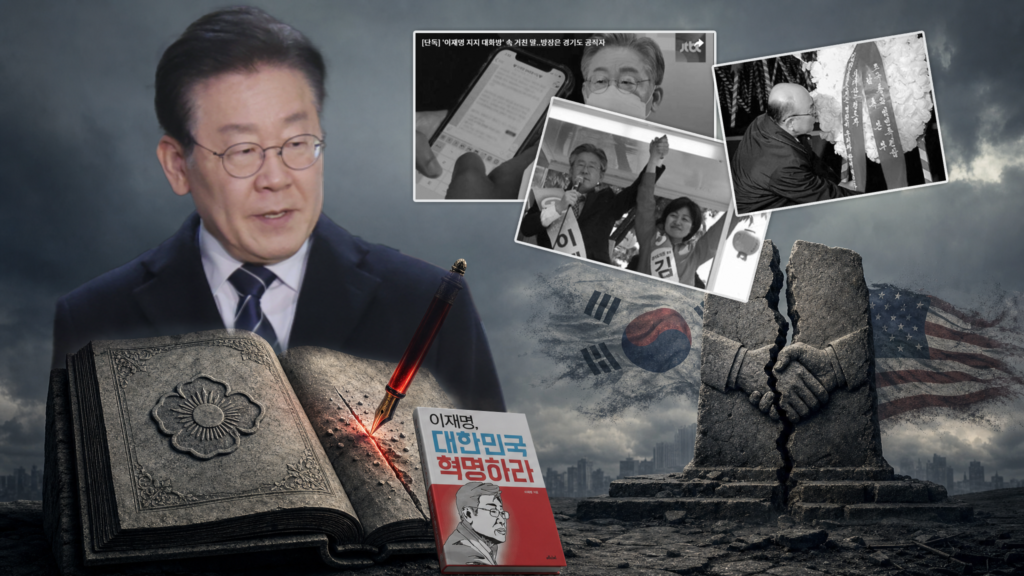
President Lee himself has also advocated a radical transformation of South Korea’s political system. In his 2017 book, Revolutionize the Republic of Korea, he characterized the country’s 70-year constitutional history as “deep-rooted evils” that needed to be swept away and called for a radical transformation of the existing system.1
In conclusion, the fact that anti-American, pro-North Korean forces that had plotted insurrection have now seized the heart of state power through legitimate elections is clear evidence of the dangers posed by the Lee Jae-myung administration. The United States must not forget that the strong U.S.-ROK alliance and combined defense structure could be undermined if Washington misjudges the nature and intentions of the Lee Jae-myung administration.
3. The Hidden Poison Pills in the Constitutional Amendment: Systemic Subversion Disguised as Legality and the Shift to an Anti-US State
The previous Moon Jae-in administration failed in early 2018 when it attempted a systemic-altering constitutional amendment—such as removing the word “freedom” from the constitution—facing massive public backlash. Consequently, the Lee Jae-myung regime has cunningly modified its amendment tactics. They have erected a deceptive smokescreen so the public and the opposition cannot discern their true intentions, while stealthily implanting “Three Major Poison Pills” into the constitution that will irreversibly collapse the national system. It is, quite literally, a wolf in sheep’s clothing.
The “Three Major Poison Pills” of the constitutional amendment pushed by the Lee Jae-myung regime are as follows:
First, Enshrining the May 18 Incident in the Preamble of the Constitution: The Weaponization of History and the Codification of Anti-AmericanismThe May 18 incident itself was not an anti-American movement, but North Korea and the Jusapa have exploited it over the past 45 years as powerful fuel to drive anti-American struggles. Particularly, around the time of the incident, North Korea continuously spread a meticulous false narrative across university campuses claiming that “martial law troops could not have been deployed to Gwangju without the approval of the U.S. military, which holds wartime operational control.” This malicious anti-South Korean propaganda became the catalyst for violent anti-American protests, such as the arson and occupation of U.S. Cultural Centers in Busan, Gwangju, and Seoul in the 1980s. The anti-American, pro-North Jusapa forces sprouted like poisonous mushrooms on the soil of this anti-American agitation that spanned years. It is these forces that are now leading the Lee Jae-myung regime.Therefore, the true intention behind their relentless push to engrave May 18 into the Preamble—the ideological compass of the nation—is to permanently erase former President Syngman Rhee’s anti-communist founding spirit and replace it with the “Anti-American Independence Revolution Spirit” (NLPDR) planted by Kim Il-sung, elevating it to the highest constitutional principle of South Korea. The moment a symbol of anti-American struggle is codified in the Constitution, it signifies the Republic of Korea’s transition into an anti-American state.
Second, Establishing a ‘Prior National Assembly Approval’ Requirement for Martial Law: A Tool for One-Party Dictatorship and Right-Wing PurgesThe hidden intent behind inserting this clause is to lay the groundwork to prosecute President Yoon Suk-yeol—who declared martial law—as the “ringleader of a rebellion,” and further to frame his affiliated party, the People Power Party, as a “rebellion-sympathizing party” to force its dissolution via the Constitutional Court. Once the Democratic Party secures over 250 seats through this scheme and establishes a one-party dictatorship, they will ruthlessly execute a “second constitutional amendment” charting a direct course toward a North Korean-style socialist system.
Third, Mandating the Promotion of ‘Balanced Regional Development’: The Completion of a Grassroots Socialist Surveillance and Control NetworkThe amendment includes a benign-sounding provision stating, “The State shall bear the duty to promote balanced development regardless of residential region.” The practical purpose of this clause is to provide constitutional backing for a socialist control system—modeled after the left-wing village dictatorship system (Comuna) built by Venezuela’s Chavez regime, or the North Korean “People’s Committees” that drenched the South in blood during the Korean War.
4. The Collapse of the US-ROK Alliance and a Global Geopolitical Catastrophe
If the Republic of Korea degenerates into an “anti-American state” through a constitutional amendment exactly as the Lee Jae-myung regime intends, what will be the consequences? Not only will the US-ROK-Japan trilateral security cooperation be dismantled, but the U.S. “Indo-Pacific Strategy” will suffer a fatal blow. For the United States, it means taking a direct hit by losing its core forward operating base—akin to a “pistol” pointed right under China’s chin. This is not merely a matter of losing a geopolitical chokepoint.
The Washington establishment must coldly calculate the price it will have to pay if it loses South Korea. This nation is an economic and technological powerhouse, a global top-five producer of formidable conventional weapons (tanks, self-propelled howitzers, fighter jets, naval vessels) known as “K-Defense,” and possesses world-class infrastructure in semiconductors and advanced heavy chemical industries. Furthermore, based on national credibility built over decades, it maintains massive material and human supply chain networks worldwide.
Former U.S. President Jimmy Carter once declared the complete withdrawal of U.S. troops from South Korea. However, after he, U.S. congressional members, and the Secretary of Defense inspected weapons factories in Changwon in 1977-78, they were left in shock. Seeing a country that had only just begun manufacturing rifles with U.S. help in 1974 mass-producing advanced weapons like tanks and missiles merely 3-4 years later, Carter ultimately scrapped the withdrawal plan. They realized: ‘If U.S. troops withdraw, South Korea falls to communism, and this formidable military industry and weapons production infrastructure falls intact into North Korean hands, it will be a terrifying threat not just to Asia, but to the entire free world.’Today, if the Republic of Korea falls into enemy hands, would defense technology be the only danger?
If South Korea is absorbed into the continental totalitarian bloc connecting North Korea, China, and Russia via this constitutional amendment, it means this mighty defense production capacity, cutting-edge technology, and global network will be handed straight to U.S. adversaries. This will lead to consequences that upend the global order, going far beyond a mere shift in the Balance of Power in East Asia.
The most fatal issue is the “Communization Domino Effect.” If the South Korean defense line collapses, a massive hole will be torn right in the center of the U.S. containment ring against China.
Some in Washington might harbor complacent and passive defense theories, suggesting that even if South Korea is abandoned, maintaining the “maritime defense line (Japan-Taiwan-Philippines)” is sufficient. This is a severe misjudgment born from the outdated notion that war only involves armed conflict. Concurrently, it is a fatal blunder of dismantling the frontline breakwater of the Asian defense perimeter with their own hands. The result will be a domino catastrophe where Japan and Taiwan, stripped of their breakwater, are sequentially swallowed by the communist offensive. Even more alarming is the potential plummet in U.S. credibility. If the world’s hegemon fails to fire a single shot and loses its blood ally, South Korea, in a hybrid war to China and North Korea, the free world’s trust in the United States will be irreparably shattered.
5. Conclusion: ‘The US Must Stop Being a Bystander and Save Its Blood Ally’
The United States must absolutely not treat the systemic warfare occurring inside South Korea as a mere “domestic political conflict,” responding passively while bound by the framework of non-interference in internal affairs. Believing that the Lee Jae-myung regime can be moderately appeased or persuaded is akin to repeating the fatal mistake of being deceived by North Korea’s Kim Jong-il’s shallow deceptive tactics, which resulted in missing the golden time to deter nuclear development.
A paradigm shift in the perception of the Lee Jae-myung regime is urgently required. Washington policymakers and think-tank elites must face the reality that the Lee Jae-myung regime is not a normal democratic partner sharing U.S. values, but a “Trojan Horse” that has seized the strongholds of the liberal democratic system to legally destroy it from within.
The U.S. must take a more proactive stance on the South Korean issue. The omnidirectional and total “Hybrid Warfare”—encompassing ideological infiltration and election interference—waged by China and North Korea using pro-North and pro-China forces within South Korea must not be neglected simply because it is not a kinetic war. The U.S. must clearly recognize the nature of the invisible war being fought in the world today. While the U.S. employs a strategy of containing China and isolating/destroying regimes like Venezuela and Iran, there is a fatal loophole in its strategy against China: it has overlooked the 80-year hybrid war that has taken place in South Korea.
Now is the last, golden opportunity to save the Republic of Korea. The Lee Jae-myung regime is currently facing fierce public resistance over issues of election fraud. The youth (teens to 30s) and the elderly (60s to 80s) have united to launch a resistance movement criticizing the Lee regime. Today, 80% of South Koreans hold pro-U.S. and anti-China sentiments. They are waving the Taegeukgi (Korean flag) and the Stars and Stripes, eagerly waiting for the United States to stand with them.
In October 2024, the United States has already confirmed that cyberattacks and attacks in the space domain may fall within the scope of responses under Article III of the U.S.-ROK Mutual Defense Treaty. This demonstrates that the scope of alliance security is expanding beyond traditional armed attacks to include modern asymmetric threats. It is therefore time for the U.S. government to take a more proactive response based on this understanding.
Lee Hee-cheon is a former National Intelligence Service (NIS) official and professor at the National Intelligence University of South Korea, where he specialized in national security and Korea’s political and social systems. He spent 27 years with the NIS and 16 years as a professor at the National Intelligence University. He also served as a senior research fellow at the Park Chung-hee Memorial Foundation and as a policy adviser to the Korea Freedom Federation. He holds bachelor’s and master’s degrees in public administration from Kyungpook National University and completed doctoral coursework in political science at the Academy of Korean Studies. He is the author of several books on South Korea’s national security and political system, including Presidential Impeachment and the System War (2025), Master Plan for the System War (2025), Village War (2026), and A Planned Insurrection (2026).


