


By Fred Fleitz
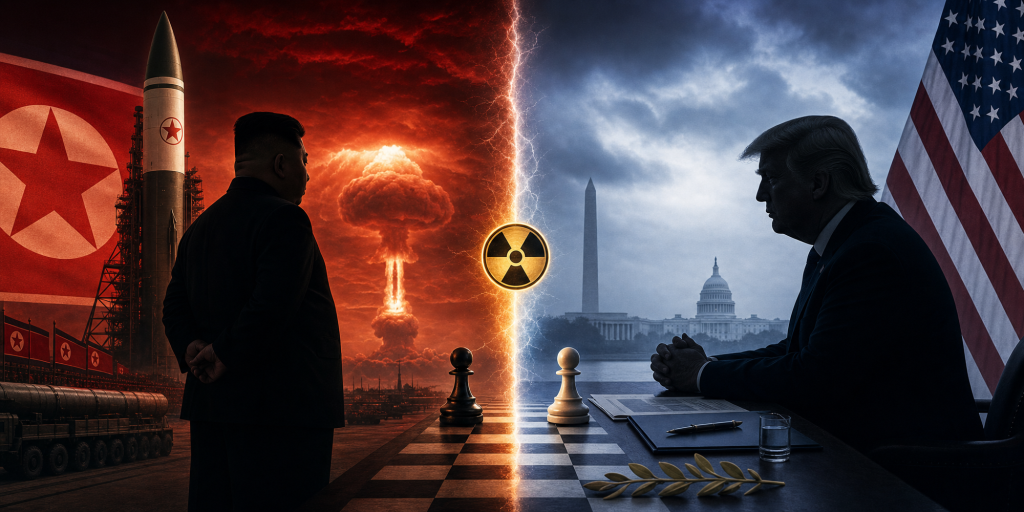
The strong US global leadership that President Trump brought restored when he returned to the White House in January 2025 is urgently needed to address the continuing and growing threat from North Korea’s nuclear weapons and missile programs. With an estimated 50 or more warheads, active fissile material production, and advancing ICBM capabilities, Pyongyang has enshrined its nuclear status in its constitution and deepened ties with Russia and China.
For the second Trump administration, the challenge is not merely to build on the first term’s diplomatic openings with North Korea, but to craft a realistic, results-oriented strategy grounded in “peace through strength” and transactional diplomacy. As I argued in my book “North Korea, Nuclear Brinkmanship, and the Oval Office,” success depends on strong presidential leadership, clear-eyed realism, disciplined leverage, and a refusal to be manipulated by Pyongyang. Washington must also reject the defeatist consensus that quickly declares “North Korea has already won.”
Lessons from Past Failures
U.S.-North Korea nuclear negotiations have followed a recurring and frustrating pattern for more than three decades. This was evident in the 1994 Agreed Framework, the Six-Party Talks (2003–2009), and the George W. Bush administration’s late-term efforts to secure a nuclear agreement in its second term. American diplomats repeatedly came up short because they underestimated North Korea’s determination to acquire nuclear weapons and were outmaneuvered in the negotiating process. At the same time, U.S. officials pursued weak agreements and offered significant concessions in the hope of producing a diplomatic success that could be presented as political wins. Some observers have drawn parallels to the Obama administration’s 2015 nuclear agreement with Iran (the JCPOA), contending that the priority in both cases was to secure any deal rather than insist on fully verifiable and irreversible disarmament.
North Korean officials recognized this approach and leveraged it effectively. They routinely accepted weak, easily reversible commitments in exchange for substantial benefits such as heavy fuel oil, food aid, and promises of light-water reactors. The limited steps Pyongyang took—most notably the dramatic demolition of the cooling tower at its 5-megawatt reactor at Yongbyon in 2008—were largely symbolic and readily reversible. North Korea consistently refused to make serious, irreversible concessions, such as the permanent disablement of key plutonium-production facilities or the surrender of its spent nuclear fuel rods, which it used to produce plutonium for its nuclear weapons.
Trump Changed the Game with Pyongyang in His First Term
President Trump fundamentally changed the dynamics of U.S.–North Korea relations during his first term. Through a policy of “maximum pressure”—including tightened sanctions, coordinated international diplomacy, and tough rhetoric, such as his 2017 “fire and fury” warning and his “Rocket Man” remarks at the UN General Assembly—he created the conditions for three unprecedented face-to-face summits between a sitting U.S. president and Kim Jong Un (Singapore in 2018, Hanoi in 2019, and the Korean DMZ in 2019).
The results were significant but incomplete. North Korea conducted no nuclear tests after September 2017. It also observed a self-imposed moratorium on long-range ballistic missile and ICBM tests that lasted until March 2022. Shorter-range missile testing was suspended for roughly nine months after the Singapore summit before resuming in May 2019. The risk of war that had escalated in 2017 eased dramatically, and the door opened to the possibility of improved bilateral relations.
Those gains proved temporary. Lower-level North Korean officials showed little interest in implementing the broad principles agreed at the summits. Inside the U.S. government, internal tensions over negotiating strategy—particularly around compromise formulas floated by a State Department official with his North Korean counterparts ahead of the Hanoi summit, which President Trump ultimately rejected—contributed to the breakdown. Diplomacy effectively collapsed in 2020 amid the COVID-19 pandemic, North Korea’s self-isolation, and the U.S. election cycle.
North Korea’s Growing Threat and Perceived U.S. Weakness Under Biden
Joe Biden mocked Trump’s North Korea policies and tried to ignore the country. The Biden administration named a part-time special envoy for North Korea and held no high-level talks with the regime during Biden’s term. Serious diplomatic engagement only appeared after tensions escalated sharply in 2023.
The Kim regime viewed the chaotic U.S. withdrawal from Afghanistan in 2021 as evidence of American weakness. That perception coincided with a dramatic surge in North Korean missile tests that began in 2022 and intensified through 2023. In late 2022, Kim Jong Un moved closer to Russian President Vladimir Putin, openly supporting Russia’s invasion of Ukraine and supplying Moscow with large quantities of missiles and artillery shells. North Korea simultaneously deepened ties with China between 2021 and 2024 and aligned itself with the emerging Russia-China-Iran axis.
At the 9th Workers’ Party Congress in February 2026, North Korea formally reaffirmed Kim’s “two hostile states” doctrine, first announced in December 2023. It declared its nuclear weapons program permanent and non-negotiable, while leaving a narrow door open to future talks and coexistence with the United States—if Washington accepted North Korea’s nuclear status. The Congress also called for a major expansion of nuclear warheads and delivery systems and reiterated the “nuclear trigger” doctrine mandating automatic nuclear retaliation against any threat to the regime’s leadership or command-and-control systems.
How US-North Korea Diplomacy Can Succeed in the Second Trump Term
North Korea remains a growing and increasingly intractable threat to regional and global security. However, the second Trump administration has several realistic strategies available to reduce tensions and make meaningful progress toward curbing the regime’s nuclear and missile programs. Moreover, Trump’s second-term national security team is far more unified than during the first term and is unlikely to repeat the internal infighting that hampered earlier diplomatic efforts with North Korea.
President Trump could increase the chances of negotiating an agreement to lower tensions with North Korea and halt threats from its nuclear and missile programs by striking a deal to end the war in Ukraine. Trump’s envoys are hard at work on this. I believe Russia’s current support for
North Korea is transactional, and that Moscow would end this support in exchange for the U.S. and Europe lifting sanctions on Russia. This probably would make Kim Jong Un more willing to negotiate with the U.S.
The recent nomination of former Congresswoman Michelle Steel, a Korean American with deep knowledge of the North Korean threat, as U.S. ambassador to South Korea is an important step. It signals a renewed focus on the Korean Peninsula and strengthens the U.S.–South Korea alliance. Trump should build on this momentum by appointing a high-profile special envoy for North Korea—ideally a respected former elected or appointed official such as Senator Bill Hagerty (Trump’s former ambassador to Japan), former National Security Adviser Robert O’Brien, or CIA Director John Ratcliffe. This envoy should immediately press for high-level talks with North Korean officials, work to arrange a meeting between Secretary of State Marco Rubio and Kim Jong Un, and lay the groundwork for a potential Trump–Kim summit if early discussions prove productive.
The personal rapport Trump and Kim developed during their three first-term meetings remains an asset. Kim appeared to value the international spotlight those summits provided. A new diplomatic framework could capitalize on this by offering targeted sanctions relief in exchange for verifiable steps from Pyongyang: a freeze on nuclear and long-range missile testing, a halt to new warhead and ICBM production, limits on missile ranges, and an end to military aid for Russia in Ukraine.
This must be accompanied by a continuation of Trump’s Maximum Pressure policy on North Korea, including robust sanctions enforcement, continuing joint U.S.-South Korea military exercises, and credible extended deterrence
In addition, any renewed high-level diplomacy with the Kim regime must be conducted in close coordination with the governments of South Korea and Japan, including frequent consultations to ensure alignment and avoid surprises.
Denuclearizing North Korea and eliminating its ballistic-missile program will be an extraordinarily difficult and time-consuming task—if it is possible at all. The policy failures of the Biden years have made this challenge significantly harder than it was during President Trump’s first term. The immediate priority must therefore be a verifiable freeze on further nuclear and long-range missile development, improved bilateral relations, and the groundwork for a comprehensive agreement. President Trump’s personal leadership and diplomatic track record with Kim Jong Un provide a unique opportunity to pursue these goals. Success will require sustained, focused effort by the special envoy and the broader diplomatic team. Given the grave threat North Korea poses to regional and global security, this work should begin immediately.
Fred Fleitz previously served as Chief of Staff of the Trump National Security Council. He is vice chair of the America First Policy Institute. He is the author of North Korea, Nuclear Brinkmanship, and the Oval Office, which was just released by Texas A&M Press.
글: 프레드 플라이츠
2025년 1월 트럼프 대통령이 백악관에 복귀하면서 회복시킨 강력한 미국의 글로벌 리더십은 북한의 핵무기와 미사일 프로그램이 계속되고 더욱 커지는 위협에 대응하기 위해 지금 절실히 필요하다. 북한은 50기 이상으로 추정되는 핵탄두를 보유하고 있고, 핵분열 물질 생산을 계속하고 있으며, 대륙간탄도미사일 능력도 발전시키고 있다. 평양은 핵보유국 지위를 헌법에 명시했고, 러시아 및 중국과의 관계도 더욱 깊게 만들었다.
트럼프 2기 행정부의 과제는 단순히 1기 때 북한과 열었던 외교적 접촉을 이어가는 데 그치지 않는다. “힘을 통한 평화”와 거래적 외교에 기반한 현실적이고 결과 중심의 전략을 마련해야 한다. 내가 저서 『북한, 핵 벼랑 끝 전술, 그리고 백악관 집무실』에서 주장했듯이, 성공은 강력한 대통령 리더십, 냉정한 현실 인식, 절제된 지렛대 사용, 그리고 평양에 조종당하지 않겠다는 결단에 달려 있다. 워싱턴은 또한 “북한은 이미 이겼다”고 서둘러 선언하는 패배주의적 합의를 거부해야 한다.
과거 실패에서 얻는 교훈
미국과 북한의 핵 협상은 30년 넘게 반복적이고 좌절스러운 패턴을 따라왔다. 이는 1994년 제네바 합의, 2003년부터 2009년까지의 6자회담, 그리고 조지 W. 부시 행정부가 2기 후반에 핵 합의를 확보하려 했던 노력에서도 분명히 드러났다. 미국 외교관들은 북한이 핵무기를 확보하려는 결심을 과소평가했고, 협상 과정에서 북한에 밀렸기 때문에 반복적으로 목표에 미치지 못했다. 동시에 미국 관리들은 외교적 성공으로 포장할 수 있는 정치적 승리를 만들어내기 위해 약한 합의를 추구하고 상당한 양보를 제공했다. 일부 관찰자들은 이를 오바마 행정부의 2015년 이란 핵합의, 즉 JCPOA와 비교해왔다. 두 경우 모두 완전하고 검증 가능하며 되돌릴 수 없는 비핵화를 고집하기보다, 어떤 합의라도 확보하는 것이 우선이었다는 주장이다.
북한 관리들은 이러한 접근법을 알아차렸고, 이를 효과적으로 이용했다. 그들은 중유, 식량 지원, 경수로 제공 약속과 같은 실질적 이익을 받는 대가로 약하고 쉽게 되돌릴 수 있는 약속을 반복적으로 받아들였다. 평양이 취한 제한적 조치들, 특히 2008년 영변 5메가와트 원자로 냉각탑을 극적으로 폭파한 일은 대부분 상징적이었고 쉽게 되돌릴 수 있는 것이었다. 북한은 핵무기용 플루토늄 생산에 사용한 핵심 플루토늄 생산 시설의 영구적 불능화나 사용후 핵연료봉 포기와 같은 진지하고 되돌릴 수 없는 양보를 일관되게 거부했다.
트럼프는 1기 때 평양과의 게임을 바꾸었다
트럼프 대통령은 첫 임기 동안 미북 관계의 역학을 근본적으로 바꾸었다. 그는 강화된 제재, 조율된 국제 외교, 그리고 2017년의 “화염과 분노” 경고와 유엔총회에서의 “로켓맨” 발언 같은 강한 수사를 포함한 “최대 압박” 정책을 통해, 현직 미국 대통령과 김정은 사이에 전례 없는 세 차례의 대면 정상회담이 열릴 수 있는 조건을 만들었다. 2018년 싱가포르, 2019년 하노이, 그리고 2019년 한국 비무장지대 회동이 그것이다.
그 성과는 의미 있었지만, 북한 문제를 완전히 해결한 것은 아니었다. 북한은 2017년 9월 이후 핵실험을 하지 않았다. 또한 2022년 3월까지 장거리 탄도미사일과 대륙간탄도미사일 시험을 자발적으로 중단했다. 단거리 미사일 시험도 싱가포르 정상회담 이후 약 9개월 동안 중단되었다가 2019년 5월 재개되었다. 2017년에 고조되었던 전쟁 위험은 크게 완화되었고, 양국 관계 개선 가능성의 문도 열렸다.
그러나 이러한 성과는 일시적인 것으로 드러났다. 북한의 하급 관리들은 정상회담에서 합의된 폭넓은 원칙을 이행하는 데 거의 관심을 보이지 않았다. 미국 정부 내부에서는 협상 전략을 둘러싼 이견도 있었다. 특히 하노이 정상회담을 앞두고 한 국무부 관리가 북한 측과 논의했던 타협안들이 있었지만, 트럼프 대통령은 결국 이를 받아들이지 않았다. 이러한 요소들도 협상 결렬에 영향을 주었다. 외교는 2020년 코로나19 팬데믹, 북한의 자가 고립, 그리고 미국 대선 국면 속에서 사실상 무너졌다.
바이든 시기 북한 위협의 증대와 미국 약세에 대한 인식
조 바이든은 트럼프의 대북정책을 조롱했고, 북한을 무시하려 했다. 바이든 행정부는 시간제 대북특별대표를 임명했고, 바이든 임기 동안 북한 정권과 고위급 회담을 열지 않았다. 긴장이 2023년에 급격히 고조된 뒤에야 진지한 외교적 접촉이 나타났다.
김정은 정권은 2021년 미국의 혼란스러운 아프가니스탄 철수를 미국 약세의 증거로 보았다. 그런 인식은 2022년에 시작되어 2023년까지 더욱 심해진 북한 미사일 시험의 극적인 증가와 맞물렸다. 2022년 말 김정은은 블라디미르 푸틴 러시아 대통령에게 더 가까이 다가갔고, 러시아의 우크라이나 침공을 공개적으로 지지했으며, 모스크바에 대량의 미사일과 포탄을 공급했다. 북한은 동시에 2021년부터 2024년 사이 중국과의 관계도 더욱 깊게 만들었고, 새롭게 형성되는 러시아·중국·이란 축에 자신을 맞추었다.
2026년 2월 열린 제9차 노동당 대회에서 북한은 2023년 12월 처음 발표된 김정은의 “두 적대국가” 노선을 공식적으로 재확인했다. 북한은 핵무기 프로그램이 영구적이고 협상 대상이 아니라고 선언했다. 다만 미국이 북한의 핵보유국 지위를 받아들인다면, 향후 대화와 공존의 좁은 문은 열어두었다. 당 대회는 또한 핵탄두와 운반 수단의 대대적 확대를 요구했고, 정권 지도부나 지휘통제 체계에 대한 어떠한 위협에도 자동적인 핵 보복을 명령하는 “핵 방아쇠” 교리를 재확인했다.
트럼프 2기에서 미북 외교가 성공할 수 있는 방법
북한은 여전히 지역과 세계 안보에 커지고 있으며 점점 더 다루기 어려운 위협으로 남아 있다. 그러나 트럼프 2기 행정부에는 긴장을 낮추고 북한 정권의 핵과 미사일 프로그램을 억제하는 데 의미 있는 진전을 이룰 수 있는 몇 가지 현실적 전략이 있다. 더욱이 트럼프 2기 국가안보팀은 1기 때보다 훨씬 더 통일되어 있으며, 과거 북한 외교를 방해했던 내부 갈등을 반복할 가능성은 낮다.
트럼프 대통령은 우크라이나 전쟁을 끝내는 합의를 성사시킴으로써 북한과 긴장을 낮추고 핵·미사일 프로그램의 위협을 중단시키는 합의를 협상할 가능성을 높일 수 있다. 트럼프의 특사들은 이 문제에 열심히 움직이고 있다. 나는 러시아의 현재 대북 지원이 거래적 성격을 갖고 있으며, 미국과 유럽이 러시아에 대한 제재를 해제하는 대가로 모스크바가 북한 지원을 중단할 것이라고 본다. 그렇게 되면 김정은도 미국과 협상할 의향이 더 커질 가능성이 있다.
북한 위협에 깊은 이해를 가진 한국계 미국인인 미셸 스틸 전 하원의원이 주한 미국대사로 최근 지명된 것은 중요한 조치다. 이는 한반도에 대한 새로운 집중을 보여주며, 한미동맹을 강화한다. 트럼프는 이러한 흐름을 바탕으로 북한 문제를 담당할 고위급 특별대표를 임명해야 한다. 이상적으로는 트럼프의 전 주일대사였던 빌 해거티 상원의원, 로버트 오브라이언 전 국가안보보좌관, 또는 존 랫클리프 CIA 국장 같은 존경받는 전직 선출직 또는 임명직 인사가 적합하다. 이 특사는 즉시 북한 관리들과의 고위급 회담을 추진하고, 마코 루비오 국무장관과 김정은의 회동을 준비하며, 초기 논의가 생산적으로 진행될 경우 트럼프·김정은 정상회담 가능성을 위한 토대를 마련해야 한다.
트럼프와 김정은이 1기 때 세 차례 만남을 통해 형성한 개인적 관계는 여전히 자산이다. 김정은은 그 정상회담들이 제공한 국제적 주목을 가치 있게 여긴 것으로 보인다. 새로운 외교 틀은 이를 활용할 수 있다. 평양이 검증 가능한 조치를 취하는 대가로 제한적 제재 완화를 제공하는 방식이다. 그 조치에는 핵실험과 장거리 미사일 시험 동결, 새로운 핵탄두와 대륙간탄도미사일 생산 중단, 미사일 사거리 제한, 그리고 우크라이나 전쟁에서 러시아에 대한 군사 지원 중단이 포함될 수 있다.
이는 북한에 대한 트럼프의 최대 압박 정책 지속과 함께 이루어져야 한다. 강력한 제재 집행, 한미 연합군사훈련 지속, 그리고 신뢰할 수 있는 확장억제가 포함되어야 한다.
또한 김정은 정권과의 고위급 외교가 재개된다면, 이는 한국과 일본 정부와의 긴밀한 조율 속에서 진행되어야 한다. 잦은 협의를 통해 입장을 맞추고 예상치 못한 상황을 피해야 한다.
북한을 비핵화하고 탄도미사일 프로그램을 제거하는 일은 가능하다 하더라도 극도로 어렵고 시간이 많이 걸리는 과제가 될 것이다. 바이든 시기의 정책 실패는 이 과제를 트럼프 대통령 1기 때보다 훨씬 더 어렵게 만들었다. 따라서 당장의 우선순위는 추가적인 핵 개발과 장거리 미사일 개발의 검증 가능한 동결, 양국 관계 개선, 그리고 포괄적 합의를 위한 토대 마련이어야 한다. 트럼프 대통령의 개인적 리더십과 김정은과의 외교적 기록은 이러한 목표를 추구할 수 있는 독특한 기회를 제공한다. 성공하려면 특별대표와 더 넓은 외교팀의 지속적이고 집중된 노력이 필요하다. 북한이 지역과 세계 안보에 제기하는 중대한 위협을 고려할 때, 이 작업은 즉시 시작되어야 한다.
프레드 플라이츠는 과거 트럼프 국가안보회의 비서실장을 지냈다. 그는 America First Policy Institute의 부의장이다. 그는 최근 텍사스 A&M 대학 출판부에서 출간된 『북한, 핵 벼랑 끝 전술, 그리고 백악관 집무실』의 저자다.